


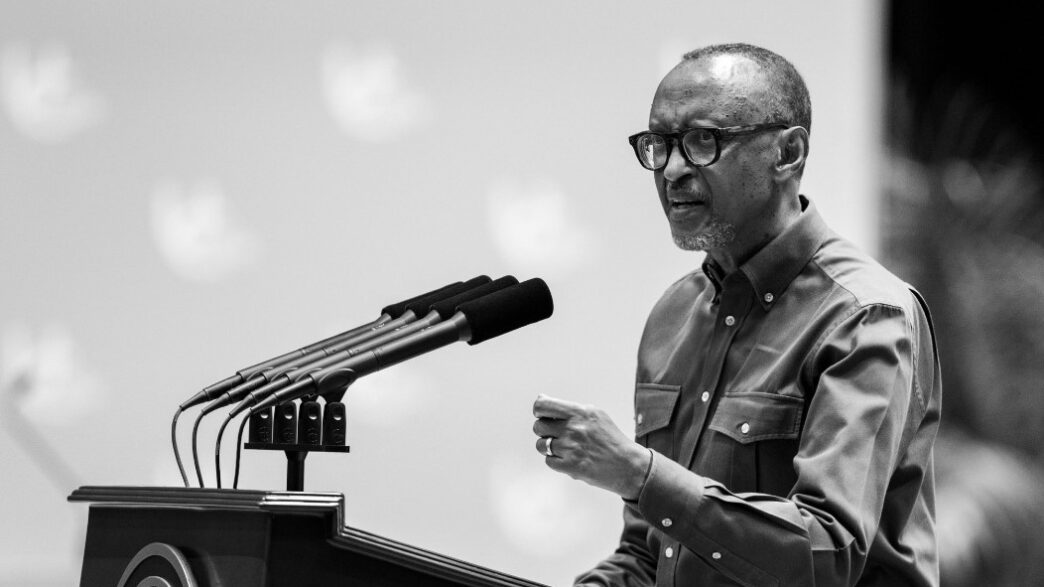
Kigali – Rwandan President Paul Kagame has told members of the Unity Club that Rwanda will always remain ahead of those who seek to destabilise it, speaking at a dialogue session held at Intare Arena on Saturday morning where leaders and club members gathered to reflect on the history of the 1994 Genocide against the Tutsi and the Campaign Against Genocide that led to Rwanda’s liberation.
Kagame spoke candidly about the recent conflict in eastern Congo, describing how a broad coalition of forces had assembled against Rwanda in Goma and elsewhere, including the FDLR and associated armed groups, the Wazalendo, Burundian forces, the FARDC and South African troops.
“If you look at what has happened in Eastern Congo, and everything we have gone through over the past four or five years, and you look at what we have left behind, there is evidence. There are facts that speak for themselves. In Eastern Congo, in Goma and elsewhere, the whole world came together against Rwanda. The whole world lined up against Rwanda: the FDLR and all the groups associated with it that have been mentioned, the Wazalendo, the Burundian forces, the FARDC, the South Africans, and many others. I would rather not spend time naming them all; there were so many,” he said. 
The president said the scale of the forces assembled made clear that the objective was to wage war against Rwanda, destabilise the country and reshape it according to the will of others. He noted that mercenaries had also been brought in, and that Rwanda had even allowed some of its enemies free passage out of a war they had waged against it.
“As for Rwanda, we will always be in a struggle for our very existence. Regardless of those who wish us harm, surrounding us from many sides, one thing remains true: we should and will always be a step ahead of them. It is our right. It is our will. And our history has taught us that we have within ourselves the capacity to defend and protect ourselves whenever necessary. And that is exactly what we will continue to do,” Kagame said.
The Unity Club panel brought together a former member of the ex-FAR, retired General Ibingira from the RPA/RPF, and a former member of the FDLR. Kagame described the composition as a reflection of just how complex and layered Rwanda’s history is, and called on Rwandans to draw lessons from that history to move the country forward.
Responding to remarks Ibingira made about people who insult and disparage others, Kagame offered direct counsel to the audience.
“My advice is simple: do not waste your energy fighting those who insult you. Put your energy into building, building yourselves, and building your country, so that insults and the people who make them become insignificant and have no impact on you. Ignore them, and keep doing what you are supposed to do. That is what matters. Your response should be your actions. Eventually, those who thrive on insults grow tired and stay hostages of history,” he said.
Kagame also addressed the meaning of Rwanda’s liberation in the context of the genocide, saying the dark chapter the country went through did not define who Rwandans were meant to be.
“We went through a very dark chapter. But is that who we were meant to be? Is that what Rwandans wanted for themselves? Even if some people at the time wanted it that way, our responsibility today is to say: no. It is our history, but it is not who we should have been, and it is not who we should become. That is what liberation means. It means that, as Rwandans, we freed ourselves. You live for what you truly believe in, to the point where, if necessary, you are ready to die for it. That is where Rwanda stands today, whether some people like it or not,” he said.
The president also addressed the danger of Rwandans, particularly young people studying abroad, absorbing foreign ideas that strip them of their identity.
“Do we really accept that, as black people, we are somehow less human and inferior? Accepting it is not simply a matter of saying ‘yes.’ No one will ask you that question directly. You can even say ‘no,’ but if you behave in the very ways that brought us to the kind of history we have lived through, then, in reality, you have accepted it. You have diminished yourself. And your actions become the evidence,” Kagame said.
He warned that returning students could come back having absorbed ideas without question, ideas that pull them away from who they are and attempt to turn them into something else.
“Whether those ideas are good or bad, there is one illness I do not think we will cure anytime soon: when, in your own mind, you stop being yourself and begin wishing you were somebody else. Why would you want to become someone else? To achieve what? In our own history, with everything we have been through, that is exactly how we lost our way. And then you wait for someone from outside to tell you, ‘This is wrong,’ and you immediately agree, without realizing that what is being condemned is you. It is about stripping you of your identity, and you willingly accepting it,” he said.