


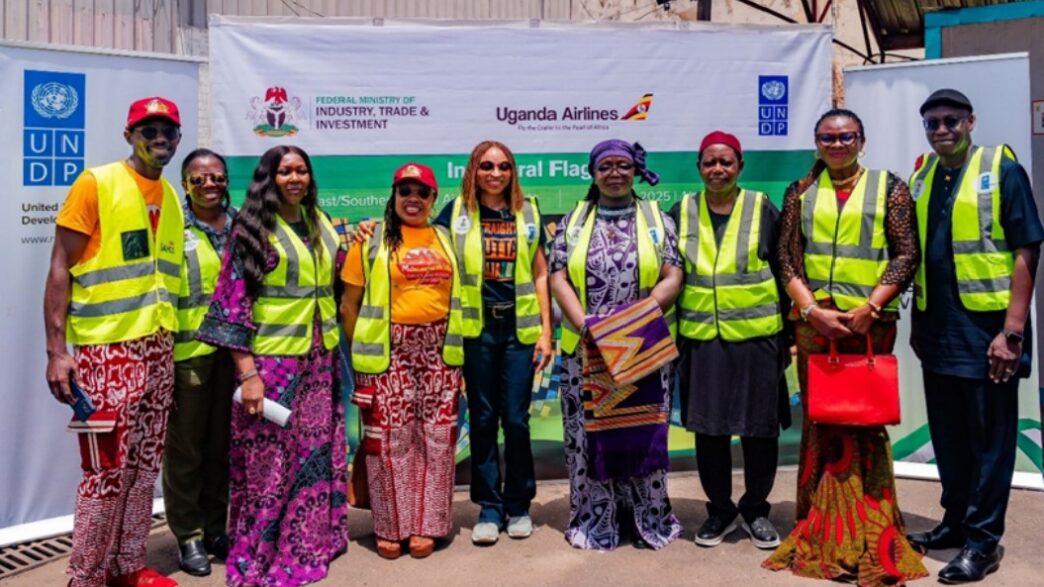
Lagos, Nigeria – A year after five women-owned Nigerian businesses made history by sending the first consignment along a dedicated air cargo corridor to East and Southern Africa, Nigeria has expanded the route to three new destinations, with exporters now getting freight rates as much as 75% cheaper than what commercial airlines typically charge.
The corridor, which launched on Africa Day, 25 May 2025, with Uganda Airlines carrying goods from Lagos to Entebbe, Nairobi and Johannesburg, has been extended through a new partnership with RwandAir to include Kigali, Lusaka and Harare, with a formal flag-off of the new arrangement scheduled for June 2026.

The five businesses that pioneered the corridor a year ago were all women-owned and led. They were Avila Naturalle Ltd, run by Dr. Temitope Mayegun, exporting black soap; Macariusville Dates and Foods Ltd, led by Vivyen Ayodele-Bamisaye, exporting date and tigernut mixed powder and date powder; Bio-Pulse Limited, run by Ifeoma Ogbukagu, exporting bean flour, peas flour and finger millet flour; Lelook Nigeria Ltd, led by Chief Mrs. Chinwe Ezenwa, exporting leather bags, garments and apparel; and Shea Origin Ltd, led by Mobola Sagoe, exporting shea butter products. 
Their inaugural consignment flew to Nairobi, Kenya, on 26 May 2025, where it received preferential tariff treatment under the African Continental Free Trade Area agreement.
The impact since then has been significant. One textile exporter reported shipping up to 1,000 metric tonnes to Kenya in under 12 months, generating approximately USD 100,000 in export revenue, and projected a further 50% increase in volumes in the near term.
Chief Chinwe Ezenwa of Lelook Nigeria Ltd, one of the original five exporters, described what the corridor had meant for her business.
“I have since shipped bags, garments, and apparel directly to Kenya and Uganda, and I am now planning to export to South Africa. My target is to exceed 1,000 kg monthly. This arrangement has genuinely opened a new door for me,” she said.
A freight forwarder facilitating shipments through the corridor, March 31st Logistics Ltd, put numbers to the difference it had made.
“The tiered rate arrangement has driven a 70% reduction in cargo costs compared to other airlines, making it far cheaper for MSMEs. Since May 2025, we’ve seen an increase of approximately 40% in export volumes. The main products exported are agro-processed products, bags, clothes, and medical equipment from Lagos and Abuja into Kenya and South Africa. Some exports have gone to Uganda as well. We also see more micro and small businesses using the corridor. This arrangement needs to be sustained in the long-term so smaller exporters can rely on it consistently,” the company said.
Dr. Temitope Mayegun of Avila Naturalle Ltd said the lower rates had directly changed what was possible for her business.
“My pricing was not competitive in the Kenya market before because of the logistics cost. With the reduced rate, I have used the arrangement twice to Kenya. I want to see more initiatives like this so MSMEs can sell more and grow, and I especially appreciate that it is a transparent process,” she said.
Before the corridor launched, exporters were paying between USD 5 and USD 7 per kilogram to move goods to East and Southern Africa by air, with some paying above USD 10. Under the RwandAir arrangement now in place, Lagos to Kigali costs USD 1.40 per kilogram for shipments below 1,000 kg and USD 1.20 above that, with a minimum charge of USD 100. Lagos to Harare and Lagos to Lusaka both carry rates of USD 1.80 and USD 1.60 per kilogram respectively, with a USD 110 minimum. Lagos to Johannesburg runs at USD 1.90 and USD 1.70 per kilogram with a USD 120 minimum, while Lagos to Nairobi is priced at USD 1.70 and USD 1.50 per kilogram with a USD 100 minimum. A flat airway bill fee of USD 15 applies across all destinations.
Nigeria’s non-oil exports to 25 African countries outside the Economic Community of West African States grew from USD 150 million in 2024 to USD 207 million in 2025, a trajectory the government credits in part to the corridor and to the gazetting of Nigeria’s Provisional Schedule of Tariff Concessions under the AfCFTA in April 2025, which cut import duties on Nigerian goods in Kenya and South Africa by half.
However, standards compliance remains a sticking point. Cecilia Ifeoma Ogbukagu of Bio Pulse Ltd said the cost savings were real but certification was still a hurdle.
“The freight cost was genuinely reduced, and that’s a huge breakthrough for me as an exporter. But it was expensive to obtain the relevant certification for our products in Kenya. We need harmonisation of standards across African countries. Nonetheless, I am definitely going to leverage the reduced rates again,” she said.
Kola Awe, Chairman of the Nigerian Association of Chambers of Commerce, Industry, Mines and Agriculture Export Group and Chief Executive of XPT Group of Companies, summed up what the corridor represents for smaller businesses.
“The strength of this initiative is that it makes MSMEs competitive and expands their reach into new markets,” he said.
Exporters wanting to join the inaugural RwandAir shipment in mid-June 2026 can register their interest at https://forms.office.com/r/yTMb9tt3pi before the window closes on Friday, 29 May 2026. For assistance with trade formalities, businesses can visit the Nigerian Export Promotion Council at https://nepc.gov.ng or the Nigeria AfCFTA Coordination Office at www.ngrafcfta.gov.ng.
For the Southern African region, including Eswatini, the expansion of the corridor to Lusaka and Harare brings Nigerian goods closer to home and could stimulate new intra-African trade conversations as the AfCFTA continues to take practical shape across the continent.