

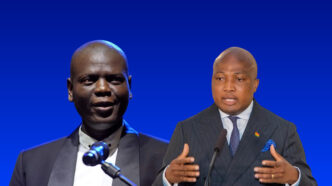
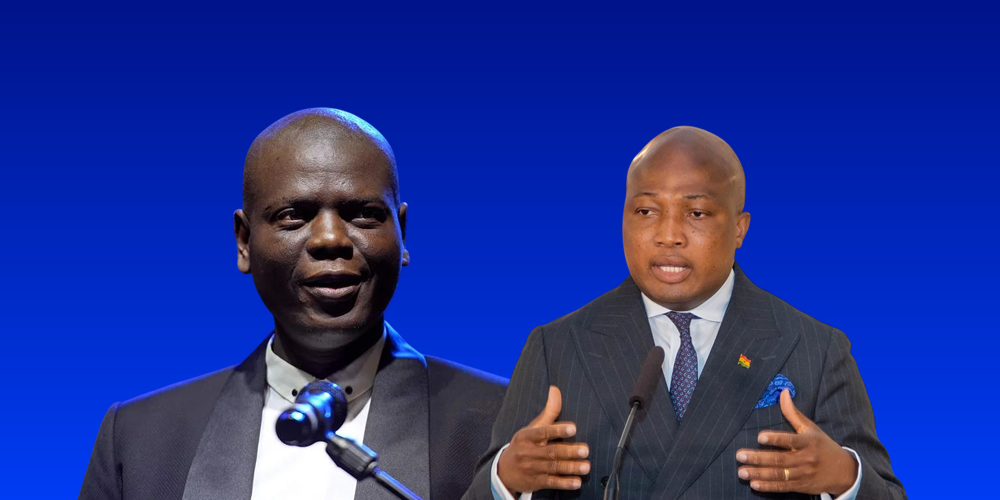
Johannesburg – South Africa’s Minister of International Relations and Cooperation, Ronald Lamola, has publicly rebuked his Ghanaian counterpart, Samuel Okudzeto Ablakwa, accusing him of peddling misinformation about the ongoing xenophobic attacks on foreign nationals in South Africa.
Lamola, responding directly to an interview Ablakwa gave to a Ghanaian media house, said the interview was “riddled with misinformation and factual inaccuracies” and warned that South Africa would not tolerate what he described as public spectacles devoid of diplomatic decorum.
The dispute centres on a series of claims Ablakwa made during his interview, including that two Nigerian nationals and five Mozambican nationals had been killed during the current wave of attacks, that 16 Ghanaians were hospitalised in South Africa, and that nearly 30 percent of repatriated Ghanaians had been in the country legally. 
Lamola flatly rejected each of those claims.
“We have verified with all our law enforcement agencies and all state authorities. There was no Nigerian national that has been killed during this current wave of attack,” Lamola said.
On the Mozambican deaths, Lamola said at least two Mozambican nationals had indeed been killed and that the South African Police Service was actively investigating the matter with possible arrests expected soon. He said the South African government had extended its condolences to Mozambique and condemned the killings in the strongest terms.
Regarding the claim that 16 Ghanaians were hospitalised, Lamola said neither his law enforcement agencies nor officials at the South African High Commission in Accra had received any formal communication about the matter.
“It is therefore deeply strange that we are hearing for the first time, through this interview, that 15 Ghanaians are currently hospitalised. We have no information of that nature whatsoever,” Lamola said.
On the question of the legal status of repatriated Ghanaians, Lamola pointed to findings from the Department of Home Affairs and the Border Management Authority regarding a flight carrying 300 individuals that departed on 27 May. He said 25 of those passengers came from a deportation facility, while the remaining 275 were brought by the Ghanaian High Commissioner. Following immigration checks, approximately 90 percent were found to be undocumented, and the Ghanaian Embassy was required to issue them emergency travel certificates, described as single-page, one-way documents permitting travel only to their country of origin.
“Most of these travellers were found to have overstayed their visas by more than 30 days, with some overstaying by a year or more,” Lamola said.
Ablakwa had, in his interview, pushed back strongly against those figures, saying he had personally instructed the High Commission to check the immigration status of evacuees and found that more than 80 percent were documented, with most of the remainder having already submitted renewal applications that were pending approval.
“That is something we checked at the High Commission. I instructed that we should check to know the immigration status. And they over more than 80% even the few who had immigration issues, they had put in a request. The initial residence permit request had been approved and they were waiting for renewals,” Ablakwa said.
The Ghanaian minister also revealed that South African crime authorities had stationed officers at the High Commission during the screening process to cross-check returning Ghanaians against crime databases.
“Would you believe that so far not a single Ghanaian has been of interest to them,” Ablakwa said, challenging the narrative that African foreign nationals are responsible for high crime rates in South Africa.
Ablakwa said Ghana had taken a principled stance since the outbreak of the latest wave of attacks, condemning the violence, summoning the acting South African High Commissioner in Accra, evacuating a Ghanaian national who had been publicly harassed and dehumanised, and petitioning the African Union to place the matter on the agenda of an upcoming coordinating meeting scheduled for 24 June.
He said 255 incidents of xenophobic violence had been recorded since 2022, with as many as 57 people killed in total across various waves of attacks.
“This cannot continue,” Ablakwa said, calling on the South African government to demonstrate political will in dealing with perpetrators.
Lamola hit back at the threat of what Ablakwa described as a “nuclear route” against South African companies operating in Ghana, saying such action would not come as a surprise.
“The truth is, mere months into the new Ghanaian administration, the operating conditions for a number of South African companies had already been made untenable. I was compelled to write to you, my dear brother, alerting you to these challenges,” Lamola said, adding that he was prepared to publish the letter if its existence was denied.
He warned that South Africa would vigorously defend any lawsuit emanating from Ghana.
“Let there be no misunderstanding: we will vigorously defend any frivolous or baseless lawsuit emanating from Ghana against South Africa,” Lamola said.
Despite the sharp exchange, both ministers said they remained open to dialogue. Lamola said South Africa was willing to engage on migration at a bilateral level, through the African Union or any multilateral forum, but insisted that engagements must be grounded in facts.
“Let us be factual in our engagements and not pander to unnecessary public spectacles that are devoid of any diplomatic decorum,” Lamola said.
Ablakwa, for his part, said Ghana was not on a war path and was deliberately avoiding retaliatory measures to preserve its standing as a Pan-Africanist nation.
“We want to take the high moral ground. Let’s remember that this whole Africa Unity agenda was espoused by the foremost Pan-Africanist, anti-apartheid legend, the founder of our country, the Osagyefo Dr. Kwame Nkrumah,” Ablakwa said.
He noted that 11,981 South Africans visited Ghana in 2025 alone, with a further 10,282 recorded between January and 5 June this year, mostly as tourists, saying Ghana would continue to welcome South African visitors despite the tensions.