



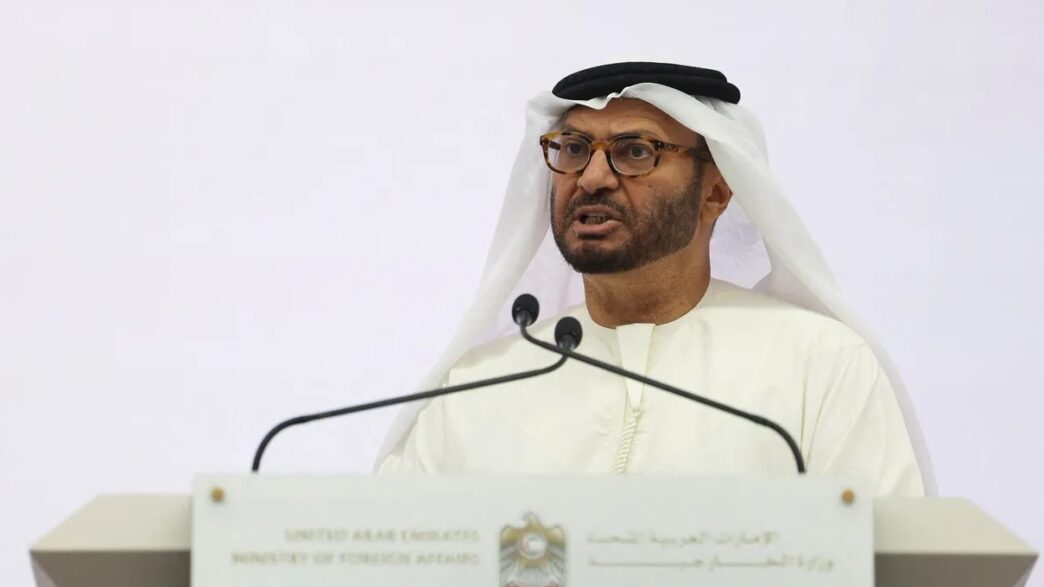
Dubai, April 6 – The United Arab Emirates says any U.S.-Iran settlement must guarantee free passage through the Strait of Hormuz, warning that a deal failing to curb Iran’s nuclear programme, missiles and drones could make the Middle East more unstable.
Anwar Gargash, diplomatic adviser to the UAE president, told reporters that the strait – a key artery for global oil shipments – “cannot be held hostage by any country” and that freedom of navigation must be included in any conflict resolution.
Gargash said the UAE seeks an end to hostilities but cautioned against a ceasefire that ignores underlying threats. “We don’t want to see more and more escalation. But we don’t want a ceasefire that fails to address some of the main issues that will create a much more dangerous environment in the region…notably (Iran’s) nuclear programme, the missiles and drones that are still raining down on us and on other countries,” he said. 
U.S. President Donald Trump has threatened further strikes on Tehran if the strait is not reopened by Tuesday, while Washington and Israel have carried out missile and air attacks on Iran for over five weeks, targeting nuclear facilities, missile arsenals and regional proxies.
The UAE, which has faced heavier Iranian strikes than other Gulf states, said it is prepared to join any U.S.-led effort to secure shipping through the waterway. About a fifth of the world’s oil and liquefied gas passes through the strait daily, but Iran’s actions have slowed traffic, aggravating the global energy crisis.
Gargash described the current situation as the long-feared worst-case scenario for the UAE, but said the country remains resilient. He added that Iran’s campaign could strengthen U.S. and Israeli security roles in the Gulf, and the UAE intends to maintain Washington as its core security partner.
He also praised international support, singling out France and the United States for helping to reinforce the UAE’s air-defence capabilities.








![Police officials gather outside The Israeli Consulate in Istanbul following a shootout between gunmen and police [AFP]](https://swazi24.com/wp-content/uploads/2026/04/Screenshot-2026-04-07-141636-332x213.jpg)
![Police officials gather outside The Israeli Consulate in Istanbul following a shootout between gunmen and police [AFP]](https://swazi24.com/wp-content/uploads/2026/04/Screenshot-2026-04-07-141636-688x387.jpg)