

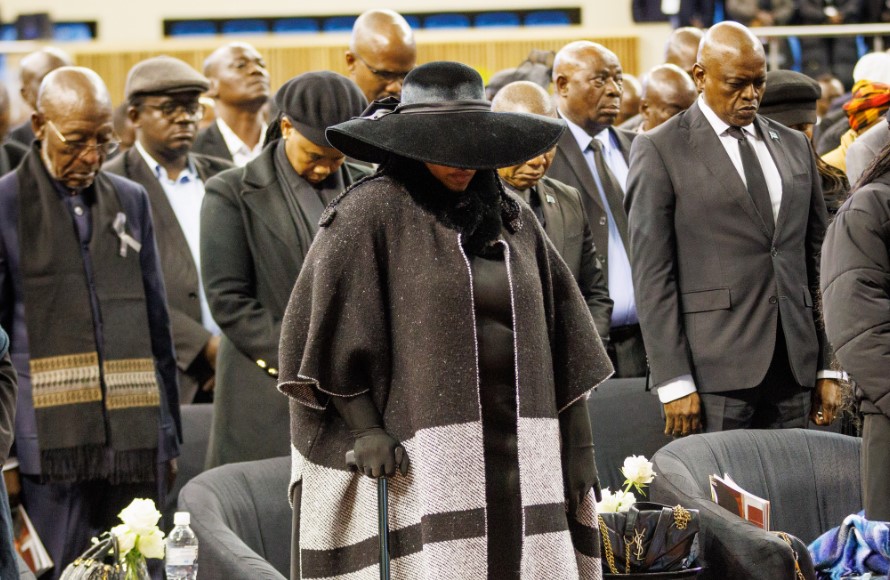
Boikaego Mogae, the last born daughter of former Botswana President Festus Mogae, stepped up to the podium at her father’s memorial to share a side of the late head of state that the world rarely saw, painting a picture of a family man, a foodie, a fashion lover, and a self-described retired civil servant.
Speaking with warmth and wit, Boikaego told mourners she would not spend her time recounting awards and accolades, saying she might be “complicit in boring you all to death, and that would be no good.”
She reminded those gathered that the ten years Festus Mogae spent as head of state represented only twelve percent of his eighty-six years on earth, and that when asked what he did after leaving office, he would simply say: “I’m a retired civil servant.” 
“Rra Nam viewed his life’s work as a career civil servant,” she said, adding that her father held the civil service in very high regard and often spoke of it with reverence, recognising that collective effort driven in the same direction could yield remarkable results.
On his life as a husband and father, Boikaego told mourners that in 1967, Festus Mogae married a “beautiful, spirited and intelligent young lady named Barbara,” with whom he would build a life over fifty-nine years. Between 1969 and 1987, the couple raised three daughters.
She recalled as a child being puzzled and irritated by strangers calling her father “Father of the Nation,” saying she would stomp her feet and ask him why everyone kept calling him their daddy. Her father, she said, gently helped her see it differently.
“He gently made me comfortable with the concept: that I must not look at it as a subtraction, but rather view it as a multiplier of love and goodwill,” she said.
Boikaego described her father as a progressive thinker who loved the company of thought leaders and dissenting voices, and who encouraged his children to voice disagreement. She credited him with passing on her stubborn streak, saying: “albeit, once we had settled on what we believed was right, we were difficult to budge. I am still working on it.”
She said her father urged her to examine cultural norms and decide for herself whether they were helpful or harmful, recognising that the world changes and people must change with it.
On his conviction as head of state, she said her father believed no tribe should feel favoured or excluded, and that every Motswana belonged equally to the nation. She noted that this belief was reflected even in his choice of burial site in Gaborone, the seat of national power and the convergence point of all Batswana.
“He returns as one of the true architects of Botswana. A man whose vision and quiet labour helped lay the foundations on which this country still stands,” she said.
Boikaego also shared lighter memories of her father, saying the two shared a love of fashion and would dress up together, from street-bought Rolexes to high-end finds, giggling like schoolgirls over loud outfit choices at state occasions. She quoted him as often saying: “Good taste has no budget.”
Her father was also a lover of classical music, often playing Mozart on the gramophone, which she said influenced his decision to encourage her to play the piano. The two also shared, she laughed, a disdain for exercise. Whenever she complained about gaining weight, he would remind her: e o tsela sentle.
She described him as a man who loved a good time and lived by the principle of working hard and playing harder, and said he could often be found on the dance floor at events, enjoying what he comically called mofino o boitshepho.
As a foodie, she said her father made sure he married a good cook, and the two of them ate everything from turtle to frog legs to snails, guided by the philosophy that you only live once.
Closing her address, Boikaego thanked all those who had sent condolences to her mother and the family, before signing off with the words: “Robala ka kagiso, Lefesto. It is well.”