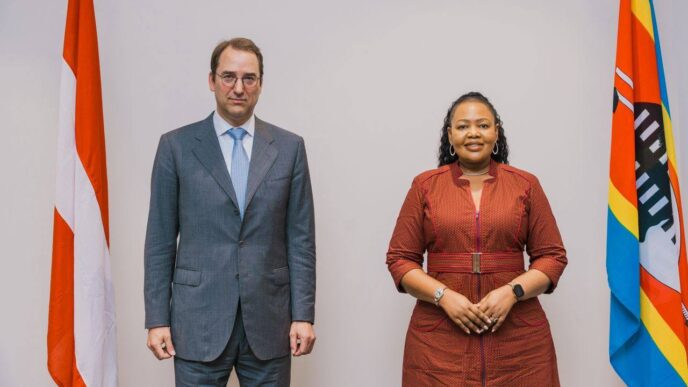



Johannesburg – African Union ministers and infrastructure experts wrapped up a four-day meeting in Johannesburg on Wednesday, 30 April 2026, with a clear message: the time for strategy is over and the continent must now focus on getting things built.
The Fifth Ordinary Session of the Specialised Technical Committee on Transport and Energy (STC-T&E), hosted by South Africa from 27 to 30 April 2026, brought together ministers and technical experts from across the continent to review progress on major continental programmes including the Programme for Infrastructure Development in Africa (PIDA), the Single African Air Transport Market (SAATM), the African Single Electricity Market (AfSEM) and the Grand Inga Hydropower Project.
AU Commission Commissioner for Infrastructure and Energy Lorato Mataboge painted a stark picture of the challenge facing the continent, telling delegates that Africa’s infrastructure deficit is costing the continent up to 2% of GDP growth annually and causing productivity losses as high as 40%. She said transport costs on the continent are up to 175% higher than in other regions, 600 million Africans have no access to electricity and nearly one billion lack clean cooking solutions. Average continental debt levels sitting at 64% of GDP are further squeezing the fiscal space available for investment. 
Despite the scale of the challenge, Mataboge argued that the continent has everything it needs to turn things around. She told delegates that Africa’s fundamental problem “is not resource scarcity, but structural dependence,” pointing out that the continent holds 125 billion barrels of oil reserves, 18 trillion cubic meters of natural gas, up to 40% of global renewable energy potential and abundant critical minerals.
“This STC is not merely a convening platform. It is the continent’s principal ministerial decision-making organ… In a world of increasing fragmentation, this STC represents Africa’s collective instrument for coherence, alignment, and decisive action,” she said, calling for infrastructure investment to be raised to at least 4.5% of GDP.
South Africa’s Minister of Electricity and Energy Kgosientsho Ramokgopa told the gathering that energy and transport infrastructure have become instruments of power and economic sovereignty. He argued that Africa’s energy deficits and fragmented transport systems are mutually reinforcing problems that must be tackled together through integrated planning. Ramokgopa called for a shift away from raw material extraction toward local beneficiation, and urged delegates to measure success in concrete outcomes such as megawatts added, corridors operationalised and jobs created.
Outgoing STC Chair Messele Getu, representing Ethiopia’s Minister of Transport and Logistics Alemu Sime Feyisa, pointed to progress under SAATM, the African Integrated Railway Network master plan and the Africa Energy Strategy. He called for stronger coordination between transport and energy planning, positioning integrated corridors as strategic enablers of economic resilience under the African Continental Free Trade Area (AfCFTA).
The session produced several key outcomes, including endorsement of continental studies on aviation infrastructure gaps, railway development, port digitalisation and green ports. Ministers also approved the African E-Mobility Framework and the Pan-African Action Plan for Active Mobility, and reviewed progress on the African Energy Transition Strategy and Action Plan.
The meeting also noted the entry into force of the Revised African Maritime Transport Charter in August 2025 and the African Road Safety Charter in March 2026.
A new Bureau was elected to steer the committee’s work for the next two years, with Gabon taking the chair, Togo as first vice chair, South Africa as third vice chair and Ethiopia as rapporteur. The position of second vice chair for Northern Africa was deferred.
The adopted Ministerial Declaration and Experts’ Report will guide implementation efforts until the next ordinary session.