

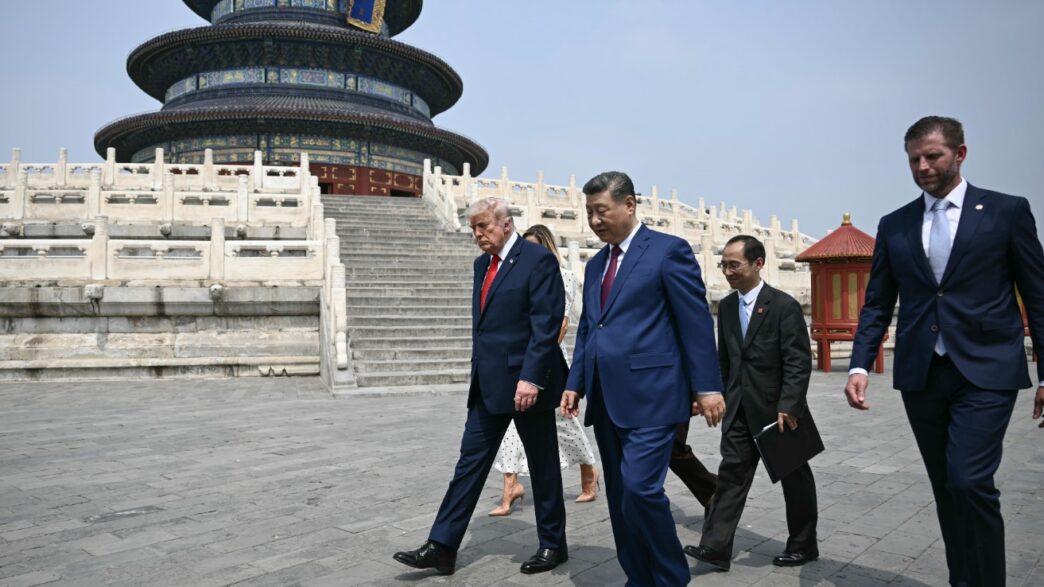
Beijing – United States President Donald Trump has revealed that he and Chinese President Xi Jinping discussed a potential $14 billion arms sale to Taiwan “in great detail” during their two-day summit in Beijing this week, even as he stopped short of committing to approving the deal.
Speaking to reporters aboard Air Force One on his way back to Washington, Trump said he has “not approved it yet” and added that fighting a war “9,500 miles away” was not in America’s best interest. “I want them to cool down. I want China to cool down,” Trump told Fox News anchor Bret Baier in an interview taped earlier this week.
Despite the talks, no substantive agreements were publicly announced on major issues, though Trump claimed “a lot of different problems” had been settled. China’s Foreign Minister Wang Yi described the summit as “historical” and said Xi had accepted Trump’s invitation to visit the United States in the fall. 
On Taiwan, Wang said Beijing sensed that Washington “attaches importance to China’s concerns” and does not support the island moving toward independence. “The Taiwan question is the most important issue in China-US relations; it affects the situation as a whole,” Wang told Chinese state media. He called on Washington to “abide by the one-China principle” and honour its international obligations.
Trump, however, told reporters he made “no commitment either way” on Taiwan during the talks.
Taiwan’s foreign minister said Taipei had closely followed the summit and was “maintaining good communication” with Washington, pointing to US Secretary of State Marco Rubio’s assurance that American policy toward Taiwan, spanning multiple presidents, “has not changed.”
The conflict in Iran also featured prominently in discussions. Trump said he and Xi agreed that Tehran should not possess a nuclear weapon. Wang added that China encourages both countries to resolve their differences through negotiations and called for the Strait of Hormuz to be reopened.
On Ukraine, Beijing said it hopes the conflict ends as soon as possible, with Wang saying both China and the United States are “willing to continue maintaining communication and play a constructive role in promoting a political settlement of the crisis.” The Kremlin said Russian President Vladimir Putin is separately planning a visit to China.
On trade, Wang said negotiators reached “overall balanced and positive outcomes” and that both countries agreed to establish a trade council and an investment council, with progress made on agricultural market access and tariff reductions.
While Trump was returning home, separate talks in Washington hosted by the State Department produced a 45-day extension to the ceasefire between Israel and Lebanon, which had been due to expire on Sunday. State Department spokesperson Tommy Pigott described the talks as “highly productive,” noting that a political track of negotiations would resume on 2 and 3 June, while a security track would be launched at the Pentagon on 29 May. Hezbollah, according to an official source, has indicated through indirect channels that it is prepared for a direct ceasefire should Israel agree.