


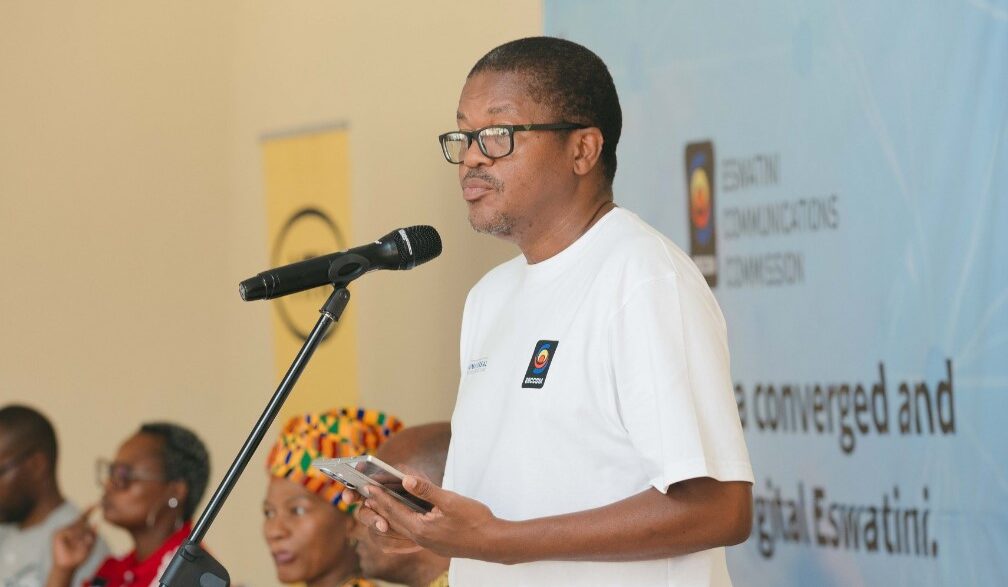
Ezulwini – The Eswatini Communications Commission is without a substantive chief executive after Mvilawemphi Dlamini’s contract expired on March 31 and was not renewed, according to a report by the Eswatini Observer.
The publication reports that the lapse leaves ESCCOM as the third parastatal under the Ministry of Information, Communication and Technology led by Savannah Maziya to face leadership uncertainty.
Dlamini’s contract came to an end on Tuesday despite support expressed in the Senate only days before its expiry. Citing insiders familiar with the matter, the Eswatini Observer reports that the ESCCOM board chaired by E Nathi Dlamini had already resolved not to renew the contract days earlier. A non renewal letter dated March 25 is said to have been issued on the same day Minister Maziya appeared before the Senate ICT portfolio committee. 
During that session, the minister was questioned about executive vacancies and governance concerns across entities under her ministry. She told senators she would meet the ESCCOM board after leaving Parliament to deliberate on the chief executive’s contract, which was then close to expiry.
Several senators commended Dlamini’s leadership during the committee sitting, pointing to what they described as measurable institutional progress during his tenure.
In line with the Public Enterprise Unit framework, Dlamini is understood to have formally indicated his intention to renew his contract six months before its expiry. The report further states that ESCCOM had submitted a recommendation for renewal earlier than the usual six month notice period due to uncertainty around the board’s composition. The current board was appointed in October, more than nine months after the previous board’s term had lapsed.
Senators raised concerns about what they described as a pattern of executive vacancies and prolonged acting appointments, warning that the situation risks weakening governance, strategic direction and operational performance in institutions central to Eswatini’s digital economy.
Senator Fezeka Dlamini is quoted as saying: “It is concerning that parastatals in the ICT ministry seem to have unstable leadership and now we are hearing that the ESCCOM chief executive’s contract has not been renewed when they have not even officially opened the building he has worked on.”
She questioned whether a board appointed only months earlier would exercise sufficient independence and fairness in handling such a significant decision.
Princess Nongengele also supported Dlamini’s leadership, crediting his stewardship with advancing ESCCOM’s mandate and aligning the institution with national priorities such as digital inclusion, economic development and improved public service delivery. She cited reductions in communication costs, expansion of broadband infrastructure, the operationalisation of data protection and cybersecurity frameworks and the near completion of the regulator’s new headquarters as achievements during his tenure.
When contacted, Dlamini referred all questions to the board chairperson and said he would only comment publicly once the board explains the reasons behind its decision.
Efforts to obtain comment from the board chairperson over the past two weeks were unsuccessful. Questions sent via WhatsApp at 11.43am on Friday March 27 had not been answered by the time of publication, although read receipts indicated the message had been seen.
The report further notes that leadership concerns extend beyond ESCCOM. At the Royal Science and Technology Park, the institution has gone more than two years without a substantive chief executive. Madoda Mdziniso, a senior ministry official and board representative, was recently appointed as the third acting chief executive.
At Eswatini Posts and Telecommunications Corporation, Fulatsa Zwane Sibanyoni was appointed acting managing director last month following the departure of former managing director Themba Khumalo.
In written responses, the ministry said it is recruiting a substantive chief executive and a full executive team for the Royal Science and Technology Park to drive a turnaround strategy focused on commercialisation and financial sustainability.
The ministry acknowledged that instability has had consequences, with the park experiencing slow revenue growth despite efforts to tighten cost controls and reduce outstanding debts.