

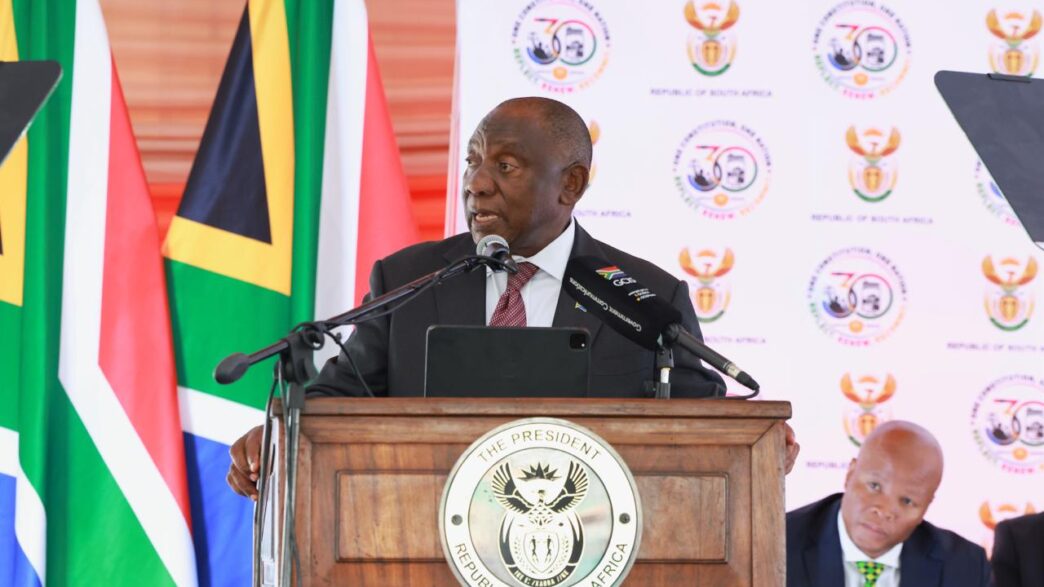
Pretoria – South Africa’s Constitutional Court has ordered that the Section 89 panel’s report on the Phala Phala scandal be referred to an impeachment committee, setting President Cyril Ramaphosa on a path toward a formal impeachment inquiry.
The judgment was delivered at Constitutional Hill in Braamfontein, Johannesburg, on Friday, 8 May 2026, more than 500 days after the case was heard in November 2024.
Chief Justice Mandisa Maya opened proceedings by apologising for the prolonged wait. “I start by taking full responsibility for the delay in producing this judgment concerning an extremely difficult matter of national importance, and I tender my sincere apology to the parties, my colleagues and fellow South Africans for the inconvenience it has caused,” she said. 
The Economic Freedom Fighters (EFF) and the African Transformation Movement (ATM) brought the matter to the apex court after the National Assembly voted in December 2022 against referring the Section 89 independent panel’s report to an impeachment committee. The ANC used its majority at the time, with MPs following the party’s instruction to reject the findings.
The panel had concluded that there was prima facie evidence for Ramaphosa to answer questions about the theft of approximately $580 000 (about R9.6 million) allegedly stolen from his Phala Phala game farm in Limpopo in February 2020.
The court found that Rule 129I of the National Assembly’s rules, which governs the process for removing a president from office under Section 89 of the constitution, effectively blocked an impeachment process without meaningful engagement during a parliamentary vote. The rule was declared inconsistent with the constitution and invalid, and the National Assembly must now amend it.
The National Assembly’s December 2022 vote to reject the panel’s report was declared irrational and unconstitutional, and has been set aside.
Maya delivered the first judgment, with Judge Jody Kollapen writing a minority ruling in which he found that even if Rule 129I was unconstitutional, this did not mean the National Assembly’s vote was automatically invalid. A third judgment, penned by three judges, found that once the rule is set aside, “the vote taken cannot stand.”
“The third judgment concludes that Rule 129I is unconstitutional and must be set aside. It further holds that the National Assembly’s vote must, likewise, be set aside because it was taken under an invalid rule that prevented the National Assembly from properly determining whether a ground for impeachment existed. The vote, therefore, lacked a lawful foundation,” Maya said.
Parliament must now establish an impeachment committee under the revised Rule 129I. Section 89 of the constitution allows for the removal of a president on three grounds: a serious violation of the constitution or the law, serious misconduct, or inability to perform the duties of office.
The committee will gather evidence, assess the credibility of claims, and make recommendations to the National Assembly. Witnesses, possibly including Ramaphosa himself, are expected to be called to respond to the allegations surrounding Phala Phala.
At the centre of the inquiry will be the origin of the $580 000 cash stolen from the farm on 9 February 2020. Ramaphosa has previously stated the money was payment for 20 buffaloes sold to Sudanese businessman Hazim Mustafa, with each animal valued at R400 000. Mustafa, who is based in Dubai, claimed he travelled from Sun City on Christmas Day in 2019 to deliver the funds to the farm, intending the money to serve as a security deposit for the transaction.
Questions remain over why the buffaloes were never delivered, why the money was allegedly not returned to Mustafa, and why it was allegedly stored in a couch for 44 days without being declared to the South African Reserve Bank, as required by the country’s Exchange Control Regulations within 30 days.
The burglary was never reported to the South African Police Service. A recent declassified Independent Police Investigative Directorate report found that the head of the Presidential Protection Service, Wally Rhoode, deliberately covered up the break-in. Rhoode was also found to have been involved in the kidnapping and interrogation of suspects, and to have crossed into Namibia unlawfully to track down the perpetrators.
Three suspects, Namibian national Imanuwela David, Froliana Joseph, and her brother Ndilinasho David Joseph, are currently on trial at the Modimolle Regional Court on charges of housebreaking, theft and conspiracy to commit burglary.
Should the impeachment committee recommend Ramaphosa’s removal, the National Assembly would need to vote on the matter. At least two-thirds of the 400 MPs, that is 267 votes, would be required to remove him from office.
The ANC and its Government of National Unity partners, including the Democratic Alliance, Rise Mzansi, Patriotic Alliance, Inkatha Freedom Party, Freedom Front Plus, United Democratic Movement, PAC, GOOD Party and Al Jama-ah, collectively hold 287 seats, meaning they could block a removal vote if they oppose it. The EFF, ATM, UAT, MK Party, BOSA and ActionSA collectively hold 108 seats, leaving them as a minority bloc in any final vote.