

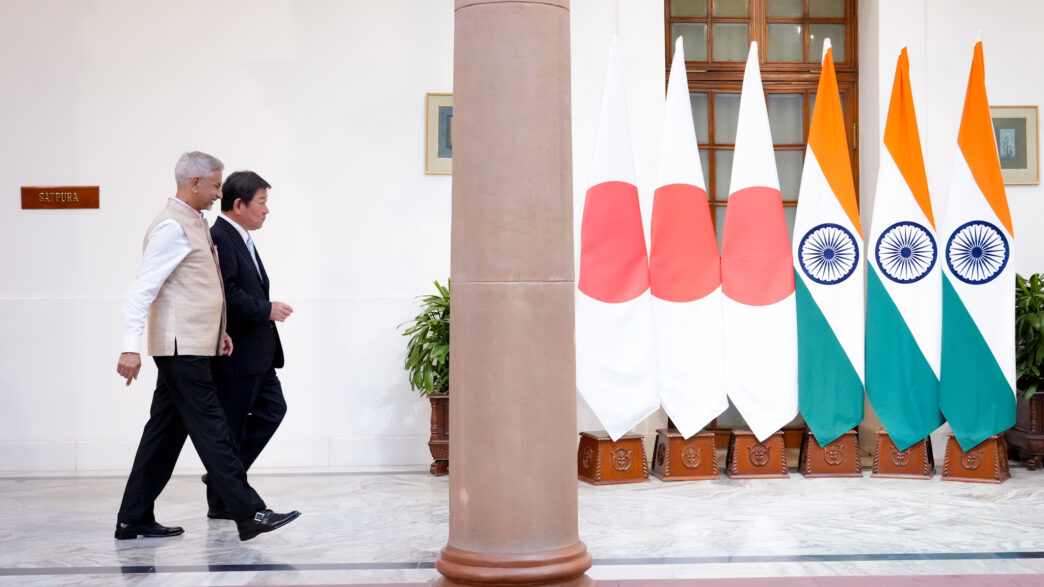
New Delhi – Japan’s Foreign Minister Toshimitsu Motegi met with his Indian counterpart, External Affairs Minister Subrahmanyam Jaishankar, in New Delhi on Monday evening for bilateral talks and a working dinner, as both countries look to deepen ties amid rising global tensions.
The meeting, which lasted about 60 minutes starting at 7:00 p.m. local time, took place on the sidelines of the Quad Foreign Ministers’ meeting, bringing together the top diplomats of Japan, Australia, India and the United States. A working dinner followed, running for roughly 70 minutes.
Jaishankar welcomed Motegi back to India, noting it was his second visit this year following an earlier trip in January, and called for stronger bilateral relations and deeper cooperation given what he described as a severe international situation. 
Motegi, for his part, laid out Japan’s updated “Free and Open Indo-Pacific” (FOIP) vision, telling his counterpart that Japan and India must serve as the driving force in realising the policy and calling for close coordination between the two countries, including through the Quad framework.
Both ministers agreed to accelerate public and private sector cooperation, particularly in the area of economic security. This includes building stronger supply chains for critical materials and driving economic growth in both countries through investment and innovation. Their agreement builds on the “Japan-India Joint Vision for the Next Decade,” which was launched during Indian Prime Minister Narendra Modi’s visit to Japan last August.
The two sides also agreed to push forward defence and security cooperation, drawing from a Joint Declaration on Security Cooperation that was revised last year. They committed to advancing people-to-people exchanges, which they described as the foundation for broader cooperation, and said they would use the milestone of the 75th anniversary of diplomatic relations between the two countries next year as an opportunity to build momentum.
On regional matters, the ministers discussed the situation in the Indo-Pacific and the Middle East, including the need to ensure free and safe navigation through the Strait of Hormuz. They also agreed to work together to secure a stable supply of energy and critical materials across Southeast Asia and South Asia.