

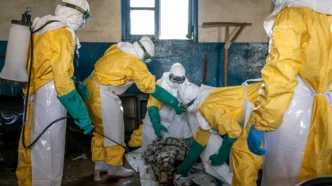
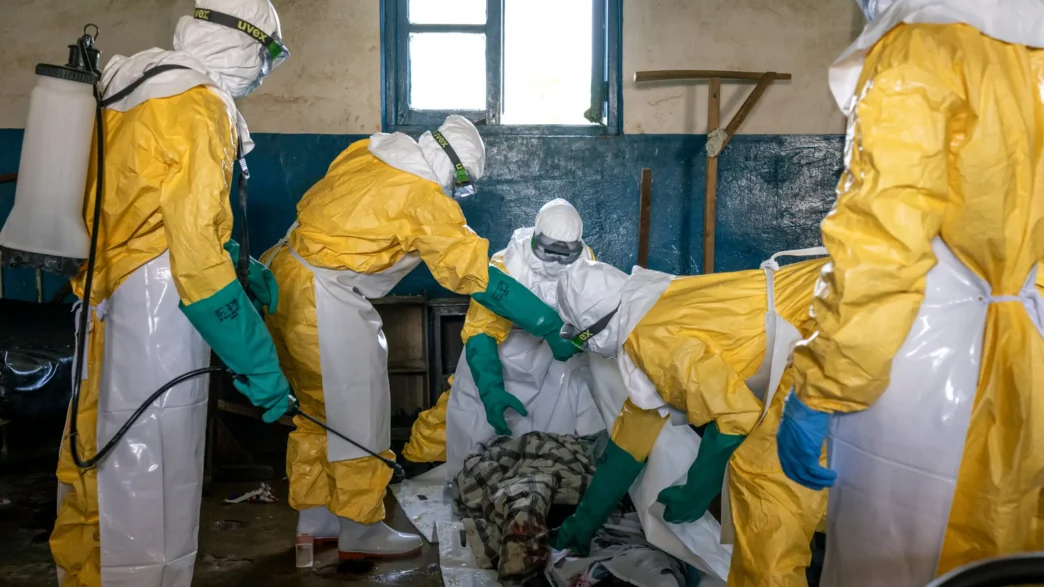
Mongbwalu, Democratic Republic of Congo – A five-year-old boy lay bleeding on a bare mattress in a cramped, dilapidated Ebola ward in Mongbwalu, a remote gold mining town in northeastern Democratic Republic of Congo, while a few beds away, the body of a 21-year-old woman who had died seven hours earlier remained uncollected beneath a thin sheet.
According to a report by The New York Times, the body of Christiane Bahati was highly contagious, yet most people moving through the ward wore no protection at all. Relatives came and went, carrying food and water to patients because the hospital had none to offer. A few wore rubber gloves or pulled scarves across their mouths. Most had nothing.

In the next ward, the hospital’s own laboratory technician was sick with suspected Ebola. Seven other hospital workers had already died from the disease. Few staff members had ever been trained to fight it, and basic supplies such as test kits, protective suits, goggles, masks and even drinking water were critically short. 
Outside, aid workers from Doctors Without Borders hammered away, racing to erect isolation tents and disinfection stations.
Dr Alex Bogole, a Congolese doctor in the hospital’s intensive care ward, was furious. The virus had been spreading for months, virtually unimpeded.
“And this is the best we can do?” he said, frustration pouring through his protective gear.
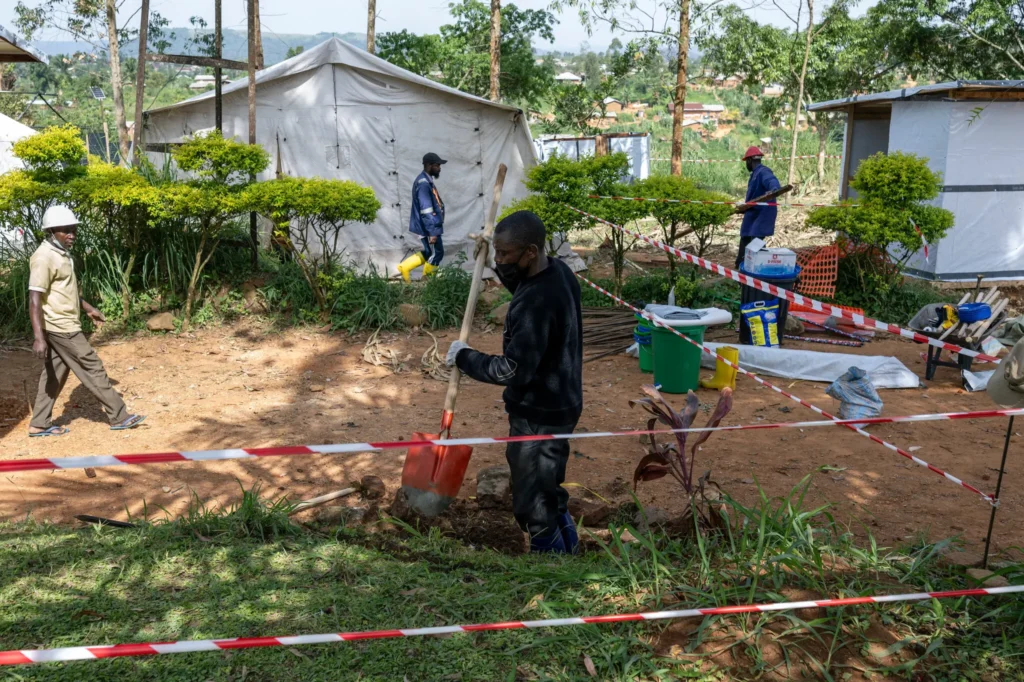
The Congolese Health Ministry declared the outbreak on 15 May, and it has since grown into the third largest on record. Two weeks into the international response, the virus is outpacing relief efforts, and aid groups warn that without urgent intervention, this could become the deadliest Ebola outbreak in history.
Bogole, who was never trained for this kind of crisis, was angry at the Congolese government for failing to detect the outbreak until perhaps six weeks after it began, and at the broader world for its slow response to Mongbwalu, a town of about 150,000 people where the outbreak is believed to have started.
“They hold meetings and meetings,” he said. “What is the purpose of these meetings? People are dying, people are getting infected, people are in danger. It’s very slow.”
Mongbwalu sits at the end of what has become known as the Ebola highway, a rutted dirt road from the regional capital, Bunia, a bumpy three-hour drive away. Giant trucks curl through lush hills, leaving clouds of dust. Congolese soldiers guard checkpoints that are often little more than string. Gold miners and people fleeing rebel conflict stream in and out of the town, providing an easy path for the virus to spread.
Through April and into early May, doctors in Mongbwalu battled a mysterious disease that was claiming dozens of lives. It turned out to be Bundibugyo, a strain of the Ebola virus for which there is no approved vaccine or treatment.
As of Thursday, at least 1,077 suspected cases and 246 suspected deaths had been recorded, according to the Africa Centres for Disease Control and Prevention. More than 400 of those cases are in Mongbwalu, a town in the heart of gold country surrounded by rebel-held territory in Ituri province.
Hospital director Dr Richard Lokudu said test results from the regional capital, some 80 kilometres away, take four days or more to arrive, by which time many patients have already died.
“I’ve been telling people that we need results immediately,” Lokudu said.
Wailing drifted into his office several times a day as news of each death set off explosions of grief. Relatives screamed, gestured and rolled on the grass outside. Checking his notebook, Lokudu said at least 30 patients had died at the hospital over the previous 12 days alone, with many more dying in their homes across the town.
Beyond the hospital gates, fear and confusion gripped residents. Many refused to accept that the virus was real, and focused their anger on Mongbwalu General, which has just 135 beds. Some claimed the outbreak was a money-making scheme invented by Congolese doctors and foreign aid workers. Others called it a curse.
An angry crowd gathered at the hospital’s front gate, where armed soldiers stood guard. Two nights earlier, assailants had burned down an isolation ward shortly after Doctors Without Borders erected it. In the chaos, 18 patients suspected of having Ebola fled their beds and disappeared into the town.
A vehicle with a smashed window sat outside Lokudu’s office. A day earlier, angry residents had chased him through the hospital grounds, throwing rocks.
“We really are in a terrible crisis,” he said. “We’re here to save them. They think we want to kill them.”
Lokudu believes he may have treated one of the outbreak’s first victims. On 6 April, he operated on a young woman who had suffered a miscarriage late in her pregnancy. During the caesarean section, he noticed unusual splotches of blood on her organs. She died six hours later. The medics who treated her subsequently fell sick. The anaesthesiologist died on 9 May. The surgical assistant died the following day. Lokudu said he also fell ill around the same time but survived, something he attributes at least in part to having been vaccinated during the previous outbreak, though for a different strain of the virus.
“That saved me,” he said.
WHO experts say a vaccine against this species of Ebola could take six to nine months to develop.
“We must make do with what we have,” Lokudu said. “Otherwise, who will do it?”
As the afternoon wore on, a Red Cross worker emerged from the Ebola ward in a protective suit, spraying disinfectant in his path. Volunteers followed, carrying a sealed white bag containing the remains of Bahati, the 21-year-old whose body had lain in the ward for hours. Mourners wailed and beat themselves as the bag was placed in a coffin.
Her husband, Héritier Alezo, watched from a distance. He had not yet told their sons, aged two and three, that their mother was gone.
“How would they understand?” he said.
He had no patience for the conspiracy theories circulating in the streets. He had his own, most painful proof.
“In my opinion,” he said firmly, “Ebola exists.”