

Manila – A magnitude 7.8 earthquake struck off the southern Philippines early Monday, killing at least 15 people, injuring 129 others and triggering tsunami warnings across several countries in the Asia-Pacific region.
The quake hit at around 7:37 a.m. local time at a depth of about 35 kilometres, with its epicentre located approximately 20 kilometres off Mindanao’s Sarangani province, according to the United States Geological Survey. Tremors were felt across a dozen provinces and as far as 420 kilometres away in Manado, on the Indonesian island of Sulawesi. It struck as schools across the Philippines were reopening after a long break.
The office of civil defence said it was working to verify reports of 15 deaths and 129 injuries in the region, with most casualties caused by falling debris. Response teams were still trying to confirm further casualty figures on the ground. 
President Ferdinand Marcos Jr ordered an immediate disaster response across Mindanao, directing all relevant government agencies to prepare relief supplies, set up evacuation centres and stand ready for rescue operations. “The national government is moving and we will not leave Mindanao behind,” he said.
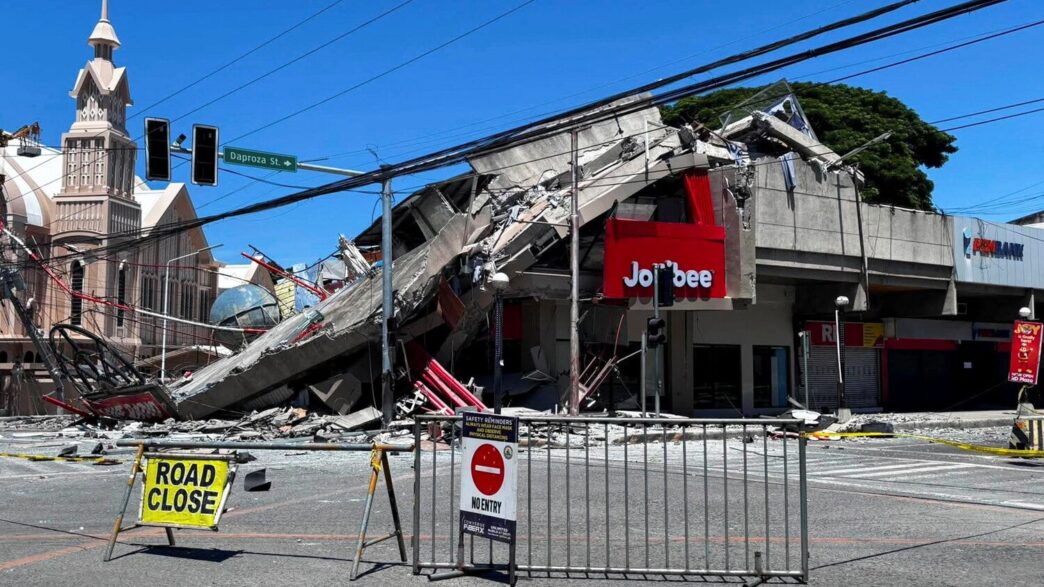
Video from General Santos, a city of about 700,000 people, showed a building housing a fast food restaurant collapsing as onlookers fled through a rapidly spreading dust cloud. A hospital in the city was evacuated over fears of structural cracks on upper floors. A building at Notre Dame of Dadiangas University also came down, though no one was inside at the time.
“I had to duck and shelter myself under the table. And it was very long and strong,” said university president Manuel de Leon, speaking to broadcaster DZMM.
Separate footage showed dozens of terrified elementary schoolchildren crouching outdoors in Davao Occidental as the ground beneath them swayed violently. Other video showed a collapsed high school roof in Davao Del Sur while pupils gathered on the sports field outside. No injuries were reported in either incident.
Social media video captured the moment the quake struck another school, showing children swaying from side to side and hugging teachers before fleeing as a makeshift shelter collapsed behind them.
Benjie Ancheta, police chief of Alabel town in Sarangani, told Reuters the quake hit during a police flag-raising ceremony, leaving cracks in the police building and causing some people to faint. “This is the strongest earthquake we’ve experienced,” he said.
Images from Sarangani province showed damaged shop fronts, collapsed signage, smashed windows and piles of rubble from crumbled concrete. The Philippine military said disaster response units had been deployed to all affected areas.
The Philippine seismology agency recorded at least nine aftershocks across Mindanao by Monday morning, the strongest at magnitude 6.7.
Tsunami alerts were issued for the southern Philippines, northern Indonesia and Malaysia’s Sabah state on Borneo island. Australia initially warned of potential tsunami waves along its northern coasts, while Japan’s meteorological agency reported an observed wave of 0.2 metres or lower and ordered precautionary beach closures and some ferry disruptions. A wave of up to 0.75 metres was detected in parts of North Sulawesi, prompting residents including those on the remote Sangihe Islands to move inland.
“They are now evacuating to the higher ground… away from the coast, to avoid the potential tsunami,” said resident Jufry Dalita, according to Indonesian state news agency Antara.
Indonesia’s disaster mitigation agency spokesperson Abdul Muhari said only minor damage was reported in that country. No tsunami threat was detected in Hawaii, according to the U.S. National Weather Service.
The Pacific Tsunami Warning Center said the threat had largely passed about five hours after the quake, but urged people to remain alert and follow instructions from local authorities as sea levels could continue to fluctuate.
Malaysian Prime Minister Anwar Ibrahim said Kuala Lumpur stood ready to assist Manila. “I pray for the safety and wellbeing of all those affected, wishing them strength and courage in the difficult days ahead,” he posted on X.
Monday’s disaster comes eight months after a 6.9 magnitude quake off Cebu killed 79 people, the deadliest tremor in the Philippines in 12 years, followed two weeks later by two powerful quakes on Mindanao, the strongest at magnitude 7.4. The Philippines, Indonesia and Japan all sit along the Pacific Ring of Fire, a seismically active belt of fault lines stretching from South America to the Russian Far East, where hundreds of earthquakes occur every year.