


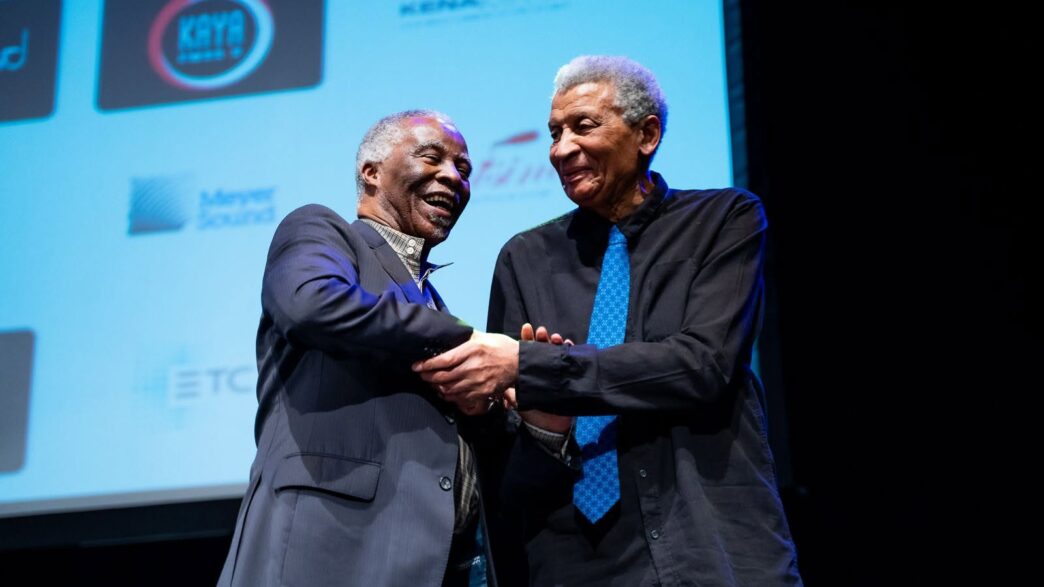
Cape Town – The Thabo Mbeki Foundation has paid tribute to South African jazz maestro Abdullah Ibrahim, describing his death as the loss of a man who gave the African liberation struggle its sound.
Ibrahim, the pianist and composer once likened by former president Nelson Mandela to Mozart, died this week in Germany at the age of 91 after a short illness. He had lived in the German state of Bavaria, where his family said he will be laid to rest.
In a statement, the Foundation said it had lost not merely a musician but a philosopher and keeper of African wisdom who spent his life pressing others to reconsider their place in the universe. 
The Foundation said Ibrahim understood that Africa’s rebirth required more than political independence. It said he believed the continent needed a spiritual reawakening, a reclaiming of its own stories and the patient building of institutions capable of preserving its heritage.
It said Ibrahim demonstrated that conviction in 2019, when the Thabo Mbeki Presidential Centre existed only as an idea shared by a small group of people. Before any ground had been broken, he staged two benefit concerts, one in Johannesburg and one in Cape Town, to support the project. The Foundation said he asked for nothing in return and simply sat at the piano to place his talent in service of an institution meant to outlast everyone involved. It said that gift would be built into the foundations of the Centre and its memory preserved permanently.
The statement described Ibrahim’s intellectual interests as spanning millennia, pointing to his fascination with both the ancient stone circles at Adam’s Calendar in Mpumalanga and the Square Kilometre Array, the radio telescope project based in the Karoo. According to the Foundation, Ibrahim saw the ancestors who once mapped the solstices and the astrophysicists now listening to the edges of the universe as taking part in the same ongoing conversation, believing that charting Africa’s future required deep familiarity with its past.
The Foundation said this awareness extended to how Ibrahim viewed the natural world, from which he drew continually for his music. It said he often urged people to see themselves not as conquerors of the earth but as its custodians.
While rooted in South African soil, his music carried far beyond the country’s borders, the statement said. It noted that Japan awarded him the Order of the Rising Sun, Gold and Silver Rays, in April 2020, which the Foundation described as recognition from the East of a healing light that had shone from the southern tip of Africa.
To mark his passing, the Foundation quoted the Senegalese poet Birago Diop’s poem “Souffles” (Breaths), which speaks to a belief that the dead remain present in the natural world rather than truly departing. The poem reads, in part:
“Listen more often To things than to beings: The voice of the fire is heard, Hear the voice of the water. Hear in the wind The weeping bush: It is the breathing of our ancestors. Those who are dead are never gone: They are there in the thickening shadow. The dead are not under the earth: They are in the tree that rustles, They are in the wood that groans, They are in the water that runs, They are in the water that sleeps, They are in the hut, they are in the crowd: The dead are not dead.”
The Foundation said it would now hear Ibrahim in the winds of the Cape, in the wisdom of ancient stones and in the cosmos he spent his life contemplating.
It extended condolences to Ibrahim’s family, the musicians who performed alongside him over the decades and the many people worldwide whose lives, it said, were enriched by his work. The statement said the vision he supported was now the Foundation’s to carry forward, in pursuit of the culturally awakened Africa he had envisioned.