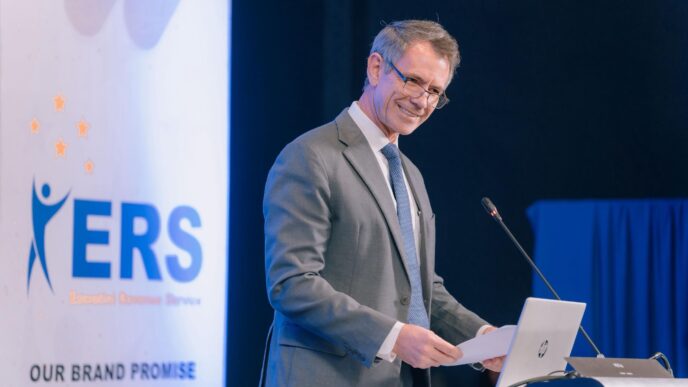


Vienna – Eswatini’s Minister of Finance Neal Rijkenberg has told the OPEC Fund Development Forum 2026 gathering in Vienna, Austria, on Tuesday that the kingdom has made a major fiscal turnaround, reducing a chunk of its deficit while boosting investments.
In a panel discussion, Rijkenberg ascribed the substantial deficit reduction and the country’s improved fiscal position to economic strategies undertaken a few years back.
Eswatini has experienced an average of 2% economic growth over the last 20 years, but has not consistently received high ratings from organisations such as Moody’s and Fitch Ratings. Furthermore, studies from the International Monetary Fund (IMF) and the World Bank have said little about Eswatini. However, a few years ago, Eswatini began to reap the fruits. 
“So we focused on trying to get our image better as a country, and over a few years, and kind of about four years ago, we started getting it right where our article four had a list of things: wage bill issues – we sorted those out; fiscal deficit – we brought it down from 7.5 to about 2,” Rijkenberg said.
Eswatini established a Southern African Customs Union (SACU) stabilisation fund to cushion its volatility. The country also rebranded, improving its political image and investor readiness.
“We changed from a country that will generally be seen as really not investable to investable. Moody’s gave us an upgrade. Our bonds on the Johannesburg Stock Exchange went from junk status to investment grade,” he said.
This opened up financial routes to Eswatini.
“The GDP growth has now moved from an average of two to an average of about five. So, the last is in our third year, about a 5% growth, and is hopefully trending upwards. But that now creates two things. Number one, the private sector has now got access to funds, which they never had before. And so, all of a sudden there’s new growth in the private sector space,” the minister said.
Rijkenberg warned, though, of the government having access to ‘a whole lot more funds they’re not used to’, stating an obvious ‘temptation because you’ve got desperate needs as a country, things you desperately need to do.’
“But the temptation to now move off the sustainable path is brutally difficult to maintain. And that’s the trick for a country. So when you get to that place, to still maintain the sustainability, to continue to make sure your private sector can continue to grow as they need to, is very tricky. So there’s a country battling with that, and we’re working on it,” he said.
Other panelists included Issifu Seidu, Minister of State for Climate Change and Sustainability of Ghana, Amb. Selma Malika Haddad, Deputy Chairperson of the African Union Commission as well as Admassu Tadesse President & Managing Director, TDB Group. The session was moderated by Prof. Dr. Andreas Klasen, Director, lill Institute for Public Value, Germany.