

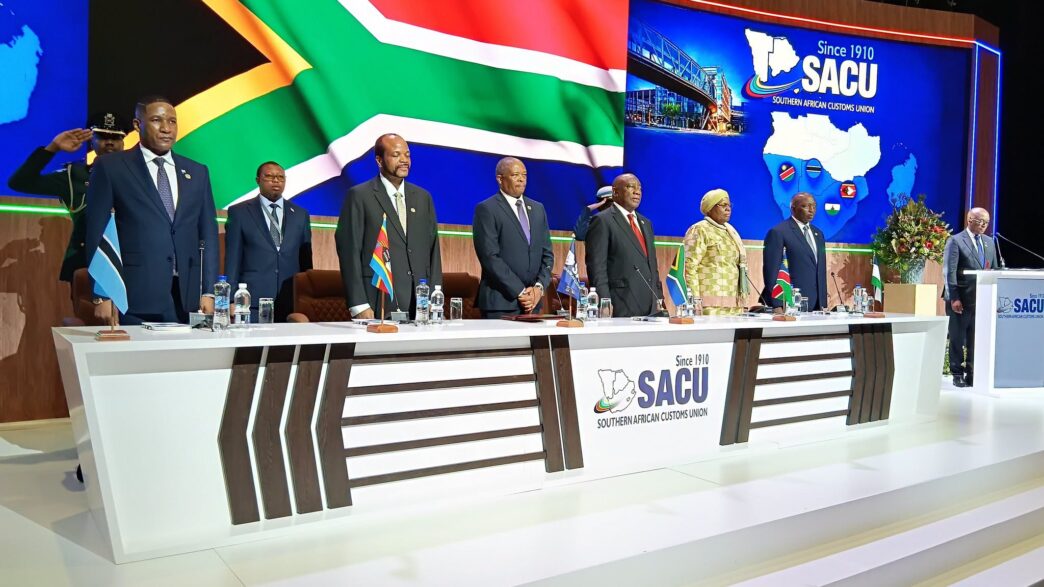
Cape Town – South African President Cyril Ramaphosa on Friday declared the 9th Summit of the Southern African Customs Union (SACU) Heads of State and Government officially open in Cape Town, calling on member states to transform the world’s oldest customs union into a dynamic engine of regional development.
Addressing leaders from Botswana, Eswatini, Lesotho, Namibia and South Africa at the Cape Town International Convention Centre, Ramaphosa said the global economic environment demanded a bolder, reimagined SACU capable of driving industrialisation, regional value chains and shared prosperity.
“In such a world, no African country, regardless of its size, can prosper alone. Our strength will increasingly depend on the strength of our region,” Ramaphosa said. 
He opened proceedings by thanking outgoing SACU Chair Namibian President Netumbo Nandi-Ndaitwah for her stewardship, and welcomed Botswana President Duma Gideon Boko to his first SACU Summit. He also called for a moment of silence in memory of former Namibian President Hage Geingob, who passed away in 2024, and former Botswana President Festus Mogae, who died in May this year, describing both as steadfast champions of pan-African solidarity and regional economic integration.
Ramaphosa traced the origins of the reimagined SACU agenda to the last Summit held in Eswatini in June 2023, when leaders agreed on the need for a coordinated response to supply chain disruptions and food and energy market volatility.
He said three years on, global conditions remained precarious, marked by trade tensions, tariff disputes and growing economic fragmentation. The World Bank estimates global growth will slow to 2.5 percent this year, partly due to conflict in the Middle East. SACU economies are projected to grow at 2.64 percent in 2026 and 2.1 percent in 2027.
“The certainties upon which the international trading system rested for decades are steadily giving way to uncertainty. It is through regional integration that our region will continue to strengthen economic sovereignty,” he said.
Ramaphosa said SACU, established in 1910 and now 116 years old, had survived empire, two world wars, the Great Depression, colonialism and apartheid, but warned that institutions which failed to adapt risked becoming custodians of the past rather than architects of the future.
“Our Union has the potential to be more than a fiscal instrument. It must be a catalyst for development,” he said, welcoming progress towards establishing a Regional Development Fund in partnership with the African Development Bank.
He pointed to specific opportunities across member states, noting Eswatini’s manufacturing base, Lesotho’s textile sector, Namibia’s green hydrogen and uranium processing potential, Botswana’s diamond beneficiation experience and South Africa’s automotive and steel capacity as assets that should be harnessed into a competitive regional industrial ecosystem.
“Industrialisation is the only durable path from commodity dependence to an economy capable of sustaining our growing populations,” Ramaphosa said.
He called for greater investment in shared infrastructure including roads, railways, ports, energy grids, digital networks and water systems, citing the Trans-Kalahari Railway being advanced by Botswana and Namibia, the Lesotho Highlands Water Project and Eswatini’s energy interconnections with South Africa and Mozambique as models of what regional cooperation could achieve.
Ramaphosa also announced the launch of cross-border special economic zones to serve as nodal points for regional industrialisation, and called on member states to leverage Africa’s approximately 30 percent share of global mineral reserves to build regional value chains and fast-track beneficiation of raw materials.
He closed with a pointed reminder of SACU’s original purpose and its future potential.
“One hundred and sixteen years ago this Union was created to serve an empire. Today it must serve the aspirations of free African nations. Its original purpose was to move goods. Its future purpose must be to create opportunity. Its past was shaped by history. Its future must be shaped by our choices,” Ramaphosa said.