

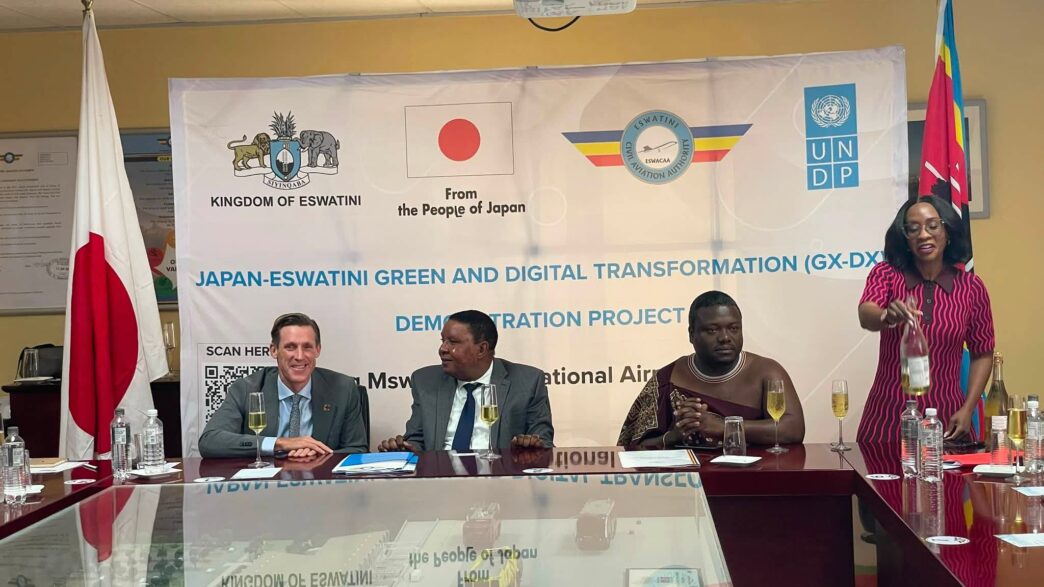
Matsapha – The Eswatini government today signed to receive a USD 693,333 (about E12 million) financial support from the Japanese government to install renewable energy systems at the King Mswati III (KMIII) International Airport, marking the start of the Japan-Eswatini Green and Digital Transformation (GX-DX) demonstration project.
Eswatini benefits from having its airports implement smart logistical technologies that modernise airport operations while cutting energy costs and carbon emissions, hence increasing economic competitiveness.
The installation of solar energy systems, the upgrade of cargo facilities with energy-efficient and smart technology, and the implementation of digital coordination tools are all intended to improve cargo processing and reduce delays. 
The signing took place at the Eswatini Civil Aviation Authority (ESWACAA) offices in Matsapha, where the minister of public works and transport, Chief Ndlaluhlaza Ndwandwe, presided over a ceremony attended by senior officials, developers, partners, and representatives from the diplomatic and donor communities.
The project will be implemented jointly by the Ministry of Public Works and Transport and the United Nations Development Programme (UNDP), with the goal of addressing the airport’s persistent challenges, such as high energy costs, carbon-intensive operations, and inefficient logistics systems, as well as strengthening the airport’s role in supporting trade, industrialisation, and regional connectivity.
The minister stated that these steps will increase operational efficiency, lower costs, and boost Eswatini’s competitiveness in regional and worldwide trade.
He added that by signing the agreement, Eswatini has taken an important step toward sustainable energy, infrastructure, innovation, and economic development for its airports, and that the project reflects Eswatini and Japan’s shared commitment to building a greener, more resilient, and technologically enabled future.
Ndwandwe thanked the Japanese government and people for their generosity and continued partnership, as well as UNDP for collaborating with the government and national institutions on initiatives that promote sustainable development, institutional capacity, and economic transformation.
The project demonstrates the faith in Eswatini’s growing aviation industry.
Ndwendwe also stated that the project contributes to broader national development priorities, such as promoting sustainable infrastructure, improving digital transformation, increasing economic competitiveness, and creating opportunities for skill development and technology transfer.
See the project brief here: https://www.undp.org/eswatini/projects/japan-green-and-digital-airport-transformation-initiative