

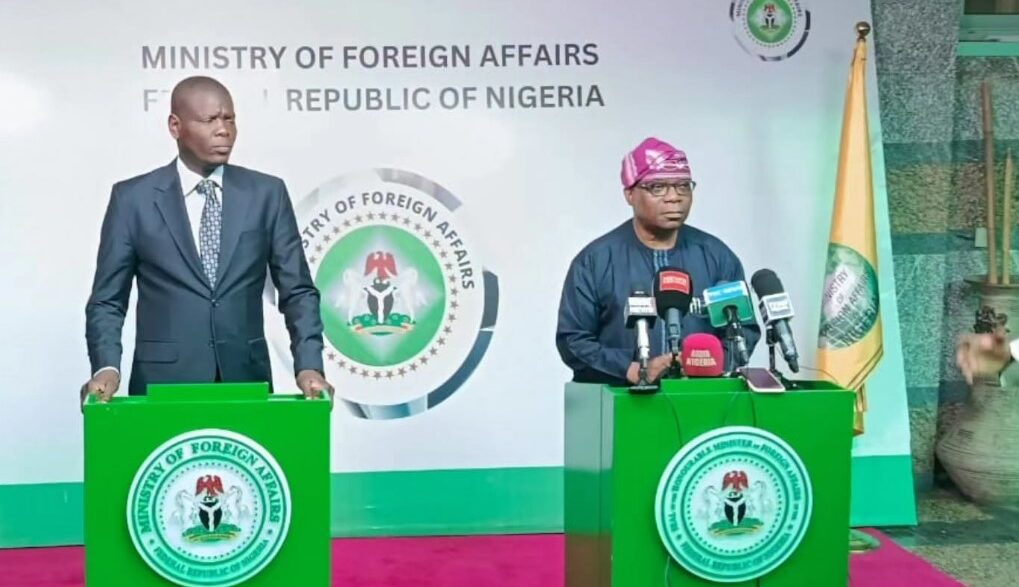
ABUJA – Nigeria’s Minister of State for Foreign Affairs, Ambassador Sola Enikanolaiye, received South African President Cyril Ramaphosa’s Special Envoy and Minister of International Relations and Cooperation, Ronald Lamola, in Abuja on 27 July 2026 to discuss recurring attacks on Nigerians and other African migrants in South Africa.
Acting on President Bola Ahmed Tinubu’s directive, Ambassador Enikanolaiye expressed Nigeria’s deep concern over the continued violence, stating that at least 98 Nigerians have been killed since 2022 in mob attacks, hate-related violence and extra-judicial killings. He urged South Africa to strengthen protection for foreign nationals, ensure accountability for perpetrators and prevent future attacks.
The minister recalled Nigeria’s support for South Africa’s anti-apartheid struggle and stressed that criminal suspects should be prosecuted through due process rather than subjected to mob justice. Reflecting on the recent evacuation of 1,490 Nigerians from South Africa, he described the humanitarian impact as deeply distressing. 
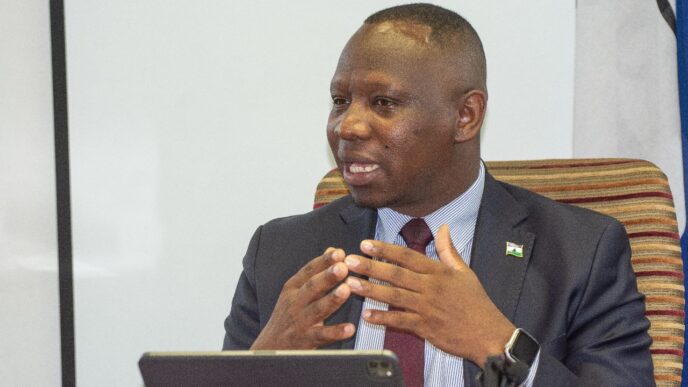
In response, South African Special Envoy Ronald Lamola reaffirmed his government’s opposition to xenophobia, racism and violence while stating South Africa’s right to enforce its immigration laws. He also raised concerns about criminal activities involving some Nigerian nationals and called for greater bilateral cooperation to tackle organised crime.
Lamola informed the Nigerian delegation that arrests had been made in connection with recent attacks on Nigerians and that prosecutions were underway.
The discussions were described as “candid, constructive, and forward-looking,” focusing on restoring mutual goodwill and strengthening bilateral relations between the two nations.
Lamola’s spokesperson Chrispin Phiri said the minister outlined three specific areas of concern that have heightened recent tensions.
“The purported installation of an unrecognised traditional ruler, titled an ‘Igbo King’, in the Eastern Cape Province in March 2026 caused widespread public concern across South Africa. Minister Lamola stated that this occurred while South Africa is actively consolidating the constitutional role of traditional leadership in a post-apartheid society.”
Phiri said concerns were raised regarding the involvement of certain foreign nationals, including Nigerian citizens, in organised crime, illicit drug trafficking, and financial fraud.
“The Special Envoy noted that as of 7 July 2026, more than 500 Nigerian nationals had been processed through the South African criminal justice system for various offences, highlighting the need for enhanced cross-border security cooperation.”
Lamola addressed instances where law enforcement officers faced violent resistance or obstruction during criminal investigations. A specific concern was raised regarding hijacked residential and commercial properties in urban centres such as Hillbrow in Johannesburg and Sunnyside in Pretoria, where unlawful enclaves have compromised public safety for local residents and foreign nationals alike.
“Regrettably, these incidents have fueled negative perceptions surrounding Nigerian nationals living in South Africa over the years. Addressing these challenges firmly, fairly, and within the bounds of the law is vital for the well-being of both our nations,” Lamola said.
Phiri said during the sessions, both delegations reviewed feedback regarding the processing and arrest of over 500 Nigerian nationals in South Africa.
“Minister Lamola clarified that these law enforcement measures are evidence-based, targeting individual criminal conduct rather than profiling the broader, law-abiding Nigerian diaspora. The Nigerian delegation acknowledged the necessity of holding lawbreakers accountable, while stating the importance of guaranteeing constitutional due process, fair trial standards, and humane treatment for all detainees,” Phiri said.
Phiri added that both delegations agreed on the urgent need to de-escalate inflammatory rhetoric in public discourse and prevent hostile actions.
Lamola stated that the South African government unequivocally condemns all forms of xenophobia, racism, discrimination, and related intolerance. While crime and lawlessness will be met with the full force of the law, public frustration or criminal activity can never be used to justify vigilante violence, intimidation, or attacks against foreign nationals.
“Law enforcement remains the exclusive prerogative of the state,” Minister Lamola stated. “While South Africa will not tolerate criminal activity by any individual regardless of nationality, we equally will not permit vigilante action or xenophobic violence against foreign nationals residing in our country. To this end, arrests have taken place, and relevant investigations are still underway.”
Lamola reiterated that shared migration and public safety challenges are best resolved through formal diplomatic channels, institutional security partnerships, and strict adherence to constitutional rights.
Phiri said the two governments reaffirmed that bilateral diplomacy and Pan-African solidarity remain the essential frameworks to ensure peaceful coexistence, safeguard human rights, and deepen historical ties between South Africa and Nigeria.
Both countries agreed to de-escalate inflammatory rhetoric through diplomacy, strengthen security and migration cooperation, accelerate the implementation of the long-delayed Early Warning Mechanism, prepare for the next Nigeria–South Africa Binational Commission meeting, and preserve the longstanding strategic partnership and Pan-African solidarity between both nations.
Ambassador Enikanolaiye is expected to brief President Bola Ahmed Tinubu on the outcome of the discussions following the meeting.