


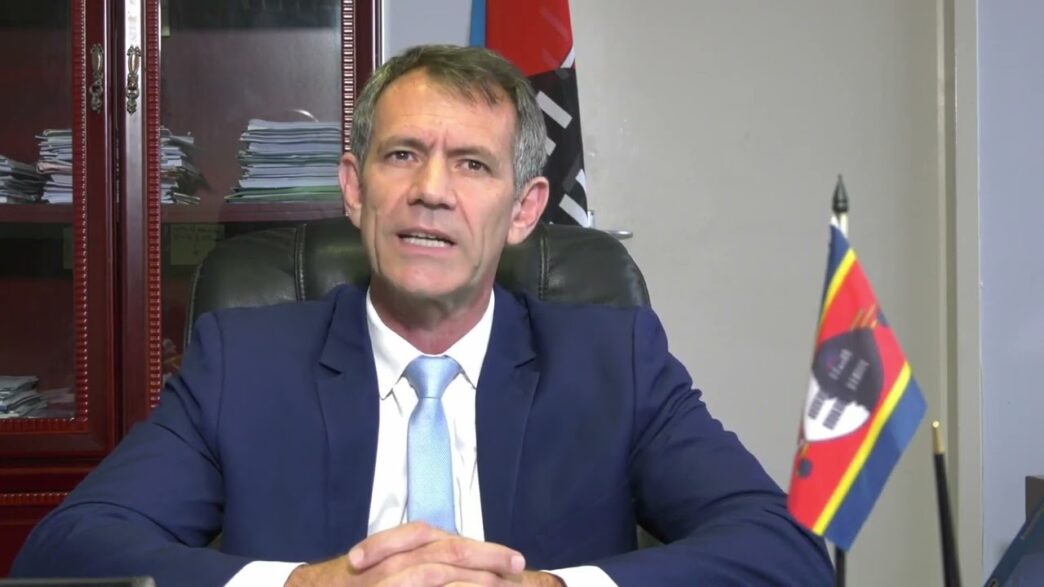
Mbabane – Finance Minister Neal Rijkenberg has warned Emaswati to be careful after scammers began using Finance in Focus footage and artificial intelligence to create fake messages pushing people to invest in specific funds.
Speaking during the weekly Finance in Focus update, Rijkenberg said he would never tell the public to put money into a particular private investment fund or single out one investment as better than another.
“Please be careful Emaswati number one. Please know I’ll never I’ll never do that. 
I’ll never say invest exactly in this private investment fund or speak about it having done a certain thing and tell people to put the money in there. I’ll speak very broadly. I’ll try and help Emaswati possibly on on on what to consider, but never never speaking to specific funds in the private sector. It’d be very wrong of me to do this as a minister. A minister shouldn’t highlight to say this fund is better than that fund. So when I everyone sees me doing that, please know it’s a scam.
Please know that it’s being done unrighteously.”
He said the fake content is being shared dishonestly and urged the public not to fall for it.
The minister also gave an update on Putu Money, an EPTC courier company that government is beginning to use to support deliveries and online purchases into Eswatini from Johannesburg. He said the service is already operating in courier work but is now being used more strategically to help people buy goods on online platforms and receive them in the Kingdom.
According to Rijkenberg, Putu Money South Africa has also been registered to help with larger imports from overseas, including containers and goods needed by the private sector. He said the aim is to make access to goods from outside Eswatini easier for importers and ordinary citizens alike.
“So that is a assistance, I think, through government that one can get and and to make to make access to the world a whole lot easier from Eswatini than what it currently is.”
Rijkenberg also moved to set the record straight on Eswatini’s debt situation after recent reports suggested the country may be borrowing too much. He said the Kingdom continues to borrow and repay loans while keeping debt around 45 per cent of GDP.
He said government is currently raising more debt to deal with arrears and outstanding payments, but insisted the country is still in safe territory.
“I think the average on the continent is 66% debt to GDP ratio. SADC countries have said we shouldn’t go over 60%. As a country, we’re on 45% debt to GDP. So from that perspective, we’re still in semi safe territory.”
The minister said Eswatini wants to stay conservative with borrowing so that banks and lenders continue to trust the country, making it easier for the private sector, parastatals and government itself to access affordable loans when needed.
He added that Eswatini has no commercial debt with international entities and that all foreign debt remains concessional debt, which helps the country manage repayments more comfortably.
On supplier payments, the minister said government currently pays about half a billion emalangeni at month end, though new invoices keep coming in, making it a continuous process. He said the country is not far behind, but more funding is being raised to bring supplier payments fully under control and speed up capital projects that have been delayed by cash flow challenges.
“So yeah, that’s just the update for the week, maSwati lamahle.”