


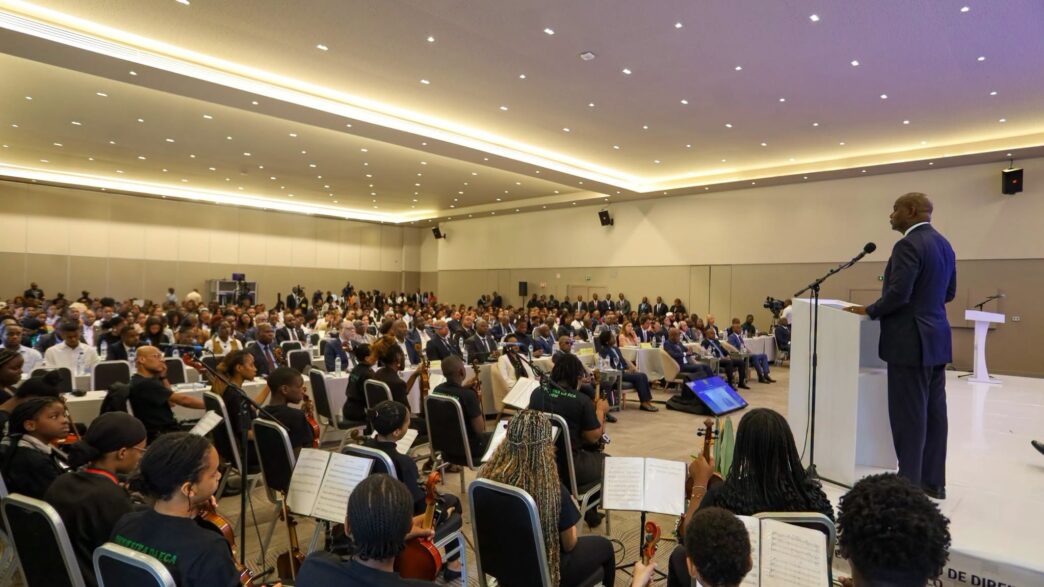
MAPUTO, Mozambique – President Daniel Chapo has called for African countries to develop constitutional approaches that reflect their own histories, cultures, institutions and values rather than simply adopting models developed elsewhere.
Chapo made the remarks on Tuesday while opening the “Constitutional Justice and Global Rule of Law” conference in Maputo.
The conference was organised by Mozambique’s Constitutional Council together with the European Public Law Organisation, EPLO, and brought together academics, judges, lawyers, constitutional law specialists, public officials and students. 
“We should not turn the global constitutional dialogue into a mere importation of models. Africa and, consequently, Mozambique, have their own experiences, their own cultures, their own legal thinking, their own institutions and values and solutions that should contribute to the construction of global constitutional thinking,” Chapo said.
The President acknowledged that globalisation has created stronger links between countries, economies and legal systems, meaning events in one country can quickly affect others.
He cited financial crises, disinformation, manipulation on social media, organised crime, cyberattacks and environmental threats as challenges that increasingly cross national borders.
Chapo said this reality raises the question of how universal principles of the rule of law can be balanced with the sovereignty, history, culture and constitutional identity of individual countries.
“And global constitutional thinking should contribute to Mozambican constitutional thinking. Constitutional dialogue should be a space where everyone learns and everyone teaches. The universal values of the rule of law must engage in dialogue with constitutional identity, political history, culture, anthropology and the cultural diversity of peoples, in this case, the Mozambican people,” he added.
He said a meaningful global rule of law can only be developed by maintaining a balance between shared international principles and the diversity of individual societies.
The President also called on Mozambique’s justice institutions to place citizens at the centre of their work and improve access to justice.
He warned that delays in resolving cases can undermine the purpose of justice, saying justice that is delayed “may cease to be justice”.
Chapo urged justice institutions to reduce procedural delays, simplify processes, use opportunities created by digital transformation and bring services closer to communities.
He also called for judges and other public servants to maintain high standards of integrity and professional conduct.
“The authority of institutions begins with the ethics, professional conduct and integrity of the people who serve in them. There is no serious, upright and trustworthy institution without serious and upright people, with ethics, morality and professional conduct,” he noted.
The President called on universities and researchers to contribute solutions to national challenges and support the development of effective public policies.
Young people were also encouraged to study the Constitution so that they understand and can defend their rights and responsibilities as citizens.
Chapo urged public institutions to promote transparency, integrity, responsibility, competence and accountability.
He also called on political leaders to use dialogue when addressing differences and national challenges.
“Democracy does not eliminate differences; on the contrary, differences enrich democracy, but it teaches us to manage them within the Constitution and the laws, and not outside the Constitution and the laws,” Chapo said.
The EPLO is an international organisation focused on the rule of law, human rights and democratic governance, with programmes covering legal education, institutional development and international cooperation.
The Maputo conference provides a platform for participants to discuss constitutionalism, justice and the development of the rule of law in a changing global environment.