

Mbabane – The Ministry of Housing and Urban Development hosted a delegation from the World Bank’s Urban Resilience, Disaster Risk Management, and Land Unit this week, kicking off a series of engagements and site visits across the country’s key urban centres.
The meetings were aimed at understanding the ministry’s urban development priorities, identifying challenges facing local authorities, and mapping out possible areas of collaboration between Eswatini and the Bank.
Discussions between the two sides brought several pressing issues to the table. Among the top priorities was the urgent need for a National Spatial Planning Framework to guide land use and bulk infrastructure development across the country. Stakeholders also raised concerns about financing gaps for bulk infrastructure in urban areas, and the absence of a clear intergovernmental fiscal transfer policy, a gap that officials say is undermining local authorities’ ability to deliver services and maintain infrastructure while managing growing urban populations. 
The delegation, led by the ministry, then embarked on a corridor tour stretching from Ngwenya to Manzini, with stops at several towns along the way.
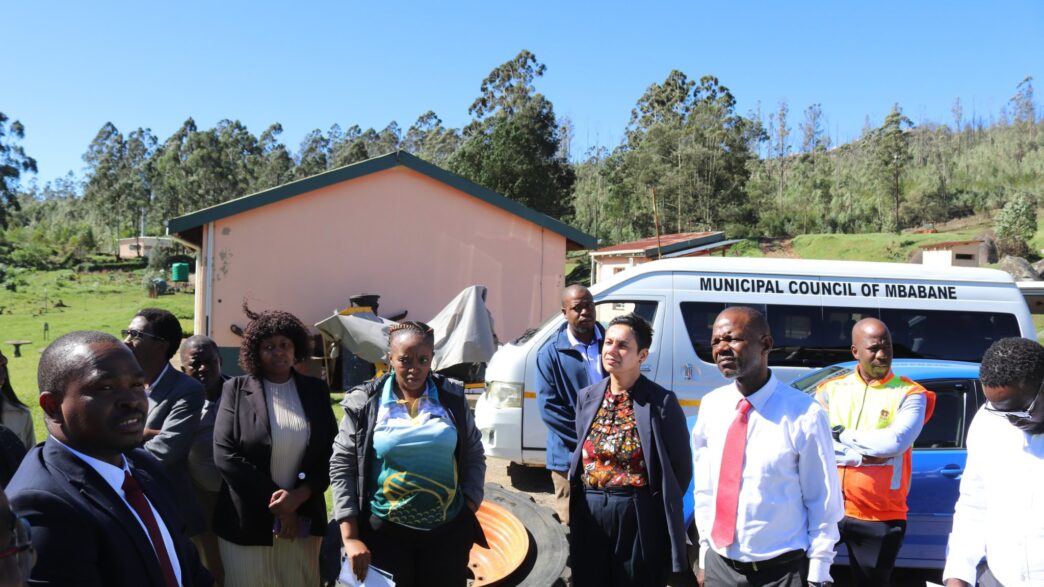
The tour opened in Mbabane at Msunduza Township, where representatives from the Eswatini Housing Board and the Municipal Council of Mbabane walked the team through a township upgrade project previously funded by the World Bank under the Urban Development Project. The project covered infrastructure development within the township and the allocation of plots to give residents security of tenure. Officials also discussed difficulties around collecting municipal rates and managing township affairs.
From there, the delegation moved to the Mbabane Sanitary Landfill, where council officials laid out the facility’s daily operations, the environmental and operational challenges it faces, and the measures being considered to improve waste management across the city. The need for investment in modern waste disposal systems was a central theme of the discussions.
At Ngwenya Town Board, the focus shifted to transport infrastructure. Government plans to revive the country’s rail network were discussed as a strategy to reduce heavy vehicle road traffic, which officials say accelerates the deterioration of the country’s road surfaces. The rail rehabilitation initiative is expected to ease pressure on roads and open up new economic opportunities through better transport connectivity.
In Ezulwini, council representatives presented findings from a traffic study conducted for the town. Among the priority recommendations is a new road connecting the MR103 to the MR3 via the Central route, intended to ease peak hour congestion. A separate project, the widening of the MR103 to dual lanes from Mvutjini to the Eswatini Water Services exit point, was also identified as a critical intervention for improving traffic flow in the area.
The delegation then visited Matsapha Town Council, where officials raised concerns about industrial area traffic congestion, describing it as a major obstacle to investment in what is one of the country’s key economic hubs. Discussions pointed to the need for infrastructure planning to support industrial growth and protect existing and future jobs.
At Mhobodleni township, the team assessed progress on the formalisation of the informal settlement, with particular attention to road upgrades that have already improved accessibility for residents living there.
The final stop was the Manzini Controlled Dumpsite, where local authority officials made the case for urgent funding to establish a proper sanitary landfill and decommission the existing facility. Plans to upgrade the nearby Mangwaneni informal settlement, with environmental risks linked to its current state, were also discussed.