

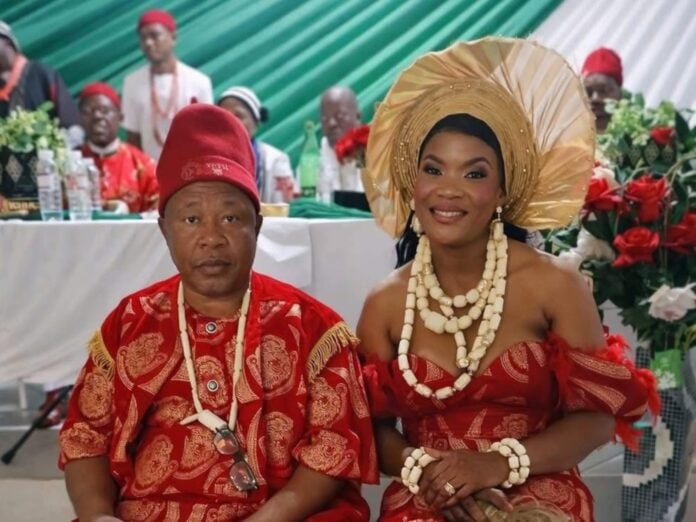
East London, South Africa – The coronation of a Nigerian national as “Igwe Ndigbo Na East London” in the Eastern Cape, South Africa, has stirred debate over traditional leadership, sovereignty and the role of diaspora communities, with warnings that the situation could turn violent if not properly handled.
Traditional expert Isaac Mthethwa said the development raises serious legal and cultural questions, particularly around the recognition of kingship beyond national borders. He cautioned that similar disputes in South Africa have previously escalated into violence between rival factions.
His concern is drawn from incidents where disagreements over traditional authority have led to communities turning against each other, with lives lost over competing claims to leadership. 
Mthethwa explained that while traditional systems are not confined by modern borders, the existence of a recognised Igwe in Nigeria complicates the recognition of another king on South African soil.
“If it’s king, then it might be challenged to say, no, you have an Igwe in Nigeria, so we can’t have two Igwes,” he said.
He noted that South Africa already recognises kingdoms whose leaders reside outside its borders, but said such recognition must be consistent and guided by established frameworks.
Mthethwa added that the situation more closely resembles a chieftaincy rather than kingship, as the individual appears to have a group of followers who recognise his authority. Drawing from history, he cited the example of the Shangaan people who migrated from Mozambique in 1896 and established chieftaincies that were later accepted without legal disputes.
He also pointed out that multiple chiefs from the same lineage can exist across different areas. In Bushbuckridge, he said, one small nation has nearly ten chieftaincies originating from a single ancestor.
On the question of formal recognition, Mthethwa said citizenship could play a role.
“If he has the citizenship, then it qualifies to be recognised by our South African government as a chief, but not as a king,” Isaac said, referencing the Moleleki Commission as a framework that has previously dealt with issues of traditional leadership status.
He warned that the emergence of parallel leadership structures poses a serious risk to stability.
“It’s just bloodshed,” he said. “Some of the chiefs are not sleeping at home, and then some are killing each other in and out.”
Mthethwa said even recognised chieftaincies that receive government support are not immune to internal disputes, and unregulated structures could worsen tensions.
The African Transformation Movement has also raised concern, describing the coronation as a direct challenge to South Africa’s constitutional order.
The party called the event “a direct affront to the sovereignty of the Republic of South Africa, a blatant disregard for our legal framework, and a profound insult to the institution of traditional leadership as recognised under South African law and custom.”
It has urged Eastern Cape Premier Oscar Mabuyane to launch a full provincial investigation, while also calling on Home Affairs Minister Dr Leon Schreiber to probe the immigration status of those involved and determine whether any laws were broken, including possible misrepresentation.
The party further appealed to Minister of Cooperative Governance and Traditional Affairs Velenkosini Hlabisa to act swiftly, stating he must “take immediate steps to protect the integrity of South Africa’s traditional leadership institutions and ensure that no parallel or illegitimate structures are allowed to emerge.”
The African Transformation Movement also called on the Commission for the Promotion and Protection of the Rights of Cultural, Religious and Linguistic Communities, together with the Eastern Cape Department of Traditional Affairs, to urgently investigate the matter and provide clarity on the legality and implications of the coronation.