


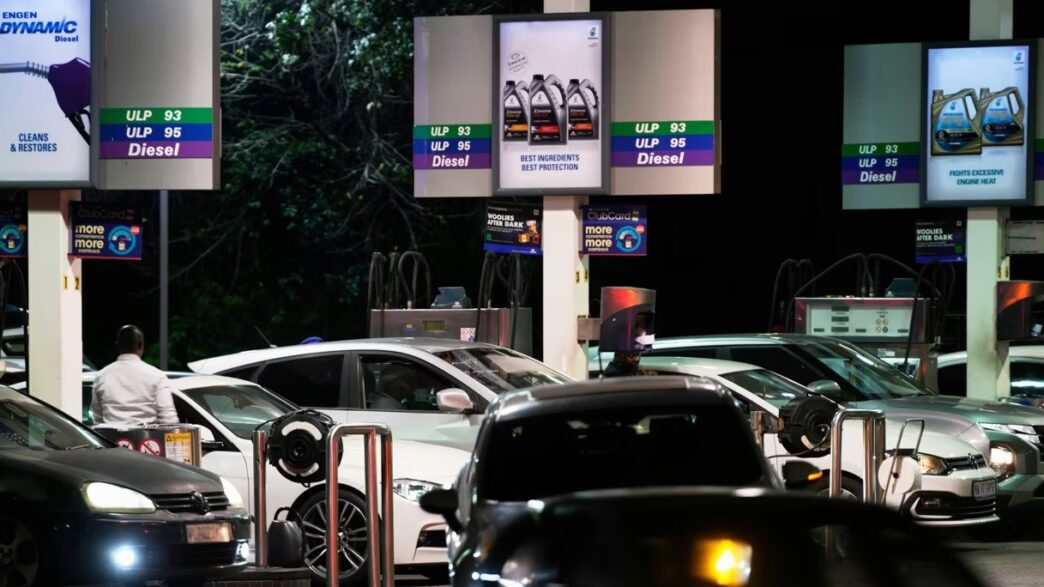
MBABANE – Motorists in neighbouring South Africa will dig deeper into their pockets from Wednesday as sweeping fuel price increases come into force on 1 April 2026.
The announcement was made on 31 March 2026 by the Department of Mineral and Petroleum Resources in Pretoria, confirming monthly adjustments driven by global oil markets, currency movements and domestic levies. The changes are likely to spill over into Eswatini, which sources much of its fuel from South Africa.
According to the department, the sharp increases are largely linked to rising international crude oil prices and ongoing geopolitical tensions between the United States and Iran, which have disrupted supply routes, particularly through the Strait of Hormuz. 
The average Brent Crude oil price surged from 69.08 US dollars to 93.67 US dollars during the review period. International petroleum product prices followed the same upward trajectory, pushing up contributions to the Basic Fuel Price by R5.26 per litre for petrol, R9.49 per litre for diesel and R10.80 per litre for illuminating paraffin.
The rand also weakened against the US dollar, depreciating from an average of R16.00 to R16.64 per dollar. This added 56.18 cents per litre to petrol, 78.07 cents per litre to diesel and 83.21 cents per litre to illuminating paraffin.
From 1 April 2026, petrol 93 and 95 will both increase by R3.06 per litre. Diesel with 0.05 percent sulphur will rise by R7.37 per litre, while diesel with 0.005 percent sulphur climbs by R7.51 per litre. Illuminating paraffin wholesale jumps by R11.67 per litre and the single maximum national retail price for illuminating paraffin rises by R15.60 per litre.
The Maximum Retail Price of LPGas will increase by R1.08 per kilogram nationally and by R1.23 per kilogram in the Western Cape. The Maximum Refinery Gate Price for LPGas imported through the Port of Saldanha Bay will be R14 001.42 per metric ton, while the Maximum Retail Price will stand at R35.07 per kilogram.
Despite the increases, the cumulative slate balance for petrol and diesel stood at a positive R4.93 billion at the end of February 2026. In line with the Self Adjusting Slate Levy Mechanism, the slate levy remains unchanged at zero cents per litre.
Finance Minister adjustments announced during the 25 February 2026 Budget Speech will also take effect. The general fuel levy rises by nine cents per litre for petrol and eight cents per litre for diesel. The carbon levy goes up by five cents per litre for petrol and six cents per litre for diesel. The Road Accident Fund levy increases by seven cents per litre to 225 cents for both petrol and diesel.
As a short term relief measure linked to the US Iran conflict, a temporary reduction of R3.00 per litre in the general fuel levy will apply to petrol and diesel from 1 April until 5 May 2026. During this period, the fuel levy will be 129.0 cents per litre for petrol and 116.0 cents per litre for diesel.
The department also confirmed adjustments to octane differentials between 95 and 93 grades, effective from the first Wednesday of the quarter. Revised road and pipeline transport tariffs have been approved, affecting pricing across 54 magisterial district zones. Annual transport tariff adjustments will range from an increase of 5.7 cents per litre in zones such as 15C and 17C for petrol and diesel and 8.3 cents for illuminating paraffin, to 4.2 cents per litre for petrol and diesel and 2.3 cents for illuminating paraffin in Zone 9C Gauteng.
The full fuel price schedule for the various magisterial district pricing zones was set for publication on Tuesday, 31 March 2026.