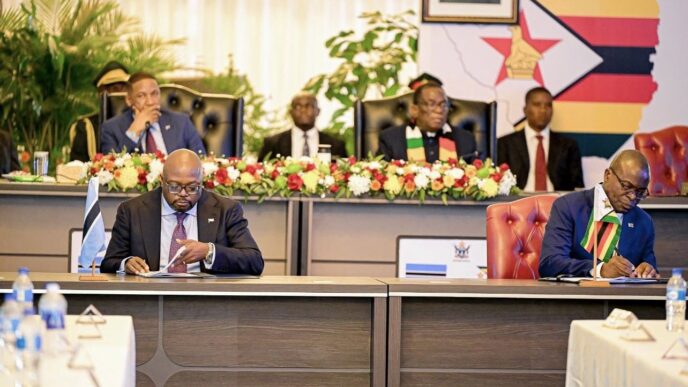


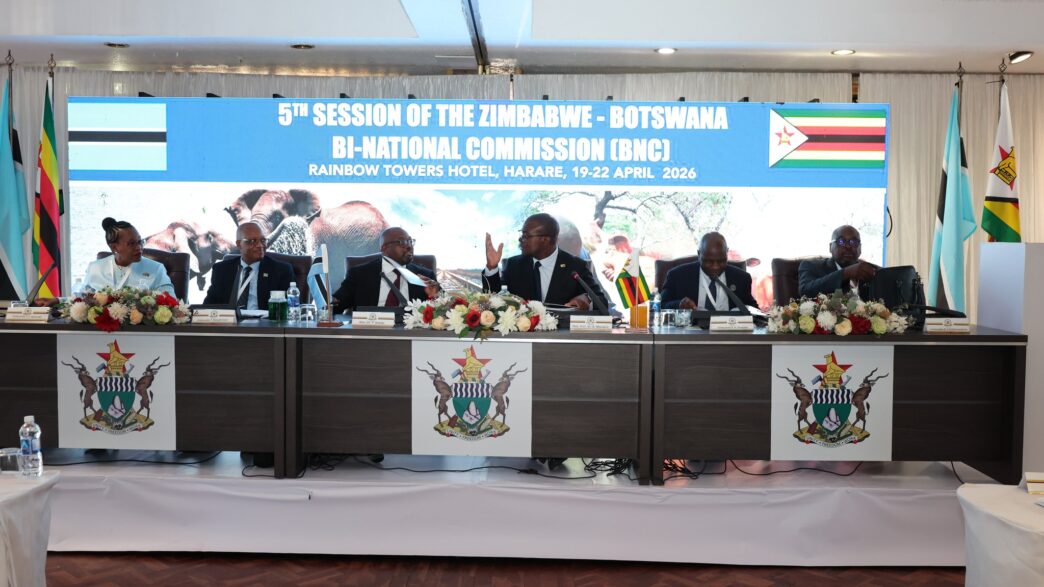
Harare – Zimbabwe and Botswana have renewed their push for deeper economic cooperation, placing citizens at the centre of bilateral policy during the ministerial segment of the 5th Session of the Zimbabwe–Botswana Bi-National Commission (BNC) held in Harare on Tuesday.
The high-level meeting was co-chaired by Zimbabwe’s Minister of Foreign Affairs and International Trade Prof Amon Murwira and Botswana’s Minister of International Relations Dr Phenyo Butale. It brought together ministers and senior officials from both countries to assess progress and chart a forward-looking agenda ahead of a Heads of State meeting scheduled for Wednesday in Harare.
Deliberations focused on trade, tourism, investment, infrastructure and regional integration, with a strong focus on delivering tangible benefits to ordinary citizens. 
Prof Murwira called on the two nations to work together for the benefit of their people.
“We must put our people at the centre of everything we do,” he said, stressing that policies should improve livelihoods rather than create “policy-induced poverty.”
Despite cordial relations and growing cooperation, the two ministers acknowledged that bilateral trade remains below its full potential. Both sides called for the removal of tariff and non-tariff barriers, improved border efficiency and stronger private sector participation to unlock growth.
The upcoming Botswana–Zimbabwe Business Forum, set for Bulawayo, is expected to play a key role in boosting investment flows and strengthening value chains in key sectors such as mining, agriculture and manufacturing.
A notable proposal from the meeting was the call to ease the movement of people across borders, including the possible use of national identity cards as travel documents, a move expected to boost trade, tourism and social integration between the two nations.
“Let our people move freely and participate in economic activities across borders,” Prof Murwira said, pointing to the deep historical and cultural ties between the two countries.
Infrastructure development also featured prominently, with a renewed focus on improving logistics and trade corridors such as the Trans-Kalahari Corridor, which is expected to facilitate the smooth movement of goods and services between the two countries.
Agriculture was also discussed, with the ministerial segment calling for joint efforts to combat transboundary animal diseases including Foot-and-Mouth disease through strengthened veterinary services and research collaboration.
On energy and natural resources, the two countries pledged to move beyond exporting raw materials toward value addition and industrialisation.
“The time of exporting raw minerals is over,” officials said, calling for investment in beneficiation and sustainable processing.
Dr Butale said the BNC has proven an effective platform for advancing cooperation across sectors such as health, education, energy and security, adding that several agreements are expected to be signed during the session to further strengthen the bilateral framework.
As the meeting concluded, both countries stressed the need to move from commitments to implementation, with clear timelines and measurable outcomes. The BNC, established in 2018, continues to serve as a key mechanism for driving economic diplomacy between Zimbabwe and Botswana.