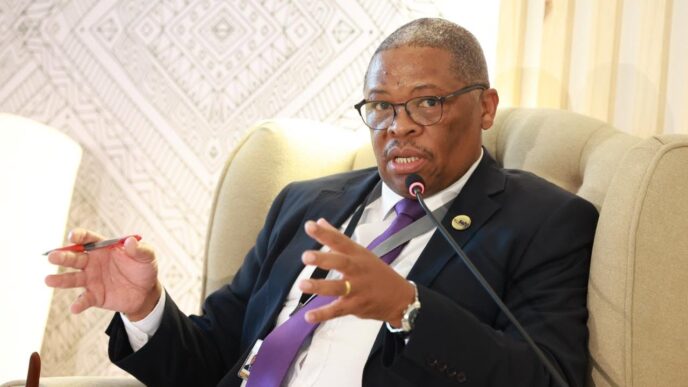




Ezulwini – Central Bank of Eswatini Governor Dr. Phil Mnisi has praised the country’s banking sector after private sector credit climbed to E23.2 billion by the end of March 2026, saying the figure signals that banks are actively channelling funds into the economy rather than chasing non-interest income.
Speaking at the Governor’s Annual Media Engagement Session at Sibebe Resort on Friday, Dr. Mnisi described the growth as a significant achievement when measured against where the sector stood just a few years ago.
“Around 2023, we were sitting and actually stuck at credit to the private sector of about E15 billion. About two or three years later, we are now tripping over the E20 billion mark, which is very good,” he said. 
Total private sector credit grew by 0.9 percent on a month-on-month basis to reach the E23.2 billion figure, with business sector credit recording the strongest performance rising 2.6 percent to reach E12.7 billion.
“Business sector credit recorded a strong performance, increasing by 2.6 percent to E12.7 billion, indicating continued demand for financing by firms and ongoing economic activity,” he said.
The Governor attributed the growth to banks fulfilling their core function of financial intermediation.
“The banks are intermediating. They are taking the deposits and they are putting them out and taking risk. Instead of making money from non-funded income, they are taking risk, intermediating and making money from interest incomes,” he said.
He expressed hope that the increased lending was flowing into capital formation and productive investment rather than consumption.
Dr. Mnisi also reported an improvement in asset quality, noting that the non-performing loan ratio had edged lower, suggesting that while credit risks remain, the overall risk profile of the sector is manageable. The banking sector, he added, remains well-capitalised and resilient.
Reiterating the Central Bank’s position on Eswatini Bank, the Governor said the regulator’s intervention through a consultant and a five-member technical team is designed to restore the institution to financial sustainability and position it for long-term growth.
“We want to assure the public that Eswatini Bank continues to fulfil its mandate as a development-orientated financial institution that supports job creation, economic development and employment,” he said.