

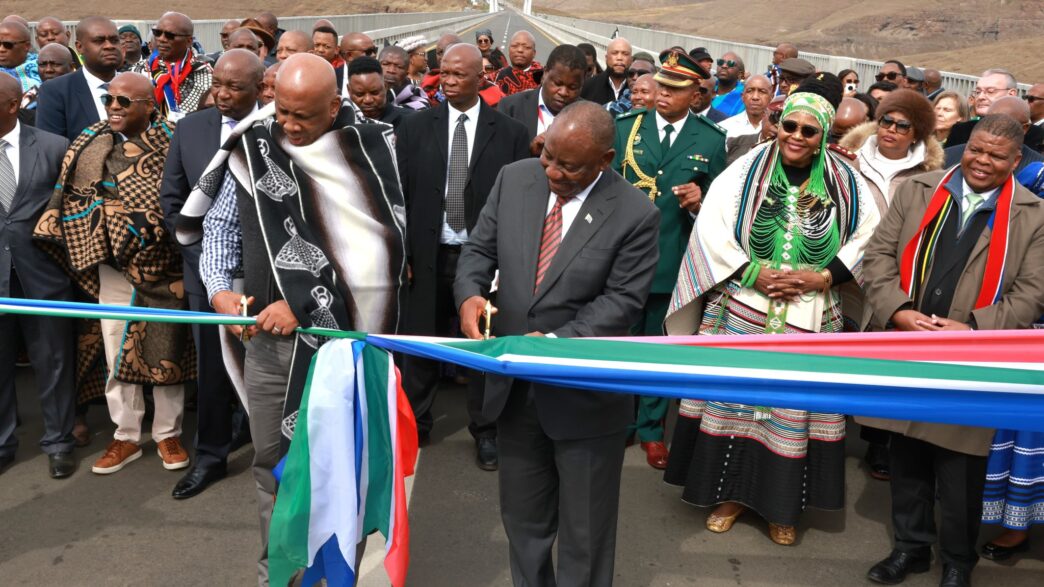
Maseru – South African President Cyril Ramaphosa travelled to Mokhotlong in the Kingdom of Lesotho on Wednesday to officially launch the Senqu Bridge, a major infrastructure milestone built as part of Phase II of the Lesotho Highlands Water Project.
The launch took place in the presence of Lesotho’s King Letsie III and Prime Minister Ntsokoane Samuel Matekane, along with high commissioners, members of the diplomatic corps and representatives of the implementing agencies and joint venture contractors.
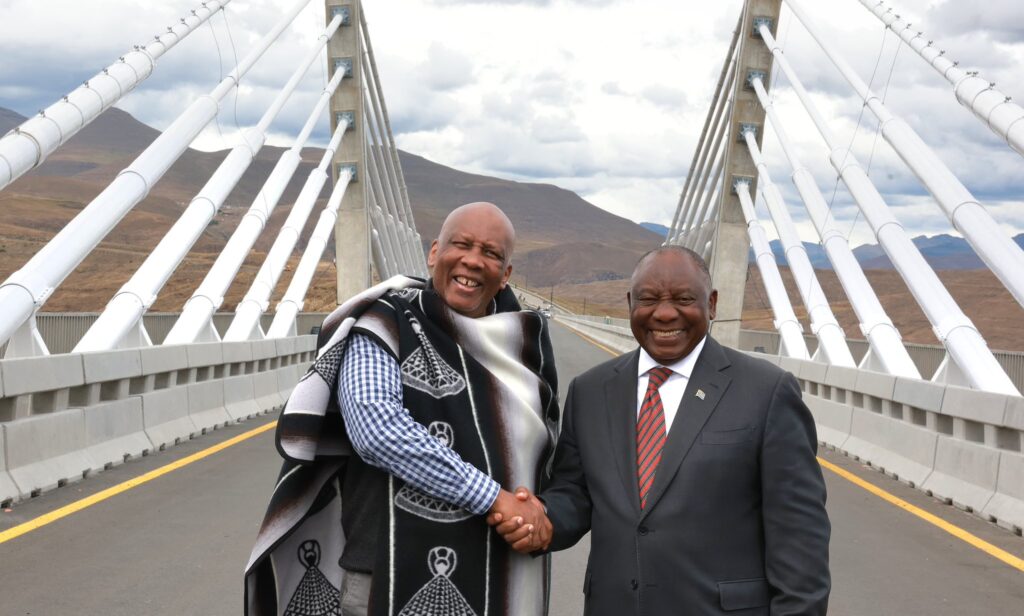
South African President Cyril Ramaphosa and Lesotho King Letsie III share a handshake during the official launch of the Senqu Bridge in Mokhotlong, Kingdom of Lesotho, on April 22, 2026.
The bridge, which sits more than 2,500 metres above sea level, was built to restore and safeguard connectivity for communities that would otherwise be cut off once the Polihali Reservoir is impounded. Together with two other bridges being constructed to span the Polihali reservoir, it will improve travel across the region, making transport easier and cheaper for communities, businesses and visitors. 
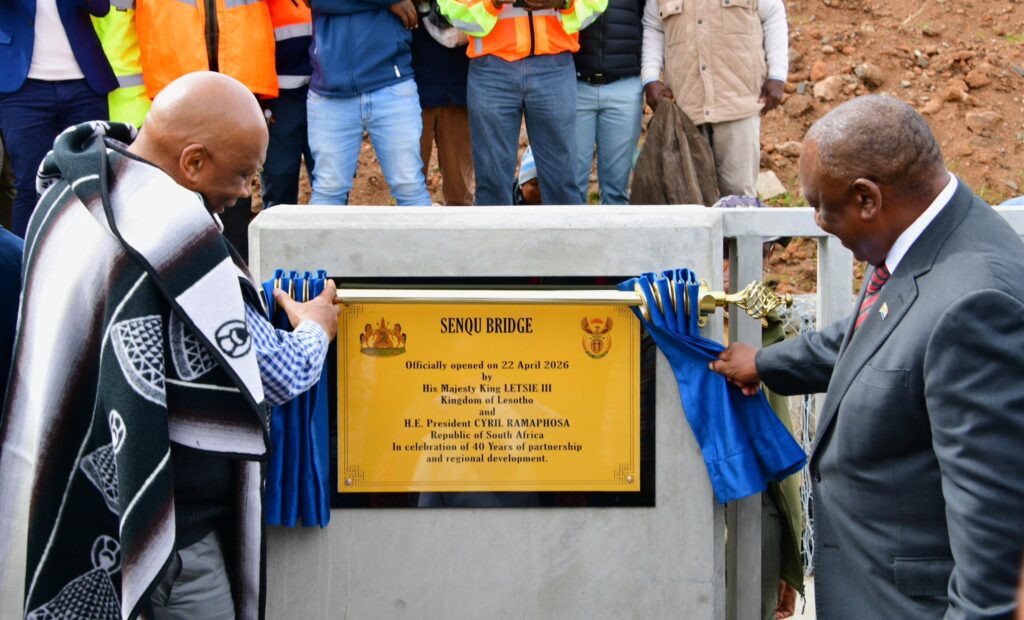
Ramaphosa said the bridge tells a story of determination in the face of complexity, noting that the project had experienced a number of challenges but that the project team stayed focused and worked to ensure that no affected communities or households were left worse off by the construction.
The project created employment for over 1,200 people, most of them Basotho, and employed local engineers, technicians and professionals from both countries. A Young Professionals Programme, now part of the Lesotho Highlands Water Project, is also introducing young graduates to the infrastructure sector.
“The Lesotho Highlands Water Project is one of the most ambitious and successful transboundary water projects in the world. It is the largest investment South Africa has ever made outside its borders,” Ramaphosa said.
He expressed gratitude to Lesotho for making its water resources available to South Africa, describing the waters of Lesotho’s highlands as vital to South Africa’s development.
Ramaphosa also recalled that in April last year, he and Prime Minister Matekane co-chaired the 2nd Session of the Bi-National Commission in Maseru, where six bilateral agreements were signed covering water and energy, capacity building and skills development, defence and social development.
He announced that South Africa would provide humanitarian assistance to Lesotho worth R30 million from the African Renaissance Fund to help the kingdom strengthen its national response to HIV and tuberculosis, amid dwindling levels of international humanitarian assistance.
“This project is more than infrastructure. It is more than steel and concrete. It is a symbol of a deep and enduring partnership,” Ramaphosa said.
He called on all implementing agencies, contractors and oversight structures to complete the Polihali Dam and Tunnel on time, within budget and to the highest standards.
The Senqu Bridge was built under a treaty signed on October 24, 1986 between the governments of South Africa and Lesotho, which established a permanent framework for cooperation covering roles, responsibilities, governance systems, cost sharing arrangements and dispute resolution mechanisms.
The project’s governance model is centred on the Lesotho Highlands Water Commission, the Lesotho Highlands Development Authority and South Africa’s Trans-Caledon Tunnel Authority, which provide joint oversight and accountability. For South Africa, the project delivers secure, gravity-fed water supply to its economic heartland. For Lesotho, it brings hydropower generation, infrastructure investment, royalties, employment and skills development.
Ramaphosa closed his address with a message of solidarity, saying South Africans and Basotho would forever be bound together, shaped by a common destiny grounded in history, geography, language and culture.
“Together, we are building bridges to the future,” he said.