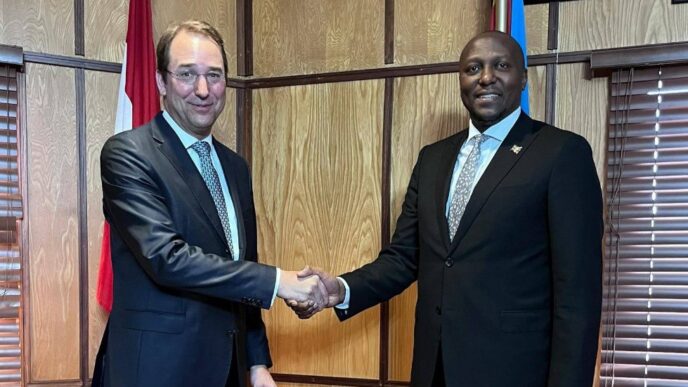


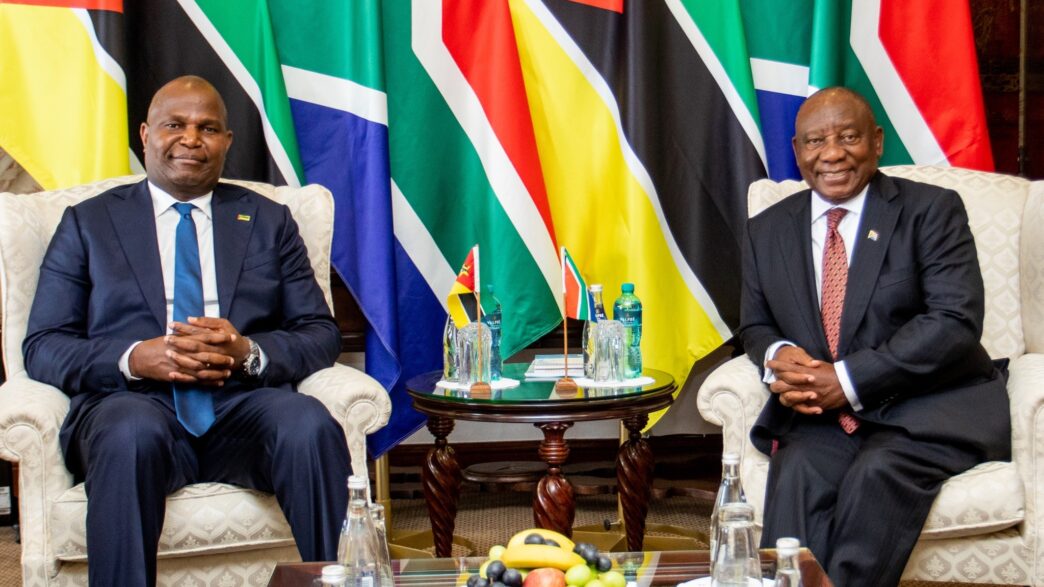
Pretoria – Mozambican President Daniel Chapo travelled to Pretoria this week to meet South African President Cyril Ramaphosa, as the two governments join forces to tackle a surge in xenophobic attacks targeting foreign nationals, including Mozambicans, across several South African cities.
The visit was confirmed by Mozambique’s Secretary of State for Foreign Affairs, Maria de Fátima Manso, who spoke to reporters on Monday in Maputo. She said the meeting was aimed at assessing the situation and seeking joint solutions that guarantee peaceful coexistence, amid growing tension in several South African cities where foreign communities have been the target of protests and threats of expulsion.
Today’s working visit with His Excellency President Daniel Francisco Chapo of the Republic of Mozambique gave us both a great opportunity to have extensive discussions on matters of mutual interest and explore ways to deepen cooperation between our two countries. pic.twitter.com/5aBgUs45LN
— Cyril Ramaphosa 🇿🇦 (@CyrilRamaphosa) May 5, 2026
“The government has been monitoring the situation for about two weeks, after the emergence of groups of South African citizens who began demonstrations against the presence of undocumented foreigners,” Manso said.
The secretary said xenophobic acts have been taking place with greater intensity in Durban. “Over 300,000 Mozambicans reside in South Africa. At this delicate moment, they are facing terror, fear, and uncertainty about their future,” she said.
Despite the tense atmosphere, Manso said the Mozambican Embassy in South Africa “has not yet registered any deaths, physical assaults, or loss of property of Mozambican citizens resulting from these demonstrations.”
She warned, however, that messages calling for protests in Cape Town, Johannesburg, Pretoria and Durban have been circulating on social media, raising the level of alert among authorities.
The anti-migrant protests, which have been recurring in recent months, have been directed primarily at black Africans living in informal settlements, with incidents of looting, displacement, harassment and deadly riots reported. South African political parties Action SA and the Inkatha Freedom Party have also joined some of the demonstrations, claiming they are protesting against undocumented migrants.
Mozambican Defence and Security Forces are coordinating with South African police to monitor the situation, with plans to reinforce the police and military contingent to contain the demonstrations and prevent outbreaks of violence.
“Given the situation, the governments of Mozambique and South Africa are in regular contact with a view to mitigating the impact of these demonstrations. The government is creating conditions near the Ressano Garcia border to welcome national citizens who, for security reasons, wish to return to the country,” Manso said.
United Nations Secretary-General António Guterres has expressed his “deep concern at the reports of xenophobic attacks and acts of harassment and intimidation against migrants and foreign nationals.”
During the Pretoria talks, Ramaphosa and Chapo also covered broader bilateral matters, including cooperation on energy, transport and logistics, as well as efforts to combat transnational organised crime.
“We’ve had very extensive discussions on matters of mutual interest spanning the economy, security, as well as social issues. We also looked at how we can deepen co-operation at an investment level, and addressed issues of restrictions that have been introduced,” Ramaphosa told the media.