

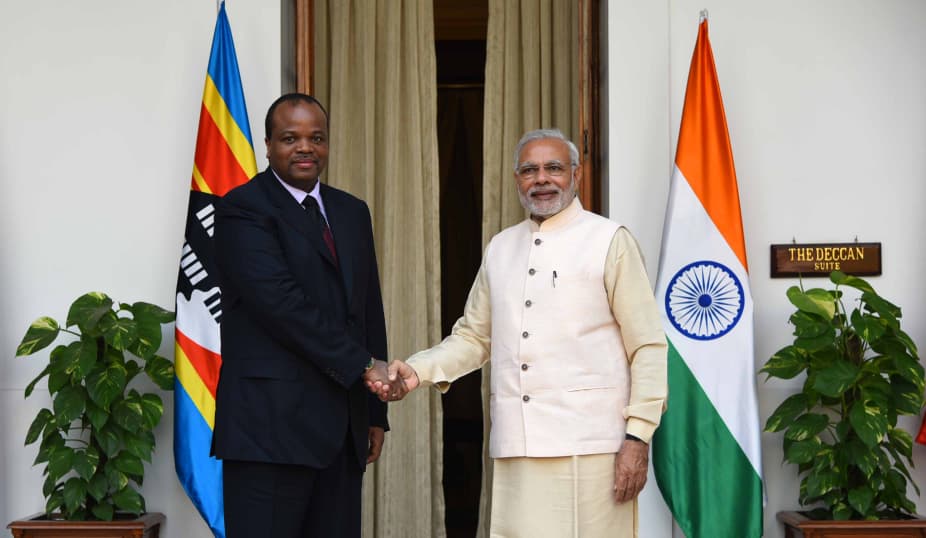
When leaders from across Africa gather in New Delhi on 31 May 2026 for the Fourth India–Africa Forum Summit (IAFS‑IV), they will not just be attending another high‑level meeting, they will also be helping to decide what kind of development model the Global South wants for itself in an increasingly fractured world. For the Kingdom of Eswatini, this is more than a diplomatic calendar event—it is a chance to align a long‑standing partnership with India to His Majesty King Mswati III’s fast‑paced “Nkwe” mandate for transformation at home.
The India–Africa Forum Summit process, launched in 2008 in New Delhi, emerged from a recognition that ad‑hoc outreach was no longer enough and that Africa needed a structured, co‑owned mechanism to manage its engagement with India. Subsequent summits in Addis Ababa in 2011 and New Delhi in 2015 produced detailed frameworks for cooperation, covering economic growth, political dialogue, science and technology, social development, infrastructure, tourism and media, all negotiated with African inputs rather than simply exported from New Delhi.
India backed these frameworks with serious commitments: at IAFS‑III in 2015, it announced US$10 billion in new concessional lines of credit and expanded scholarship and training programmes for African partners, signalling that this was a long‑term, institutional partnership rather than a one‑off gesture. Over time, the IAFS process has become the principal South–South platform through which African states collectively engage India, complementing bilateral ties and regional organisations instead of competing with them. 
In 2018, speaking to the Parliament of Uganda, Prime Minister Narendra Modi distilled India’s Africa policy into ten guiding principles that now form the political bedrock beneath initiatives like IAFS‑IV. He pledged that Africa would remain at the top of India’s diplomatic priorities and that New Delhi’s development partnership would be firmly guided by African priorities, implemented on terms that liberate African potential rather than constrain it, with an emphasis on local capacity and jobs. India would keep its markets open to African goods, support its companies to invest responsibly, and use its experience with the digital revolution to expand public services, education, health and financial inclusion across the continent. Prime Minister Modi also committed India to stand with Africa for a conflict‑free continent, cooperate closely on counter‑terrorism, cyber security and peacekeeping, uphold an open and inclusive Indian Ocean, prevent Africa from becoming a theatre of great‑power rivalry, and work jointly for a just, representative and democratic global order in which Africa enjoys an equal place—principles that the IA SPIRIT theme now translates into an operational agenda for IAFS‑IV.
IAFS‑IV comes at a moment when Africa and India face a common set of pressures—from supply‑chain disruptions and climate shocks to debt vulnerabilities and geopolitical rivalries that often leave developing countries bearing the heaviest costs. External Affairs Minister Dr. S. Jaishankar in his speech at the launch of the IAFS-IV website has succinctly summed up the India–Africa partnership as “a message of stability in a turbulent world, of reliability in an uncertain one, and of solidarity in difficult times,” underlining that Africa now occupies a central place in India’s foreign policy calculus.
The summit, to be held in New Delhi from 28 to 31 May with leaders‑level engagement on 31 May, will culminate in a New Delhi Declaration setting out the main pillars of cooperation for the coming decade. It builds directly on the African Union’s admission into the G20 during India’s presidency, a move that both sides present as evidence that the Global South can reshape global governance when it acts in concert.
The chosen theme for IAFS‑IV, “IA SPIRIT: India Africa Strategic Partnership for Innovation, Resilience, and Inclusive Transformation”—is more than an acronym, rather it is an attempt to rewrite the grammar of development cooperation itself. External Affairs Minister Dr.S.Jaishankar has stressed that “IA-SPIRIT” captures the essence of a relationship that goes beyond transactions, and is marked by shared values, mutual respect, solidarity and collaboration.
Each word in the theme speaks directly to African priorities. Innovation refers to digital public infrastructure, fintech and new technologies, where India is beginning to share its experience with digital identity, payments and e‑governance as global public goods. Resilience points to climate adaptation, health security and economic diversification, areas where African states are seeking partners willing to back local strategies rather than impose external blueprints. Inclusive transformation insists that growth must create decent jobs, empower youth and women, and avoid the extractive patterns that have often characterised North–South resource trade.
For Eswatini, already collaborating with India in agriculture, ICT, health and renewable energy, this thematic framing is strikingly close to its own domestic agenda. The “IA SPIRIT” theme therefore offers the Kingdom a vocabulary and a framework through which to project national priorities on a continental stage.
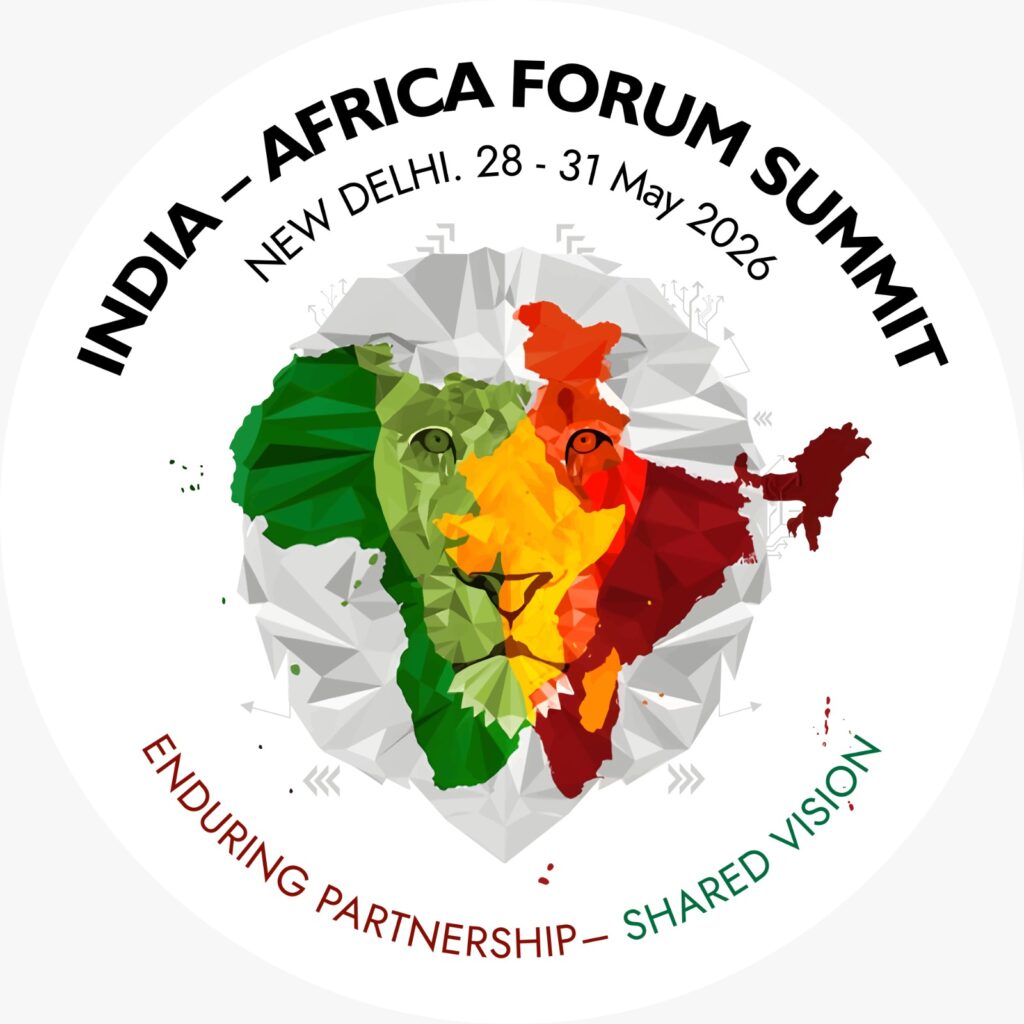
The IAFS‑IV logo, unveiled in April 2026, depicts a lion straddling the intertwined outlines of India and Africa, with the tagline “Enduring Partnership – Shared Vision.” In his speech, External Affairs Minister Dr.S.Jaishankar has described the lion as symbolising “pride, courage and a shared identity,” while the conjoined maps evoke an older geological memory of the two lands as part of one supercontinent, now reunited in purpose.
For Eswatini, this imagery carries an added layer of meaning. The King of Eswatini His Majesty King Mswati-III is formally titled Ngwenyama “lion” in an honorific sense—and the lion is entrenched in the Kingdom’s political and cultural symbolism. The lion stands for strength, guardianship and dignified leadership, invoked in royal praise‑poetry, ceremony and the iconography of state. When emaSwati see a lion anchoring the IAFS‑IV logo, they are therefore not just seeing a generic African animal—they are seeing the same metaphor they reserve at home for the apex of authority and protection. The logo’s lion, intended to capture a shared India–Africa identity, thus resonates deeply with Eswatini’s own understanding of leadership as a protective and unifying force.
The broad pillars defining India-Africa partnership as envisaged in the IAFS-IV are:
First, development partnership through concessional finance and grants remains central, building on earlier lines of credit that have funded power plants, agriculture schemes, ICT infrastructure and water projects across Africa.
Second, trade and investment cooperation seeks to shift from raw commodity exports towards value addition, regional value chains and manufacturing that creates local jobs and capabilities.
Third, human resource development—in the form of ITEC training, ICCR scholarships, e‑learning and new educational institutions—is treated as the backbone of long‑term transformation.
Fourth, digital public infrastructure and technology have emerged as signature areas, with India sharing its experience in digital identity, payments and e‑governance to help African countries “leapfrog” older systems.
Fifth, green and blue economy cooperation—renewables, climate‑smart agriculture, climate resilience and sustainable use of oceans and biodiversity—is gaining prominence, supported by initiatives like the International Solar Alliance.
These pillars are not abstract from Eswatini’s perspective but they map closely onto the sectors where India is already present in the kingdom.
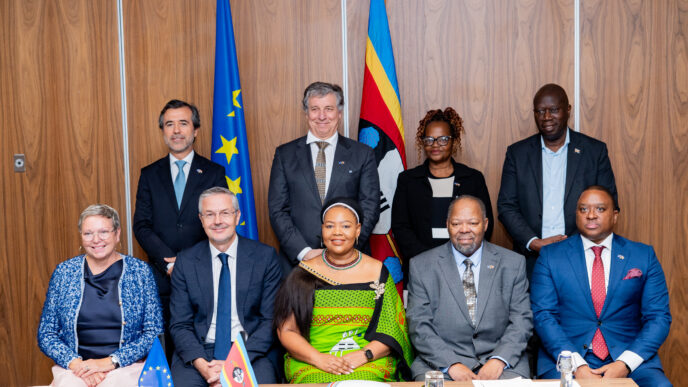
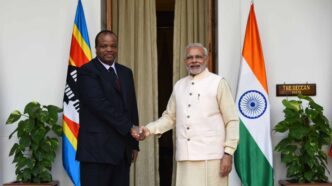
Diplomatic relations between India and Eswatini date back to 1970, but the relationship has deepened significantly in the last decade, especially since India opened a resident High Commission in Mbabane in 2019. Eswatini reciprocated by opening a mission in India in 2025, underscoring the importance it places on the partnership and, by extension, on the IAFS framework that structures much of India’s Africa policy.
At the project level, Eswatini has been a tangible beneficiary of India’s development partnership. The Royal Science and Technology Park was built with a US$ 20‑million Indian line of credit and stands as a flagship example of knowledge‑driven cooperation in the ICT sector. An agriculture development and mechanisation project financed through a US$ 37.9 million line of credit has strengthened maize productivity and food security, directly advancing Eswatini’s food security goals. India has also supplied substantial grant‑based support, including a US$ 1 million cash grant to Eswatini’s National Disaster Management Agency, food aid in the form of rice and beans, and medicines and equipment worth around three million US dollars, along with 20,000 Covid‑19 vaccine doses during the pandemic.
Human resource development has been equally important. Over 400 Emaswati officials have undergone training under the ITEC programme, with 166 participating in nine e‑ITEC courses tailored to Eswatini’s needs during the pandemic. From AI and ICT to public administration and health, these courses have created a cadre of professionals able to support the Kingdom’s own transformation agenda.
If the lion symbol in the IAFS‑IV logo resonates with Eswatini’s understanding of Kingship, the summit’s substantive agenda dovetails neatly with His Majesty King Mswati III’s “Nkwe” mandate at home. In recent years, His Majesty has explicitly called for adoption of the new ethos of Nkwe—an imperative for agile, timely execution of development programmes. Government policy documents describe the Nkwe mandate as a call for accelerated, decisive delivery to stimulate fast, inclusive economic growth, eradicate poverty, create employment, and strengthen infrastructure, health and education systems. The Government Programme of Action for 2024–2029 explicitly frames itself as operationalising the Nkwe mandate, targeting transformative growth and positioning Eswatini as a tourism and conferencing hub, an energy and mining player, and a knowledge‑driven economy.
In Parliament and in national planning documents, “agile (‘Nkwe!’) execution of the Economic Transformation Strategy” is emphasised as critical to attracting investment and creating a business‑ready environment, anchored in infrastructure development, integrity in public life and strong family and cultural values. The National Development Plan 2023/24–2027/28, still rooted in Vision 2022’s goal of joining the top 10 per cent of medium human‑development countries, foregrounds good governance, human capital development, infrastructure and green growth as the levers for changing the country’s trajectory.
Seen through this lens, IAFS‑IV is not a diversion from domestic priorities but a potential accelerator of Nkwe. Its focus on innovation, digital infrastructure, green growth, industrialisation and human capital is exactly where Eswatini’s own strategies are trying to move—only faster. The summit offers an opportunity to Eswatini to:
- Secure new lines of credit and investments that support Nkwe‑aligned mega projects in infrastructure, agriculture, manufacturing and services.
- Expand access to Indian expertise and technology in digital governance, fintech and AI, complementing initiatives like the Artificial Intelligence Academy launched at the University of Eswatini.
- Deepen cooperation in renewable energy through platforms such as the International Solar Alliance, consistent with Eswatini’s green‑growth component of its National Development Plan.
In essence, Nkwe is about speed and seriousness in implementation and IAFS‑IV is a platform to mobilise the partnerships and resources that make that speed possible.
The second India–Eswatini Foreign Office Consultations in Mbabane in February 2024 reviewed cooperation in agriculture, education, health, digital technology, renewable energy, defence and culture, and both sides agreed to deepen engagement across these sectors. With a resident mission in each other’s capitals and a dense web of existing projects, the bilateral relationship is well‑positioned to absorb and act on whatever new frameworks and funding mechanisms IAFS‑IV produces.
For Eswatini, the most productive approach to the summit will be to treat it not as a ceremonial gathering but as a working platform to align Nkwe‑driven national strategies with the India–Africa agenda. That means going to New Delhi with a clear set of proposals in sectors where cooperation has already shown results—agriculture mechanisation, ICT and data governance, public health, education and skills, renewable energy, and infrastructure—while also identifying new niches such as critical minerals, regional value chains and conferencing tourism where India and Eswatini can innovate together.
By leveraging regional bodies like SADC, SACU and COMESA, Eswatini can also ensure that IAFS‑IV outcomes on trade facilitation, infrastructure corridors or digital connectivity align with its regional integration ambitions.
Ultimately, the significance of IAFS‑IV—for Africa in general and Eswatini in particular—will be measured less by the eloquence of its declarations and more by the pace and quality of delivery that follows. The lion on the summit logo, mirrored in Eswatini’s own royal and national symbolism, evokes pride, courage and shared identity; the IA SPIRIT theme speaks to a partnership rooted in innovation, resilience and inclusive transformation; the Nkwe mandate demands urgency, focus and results.
If these three strands can be woven together—symbolism, strategy and execution—IAFS‑IV can help ensure that the India–Africa story is not just about projects on paper, but about real changes in the everyday lives of Africans and emaSwati: better roads and hospitals, more reliable power, thriving farms, dignified jobs for young people, and digital public systems that treat citizens with efficiency and respect.
For Eswatini, this summit is a chance to show that a Kingdom with a big vision can use global partnerships to move at a blistering pace set by Nkwe—and in doing so, help define what a lion‑hearted, South–South development model looks like in practice.