

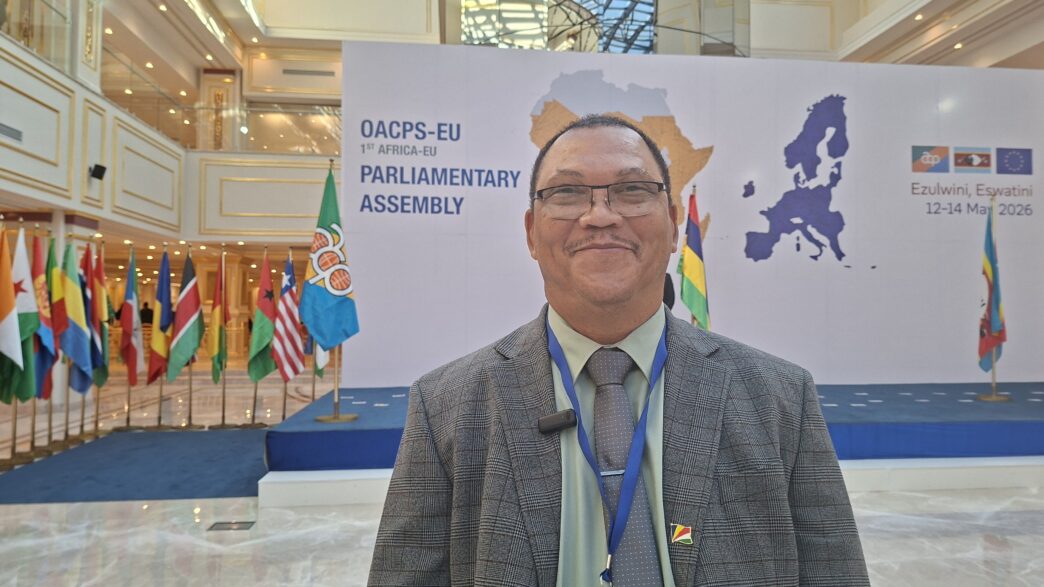
Ezulwini – A Seychelles lawmaker has called out what he describes as deep hypocrisy in the global climate change framework, warning that small island nations are being left to bear the consequences of a crisis they did little to create.
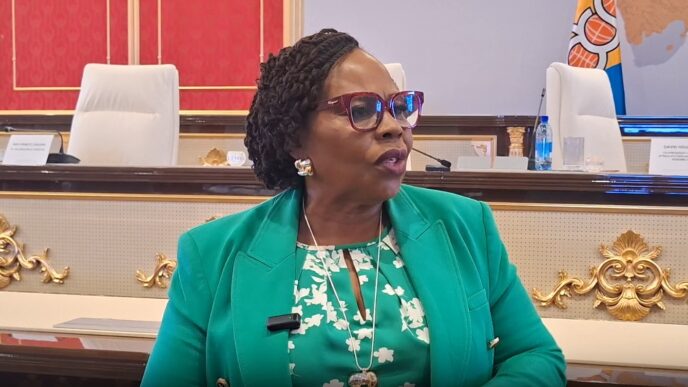
Hon. John Hoareau, a directly elected Member of the National Assembly of the Republic of Seychelles representing the minority party Linyon Demokratik Seselwa for the Beau Vallon constituency, spoke to Swazi24 on the sidelines of the OACPS-EU Parliamentary Meetings held at the ICC Ezulwini Palazzo in Eswatini. Hoareau, who was sworn in for his third parliamentary mandate on 28 October 2025, was attending the session for the first time.
“There’s a lot of hypocrisy about this issue of climate change,” he said. “We are conserving, we are doing our best, and yet we face a situation where if the global temperature continues to increase above 1.5 degrees Celsius, we would find ourselves losing more than 50% of our territory.” 
Hoareau explained that Seychelles has committed under the Paris Agreement to preserving up to 30% of its exclusive economic zone by 2030, setting aside areas rich in seagrass beds, underwater vegetation capable of absorbing carbon dioxide at roughly ten times the rate of land plants. The idea was to sell carbon credits on the international market, given that Seychelles produces far less carbon than it absorbs.
But the arrangement, he said, comes with a heavy cost. “When we declare protected areas for a particular duration, we cannot touch these areas. We lose them. We lose sovereignty over our own territory,” he said, adding that carbon credits effectively hand a blank cheque to large polluting industries to keep operating while small nations sacrifice their natural resources.
His frustration extended to the fishing industry. He said that for 45 years, the European Union has been fishing in Seychelles waters under an agreement that was supposed to eventually give the island nation its own fleet and canning capacity. That transfer of technology and financing never happened.
“We get peanuts for our resources. We have been getting 3% in revenue, and we have been trying so hard to get 30% based on inflation. We haven’t succeeded,” he said. He used a straightforward comparison to drive the point home: if a commodity valued at $100 doubles in value due to inflation but the revenue share stays at 3%, the real return shrinks even as the resource becomes more valuable.
Hoareau said Seychelles forms part of the 158 million people worldwide who live on low-lying coastal islands, and that the threat is not abstract. “It concerns the future generation. It concerns the loss of territory, the loss of sovereignty, and the very survival of our people,” he said.
He added that the international conversation has shifted away from solving the problem to managing it. “They know this issue will eventually happen at one point. Now they are talking about how we can mitigate. If we can get money to mitigate these situations, then probably we’ll stand a chance to survive or to keep our islands, maybe by building a levee around the island to prevent water from flooding in.”
On his visit to Eswatini, Hoareau said he was impressed by what he saw. “It’s a very beautiful place. I’m impressed with the cleanliness of Eswatini compared to its neighbours. It’s a progressive society. I could see a lot of development happening. The people are very gentle, very nice people to talk to.”
He also acknowledged that the Seychelles delegation faced coordination challenges during the meetings after their ambassador did not accompany them, leaving the lawmakers without access to key diplomatic briefings. He said they would return home and engage the Ministry of Foreign Affairs directly, including using formal diplomatic channels to lodge their concerns about resolutions and commitments made at the OACPS level.