

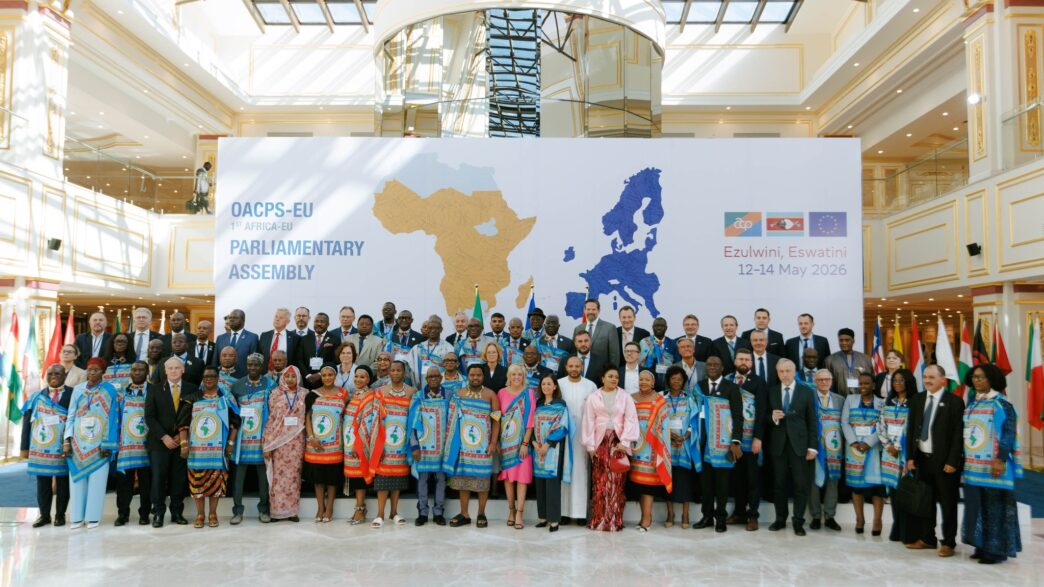
Ezulwini – Eswatini last week hosted a landmark gathering of African and European lawmakers, when the first ever Plenary Session of the Africa-EU Parliamentary Assembly convened in the Ezulwini Valley from 12 to 14 May 2026.
A total of 135 parliamentarians from European Union member states and African countries that are signatories to the Samoa Agreement spent three days debating shared priorities, alongside representatives from regional organisations, international institutions and civil society.
The session closed with the adoption of a joint political recommendation to be submitted to the Africa-EU Council of Ministers, intended to shape the future direction of the Samoa Agreement and strengthen ties between the two continents. 
The recommendation covered several key areas. On peace and security, delegates called for stronger joint efforts against terrorism, illegal arms flows and conflict financing, with particular attention to eastern Congo, the Sahel and Sudan. The assembly also called for an urgent resolution to the war in Ukraine, with the European Parliament reaffirming its condemnation of Russia’s aggression.
On trade, the assembly pushed for a new model of economic relations, particularly around critical minerals and agriculture, aimed at creating jobs, skills and industrial growth across sub-Saharan Africa and the EU. Delegates also agreed on the need to expand youth exchanges, academic pathways and skills programmes to connect students, researchers and entrepreneurs across both regions.
Women’s participation in political, economic and social life was also addressed, as was the need to develop cultural partnerships and creative industries that deliver real benefits to ordinary citizens.
A joint working group on raw materials and critical minerals was established and will be co-led by African and European representatives.
EU Co-President MEP Hilde Vautmans of Belgium said the week in Eswatini had brought the spirit of the Samoa Agreement to life.
“The EU-Africa partnership is not a luxury nor diplomacy for its own sake; it is a strategic necessity,” she said.
“Peace must remain our foremost priority. Too many conflicts continue to destroy lives and undermine the future of younger generations. The ongoing violence in the Democratic Republic of Congo, where civilians continue to suffer from grave human rights abuses and where sexual violence has been used as a weapon of war for far too long. The situation across the Sahel and in Sudan demonstrates that instability in one neighbouring region quickly becomes instability everywhere,” Vautmans said.
She added that the European Parliament delegation of 30 members had actively worked to lay the foundations for genuine legislative dialogue with their African counterparts.
“As a first concrete step, we have agreed to establish a working group on critical minerals, which I will co-chair. These resources have too often fuelled conflict, and over the coming year we will focus on developing common rules to ensure a sustainable and fair market,” she said.
Vautmans closed by drawing on Eswatini’s national symbols.
“As we conclude this Assembly in the Kingdom of Eswatini, we are reminded of its symbols: the lion, representing strength, and the elephant, representing wisdom and historical memory. These are qualities we must embrace ourselves, for they will be crucial to the effectiveness and lasting success of our Africa-Europe cooperation,” she said.
OACPS Co-President Hon. David Houinsa described the session as a turning point in the relationship between Africa and the EU.
“Today marks an important step in the evolution of relations between the OACPS Africa region and the European Union. For the first time, parliamentarians from our two regions have met within this new institutional framework established under the Samoa Agreement, with the shared responsibility of shaping a more balanced, forward-looking and strategic partnership,” he said.
Houinsa noted that 41 out of 48 OACPS Africa Region member states participated in the inaugural session, which he said reflected the collective commitment to making the assembly a meaningful platform.
“Africa stands at a decisive moment in its development journey. It is no longer seeking to be viewed simply as a market of consumption, but as a continent of transformation, innovation and economic power,” he said.
“The successful conclusion of this first Plenary Session, including the adoption of a joint recommendation to be addressed to the Africa-EU Council of Ministers, is a concrete and encouraging achievement. It shows that parliamentary diplomacy can help build trust, strengthen dialogue and translate our common priorities into practical outcomes for our peoples,” Houinsa added.
He also noted that the assembly condemned recent attacks in Chad and Mali and reaffirmed solidarity with affected communities.