

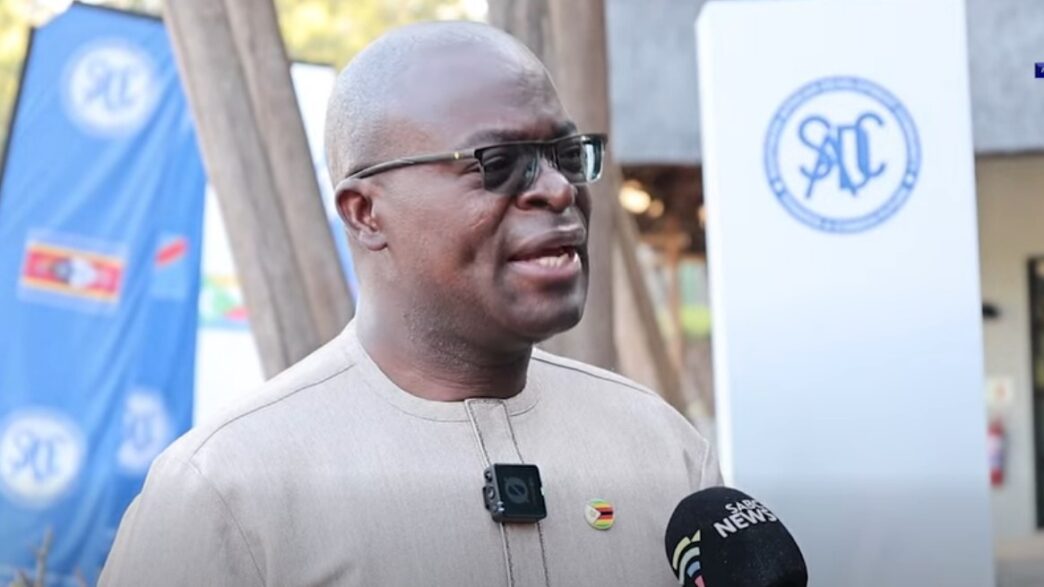
Skukuza – Zimbabwe’s Minister of Foreign Affairs and International Trade, Professor Amon Murwira, has called on Southern African nations to deepen regional integration and build strong collective architectures for security, economic growth and social cohesion, speaking at the SADC Retreat of Ministers of Foreign Affairs held at Kruger National Park in South Africa.
Reflecting on the founding vision of the Southern African Development Community, Prof. Murwira said the bloc was built for a common future rooted in prosperity, and that achieving that prosperity required the right configuration of systems and institutions.
“When SADC was formed by our founders, it was formed for a common future. And what does that common future look like? That common future must look like prosperity. And that prosperity is an intention. It has to be achieved through correct capabilities. And correct capabilities are ensured through correct configuration. So what is the correct configuration? The correct configuration is about a common security architecture, a common economic architecture, and a common social architecture. This is what SADC stands for,” he said. 
The minister traced SADC’s origins back to its predecessor, the Southern African Development Coordination Conference, which was formed to coordinate resistance against apartheid and help bring democracy to South Africa and Namibia. He said the bloc had always been designed to navigate turbulence, and that the current moment called for moving from words to action.
“This is a watershed moment where we are saying thoughts have to be connected with speech, and speech has to be connected with action,” he said.
Prof. Murwira pointed to the region’s vast natural wealth as a foundation for transformation, noting that SADC holds around 30 percent of the world’s critical minerals, along with significant energy resources, fertile agricultural land, good climate conditions and strong tourism potential.
“We have everything. We have the people. We have the will,” he said.
On regional integration, he cited existing frameworks such as the Southern African Power Pool and common road standards as examples of what collective action could look like, calling for deeper connections in economic activity, investment and the movement of people.
The minister pushed back against the idea that migration within the region constitutes a crisis, arguing that the movement of people has always been a natural part of how economies function.
“People have been moving. It’s how they move and how we regulate movement. The root cause of movement is either opportunity or push and pull. But at the end of the day, when we assure common prosperity, the movement will be for good because people move with food and people move with money, and that’s how economies function,” he said.
He warned against allowing fear-driven language to shape the region’s thinking, saying the framing of issues as crises could be counterproductive.
“Crisis should not be in our head. Control your thoughts, your thoughts will control your speech, your speech will control your actions. Be careful what you say, whether it’s a crisis or a phenomenon. What is our intention? Our intention is prosperity,” he said.
Prof. Murwira closed with a vivid analogy about the nature of transformation, arguing that change imposed from outside destroys rather than builds.
“Just imagine an egg. If an egg is transformed from outside, the chick doesn’t come out. You break the egg. But if transformation comes from within, it brings chicken. So we are basically sitting here to look into ourselves, to transform ourselves, so that we have a common policy on how to deal with the outside world,” he said.