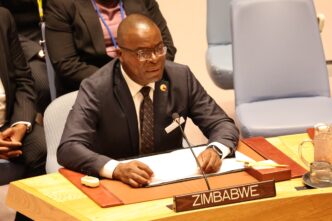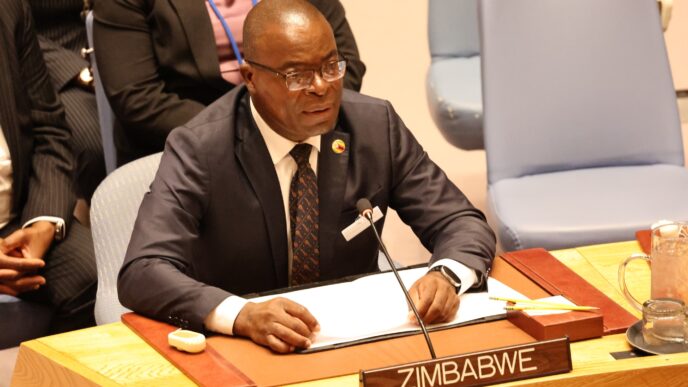


New York – Zimbabwe’s Minister of Foreign Affairs and International Trade, Professor Amon Murwira, attended the Group of Friends on Global Governance meeting at the United Nations in New York on Thursday, 28 May 2026, using the platform to advance the country’s bid for a non-permanent seat on the UN Security Council for the 2027 to 2028 term.

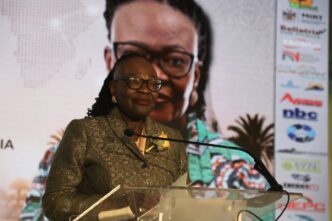
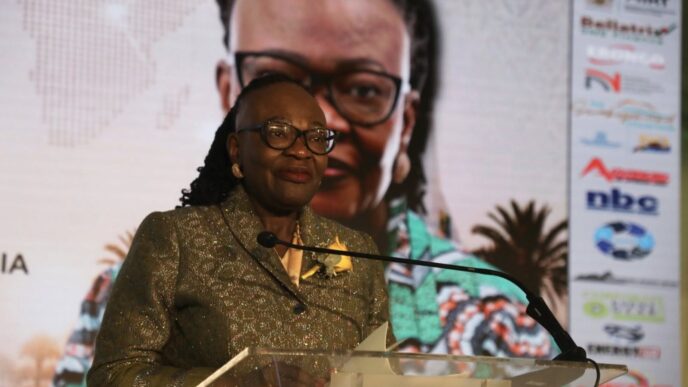
UN Deputy Secretary-General Amina J. Mohamed at the podium during the Group of Friends on Global Governance meeting at the United Nations in New York on Thursday, 28 May 2026, where she warned that rising conflicts, climate change, economic inequality and rapidly advancing technologies were exposing deep weaknesses in the current global governance architecture.
The high-level meeting was held under the theme “Reforming and Improving Global Governance: Working Together to Address Global Challenges” and was chaired by China’s Minister of Foreign Affairs, Wang Yi. UN Deputy Secretary-General Amina J. Mohamed also addressed the gathering, alongside representatives from member states and international organisations from across the globe.
Wang Yi opened proceedings by calling for a more inclusive and equitable global governance system rooted in equality, mutual respect and multilateral cooperation. He called for the rejection of “the politicization, instrumentalization, and weaponization of human rights” and pushed for reforms to global financial and economic institutions to better reflect shifting global realities, including restoring the World Trade Organisation’s dispute settlement mechanism. 

On emerging global challenges, Wang Yi proposed stronger international cooperation on artificial intelligence governance, cyberspace and outer space, announcing China’s proposal for a World Artificial Intelligence Cooperation Organisation.
“AI should serve as a force for good,” Wang Yi said, adding that China would host the World AI Conference and a high-level meeting on global AI governance in Shanghai later this year.
UN Deputy Secretary-General Mohamed told delegates that the current global moment demands urgent reform and renewed commitment to multilateralism, reflecting on the 80th anniversary of the UN Charter.
“Multilateralism has not failed. Multilateralism has been failed,” she stated.
Mohamed warned that rising conflicts, climate change, economic inequality and rapidly advancing technologies were exposing serious weaknesses in the current global governance architecture, stressing the need to reform international financial institutions and the UN Security Council to better reflect contemporary geopolitical realities, particularly by giving Africa greater representation.
Taking the floor, Prof. Murwira told delegates that Zimbabwe’s foreign policy is anchored on respect for international law, sovereign equality among states and peaceful resolution of disputes.
“Zimbabwe welcomes this important meeting under the theme reforming and improving global governance, working together to address global challenges,” Prof. Murwira said.
He told the gathering that global governance institutions must better reflect present-day geopolitical realities by ensuring fair representation of developing countries.
“The continued under-representation of Africa and the Global South in key international institutions undermines both the legitimacy and effectiveness of the global governance architecture,” he said.
Prof. Murwira also spoke on the importance of South-South cooperation and triangular cooperation as essential mechanisms for promoting sustainable development and shared prosperity, reiterating Zimbabwe’s “friend to all and enemy to none” foreign policy doctrine.
He told delegates that Zimbabwe is standing as the sole African Union-endorsed candidate for a non-permanent seat on the UN Security Council for the 2027 to 2028 term.
“If elected, Zimbabwe will work to advance a more balanced, inclusive, and effective approach to international peace and security,” he said.
Prof. Murwira is currently in New York leading diplomatic lobbying efforts, meeting UN member states and promoting Zimbabwe’s candidacy ahead of the election at UN headquarters scheduled for 3 June 2026. The outcome of that election will also be of interest to Eswatini and other African nations watching closely as the continent seeks stronger representation in international decision-making bodies.