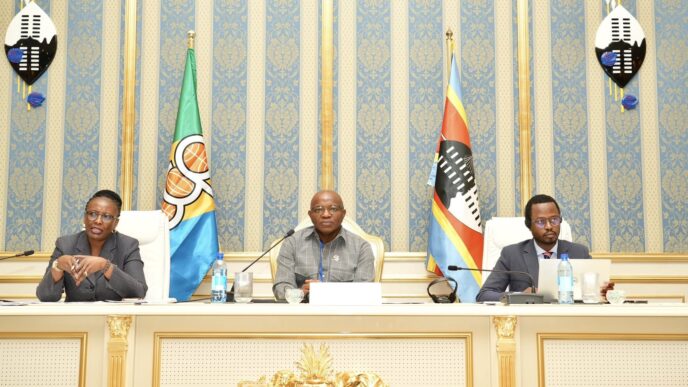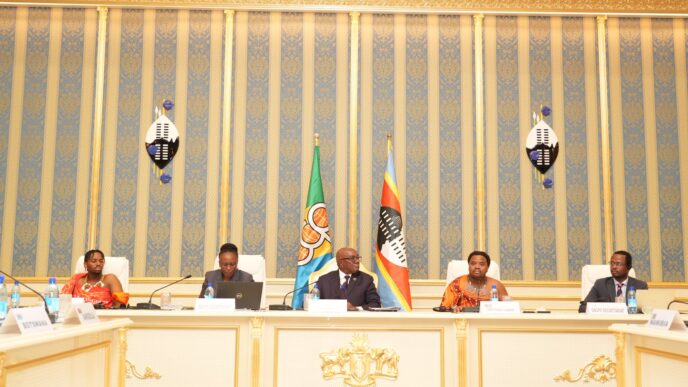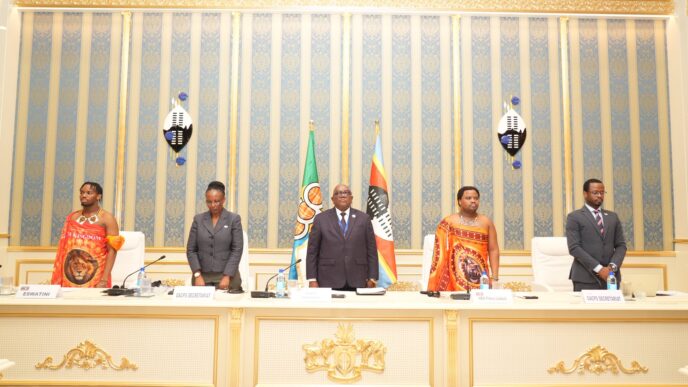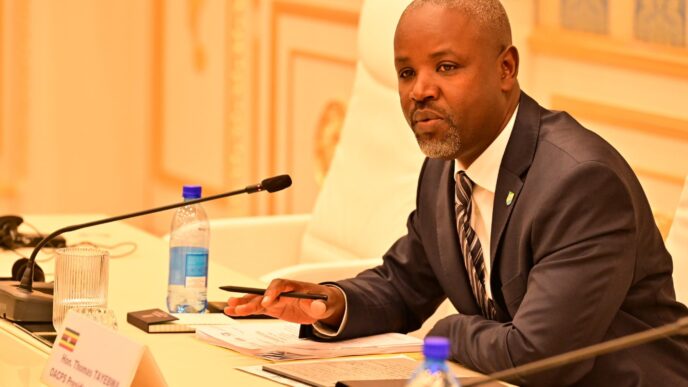


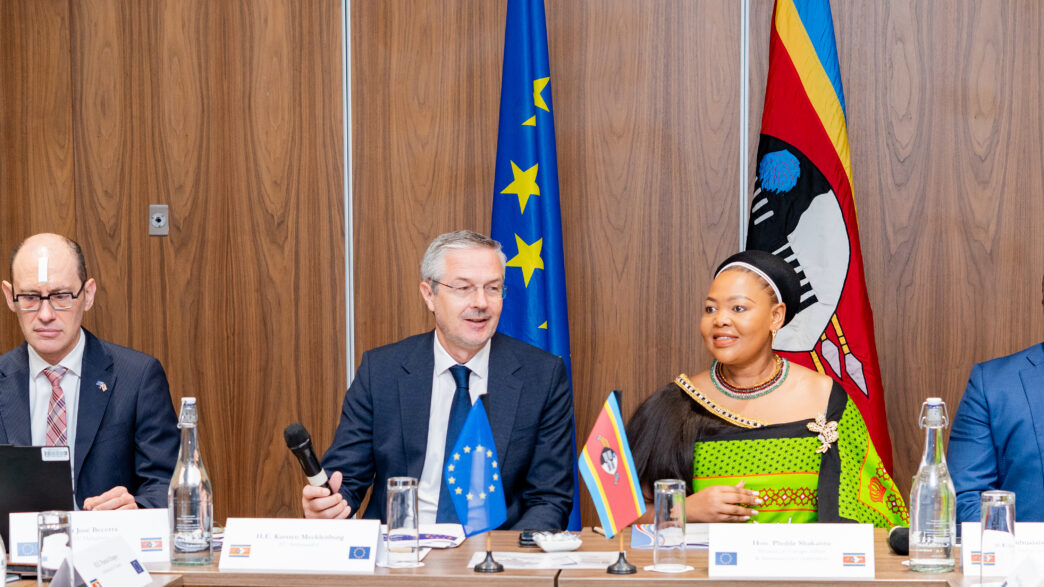
Mbabane – Foreign Affairs Minister Pholile Shakantu opened the 3rd EU-Eswatini Partnership Dialogue on Friday by pointing to the fuel pump as the most immediate proof that global geopolitics is not an abstract concern for Swazis, telling delegates that ordinary people feel the consequences of distant conflicts every single day.
Friday was the first day following Eswatini’s second fuel price increase in as many months, and Shakantu wasted no time drawing that reality into the conference room, speaking before European Union Ambassador Karsten Mecklenburg, EU member state representatives and senior government officials gathered for the annual dialogue.
“For the ordinary Liswati commuter, farmer, small business owner or transport operator, that increase immediately translates into higher transport costs, rising food prices and increased pressure on household incomes,” she said. 
She said this was one of the clearest examples of how geopolitical developments far beyond Eswatini’s borders reach into the lives of its people. Conflicts and instability in one region of the world, she explained, can increase shipping costs for a small trader in Manzini. Disruptions to global energy markets can affect the price paid by a family travelling between Mbabane and Nhlangano. Changes in international financial conditions can impact the ability of developing countries to invest in schools, hospitals, roads and youth employment programmes.
For small developing states like Eswatini, Shakantu said these realities make a stable, predictable and rules-based international system not a diplomatic luxury but a daily necessity, one grounded in cooperation rather than confrontation, dialogue rather than division and partnership rather than coercion.
She told delegates that Eswatini remains firmly committed to multilateralism as the most effective mechanism for managing complex global challenges and that the Kingdom continues to believe that dialogue, cooperation and principled engagement are essential to preserving international peace, stability and sustainable development.
At the continental level, she said Eswatini remains fully committed to the African Union Agenda 2063 and Africa’s broader vision for peace, integration, industrialisation and sustainable development. She announced that the Kingdom had been elected to the African Union Peace and Security Council for the 2025 to 2028 term, describing it as an honour and an opportunity to contribute meaningfully to preventive diplomacy, conflict prevention, mediation and peacebuilding across the continent.
“As a smaller state, Eswatini brings to the Peace and Security Council a perspective rooted in dialogue, consensus building and respect for sovereignty,” Shakantu said, adding that sustainable peace can only emerge through inclusive political processes, national ownership and development-centred solutions.
She also raised the matter of Africa’s underrepresentation in global governance structures, referencing the Ezulwini Consensus and the Sirte Declaration on the reform of the United Nations Security Council, saying this remains a matter requiring urgent international attention if the multilateral system is to remain credible, representative and effective.
At the regional level, Shakantu said SADC remains central to Eswatini’s foreign policy and that the Kingdom is taking over as Incoming Chair of the SADC Organ Troika on Politics, Defence and Security Cooperation. She said Eswatini fully appreciates the responsibility entrusted to it during a period characterised by evolving governance, security and economic challenges within the region.
She said the Kingdom supports ongoing regional discussions aimed at strengthening coordination on foreign policy matters, particularly through the elaboration of Principles and Guidelines for the Adoption of Common Foreign Policy Positions, while fully respecting the sovereign equality and national interests of member states.
On the Organisation of African, Caribbean and Pacific States, Shakantu said Eswatini’s past presidency of the OACPS Council of Ministers reflects the Kingdom’s growing contribution to multilateral diplomacy and South-South cooperation. She said it was particularly fitting that the dialogue was taking place while Eswatini is also hosting the OACPS Africa-EU Joint Parliamentary Assembly, with parliamentarians and delegates from across Africa and Europe present in the Kingdom that week.
“The presence of parliamentarians and delegates from across Africa and Europe here in the Kingdom this week serves as a practical demonstration of the continued importance of dialogue, partnership and people-centred multilateral engagement during an increasingly uncertain global period,” she said.
Within the OACPS, she said Eswatini continues to advocate for institutional reform, sustainable financing, stronger solidarity among member states and the strengthening of mutually beneficial partnerships with the European Union. She added that the Kingdom attaches significant importance to the implementation of the Samoa Agreement and views the OACPS-EU partnership as an important platform for development cooperation, political dialogue, trade, climate action and sustainable development.
Shakantu also welcomed the growing focus within the EU’s Global Gateway initiative on sustainable infrastructure, digital transformation, connectivity, education and skills development, describing these as areas offering genuine opportunities for mutually beneficial cooperation between Africa and Europe.
Closing the dialogue, she reflected on the 50-year-old partnership between Eswatini and the EU, saying the day’s discussions had demonstrated that the relationship “continues to grow from strength to strength, grounded in mutual respect, shared values and a genuine desire to see our partnership deliver meaningful and lasting impact.”
She said Eswatini values the European Union not only as a development partner but as a trusted friend, and confirmed that the Kingdom would host the next Partnership Dialogue in 2027, with the date to be announced in due course.
Shakantu also extended wishes to the EU delegation ahead of the Europe Day celebrations held later Friday evening at Malandela, expressing confidence the event would be “both memorable and a fitting celebration of the enduring friendship and cooperation between the European Union and the Kingdom of Eswatini.”atured into one that is “resilient, dynamic and forward-looking.” She confirmed that Eswatini would host the next Partnership Dialogue in 2027, with the date to be announced in due course.
She also extended wishes to the EU delegation ahead of its Europe Day celebrations held later Thursday evening at Malandela.