

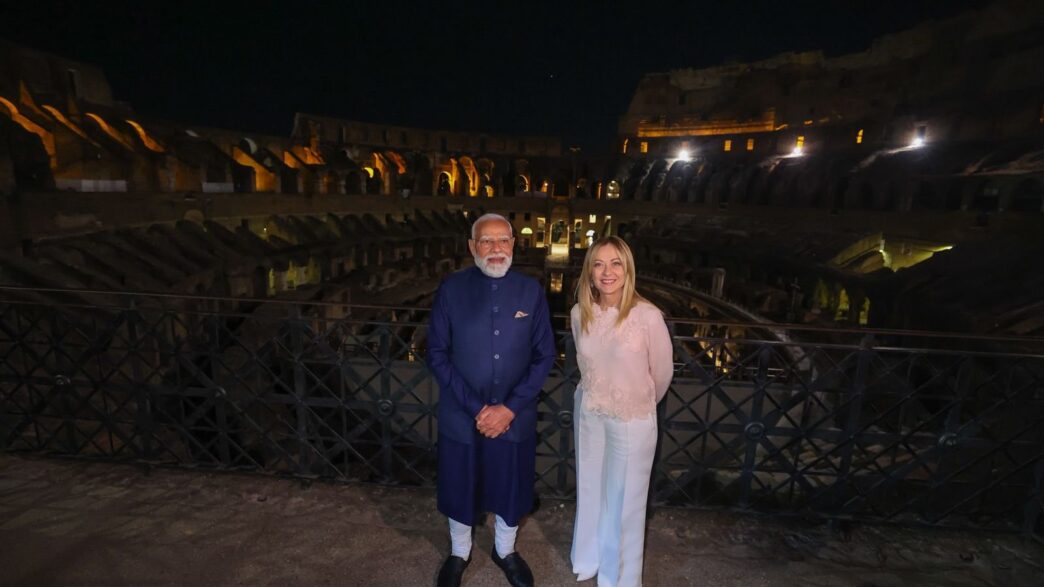
Rome – Indian Prime Minister Narendra Modi and Italian Prime Minister Giorgia Meloni have jointly authored an opinion piece declaring that relations between their two countries have reached a decisive stage, with both leaders committing to a Special Strategic Partnership built on shared democratic values and a common vision for the future.
The op-ed, published on Wednesday, sets out an ambitious agenda spanning trade, technology, defence, energy and connectivity, as the two leaders met in Rome for substantive talks.
“The relationship between India and Italy has now reached a decisive stage. In recent years, our ties have expanded with unprecedented momentum, evolving from a cordial friendship into a special strategic partnership grounded in the values of freedom and democracy, and a common vision for the future,” the two leaders wrote. 
At the heart of the partnership is a trade target of 20 billion euros by 2029, a figure that translates to roughly E423 billion in lilangeni terms. The two countries want to grow commerce across sectors including defence and aerospace, clean technologies, machinery, automotive components, chemicals, pharmaceuticals, textiles, agri-food and tourism. Bilateral trade already exceeded 14 billion euros in 2023.
The leaders pointed to the recently concluded EU-India Free Trade Agreement as a gateway for increased investment flows in both directions. They also noted that more than 1,000 businesses from each country are already operating on the other’s soil, a figure they said would deepen supply chain integration.
“‘Made in Italy’ has always been synonymous with excellence worldwide, and today it finds a natural synergy with the high-quality goals of the ‘Make in India’ initiative,” the two leaders wrote.
Technological cooperation sits at the core of the partnership. Modi and Meloni identified artificial intelligence, quantum computing, advanced manufacturing, critical minerals and digital infrastructure as priority areas, saying the coming decades would be shaped by a technological revolution of unmeasurable scope.
On AI specifically, the two leaders said they were committed to ensuring its development remains responsible and human-centred. They drew on India’s MANAV framework, which places humans at the centre of technology, and Italy’s tradition of what they called “algor-ethics,” rooted in its humanist heritage.
“Conceiving AI as a tool created by humans for humans means firmly asserting that technology cannot replace individuals or undermine their fundamental rights, nor be used to manipulate public debate or alter democratic processes,” the two leaders wrote.
The partnership also extends to space, with both countries identifying joint opportunities in satellite technology and next-generation development, given India’s advances in space exploration and Italy’s aerospace engineering expertise.
On security, Modi and Meloni said they would strengthen cooperation in defence, strategic technologies and the protection of critical maritime routes. They committed to joint efforts against terrorism, international criminal networks, drug trafficking, cybercrime and human trafficking.
Energy forms another pillar of the relationship. India’s ambition to become a hub for green hydrogen exports was described as complementing Italy’s advanced renewable infrastructure technology and its role as an energy gateway for Europe. Both countries are also collaborating through India-led initiatives including the International Solar Alliance, the Coalition for Disaster Resilient Infrastructure and the Global Biofuels Alliance.
The two leaders described their countries as sitting at the heart of two crucial global hubs, the Indo-Pacific and the Mediterranean, and said these regions must be seen as increasingly interconnected rather than separate spheres.
“We are witnessing the emergence of what might be termed the Indo-Mediterranean, an important corridor for trade, technology, energy, data and ideas tying the Indian Ocean to Europe,” they wrote, adding that the India-Middle East-Europe Economic Corridor was central to making that vision a reality.
The op-ed closed with a cultural reflection, with Modi and Meloni drawing parallels between the Indian philosophy of “Vasudhaiva Kutumbakam,” meaning the world is one family, and Italy’s Renaissance humanist tradition, describing both as underpinning a partnership with people at its centre.