

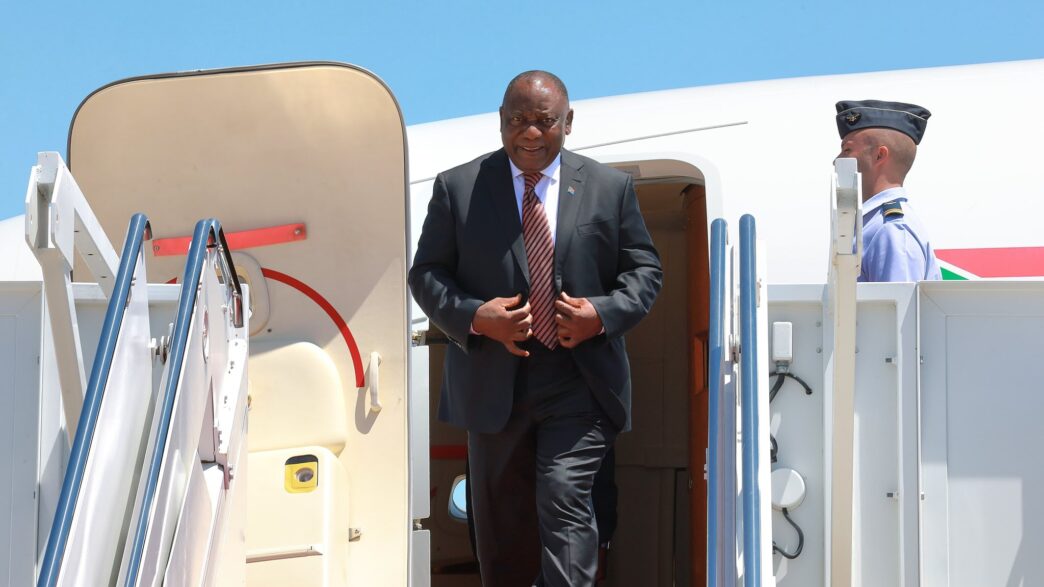
WASHINGTON, USA – President Cyril Ramaphosa landed in the United States on Monday ahead of a tense meeting with President Donald Trump, where South Africa will challenge the White House’s recent acceptance of Afrikaners as refugees and propose a new trade deal amid strained diplomatic ties.
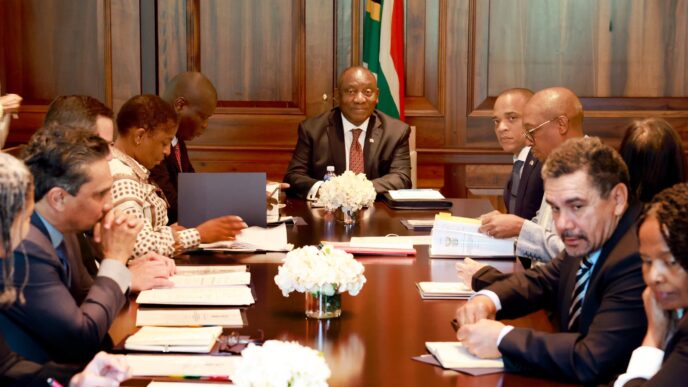
The South African president is expected to meet Trump on Wednesday at the White House, becoming the first African leader hosted by the U.S. president. The meeting comes after Trump offered refugee status to 59 Afrikaners earlier this month, citing unproven claims of genocide against white farmers.
South African officials strongly deny that such a crisis exists, pointing to police data showing that of the 225 people killed on farms between April 2020 and March 2024, fewer than a quarter were white farmers. A larger number of victims were Black farm workers or residents. Ramaphosa plans to push for an independent investigation into the genocide claims and confront what his government sees as a misinformation campaign. 
While the refugee issue will be on the table, Ramaphosa’s primary goal is to revive a faltering U.S.-South Africa relationship and reassure American investors. South Africa remains the continent’s largest economy, and the U.S. is its second-largest trading partner.
Ramaphosa’s spokesperson, Vincent Magwenya, said the president would use the visit to advance trade discussions and seek the extension of benefits under the Africa Growth and Opportunity Act (AGOA). The White House meeting could also provide a platform for deeper engagement on energy and automotive investment opportunities.
There is speculation that South African billionaire Johann Rupert, who has ties to both administrations, may be part of Ramaphosa’s delegation.
Also expected to be part of the talks is tech billionaire Elon Musk. Born in Pretoria, Musk has been a vocal critic of South Africa’s current political climate, echoing Trump’s statements on X, formerly Twitter. Ramaphosa hopes to soften Musk’s stance and discuss opportunities for Tesla and SpaceX in South Africa, including electric vehicle infrastructure and space launch collaborations.
Ramaphosa is also set to raise South Africa’s stance on Gaza, where his government has led international efforts accusing Israel of genocide at The Hague. He intends to contrast those accusations with what he sees as Trump’s unfounded use of the same term to describe conditions in rural South Africa.
South Africa’s diplomatic dealings with Iran and Hamas could complicate discussions, as Trump has expressed concern over Pretoria’s recent engagements with those entities.
Despite the tense agenda, Ramaphosa’s team believes economic diplomacy will resonate most with Trump. In 2023, South Africa exported goods worth $13.9 billion to the U.S., while importing $7.2 billion, making it the largest sub-Saharan market for American products.
With racial politics, trade, international law, and misinformation converging in this visit, Ramaphosa faces a delicate balancing act as he seeks to defend South Africa’s domestic policies while preserving a critical global partnership.