

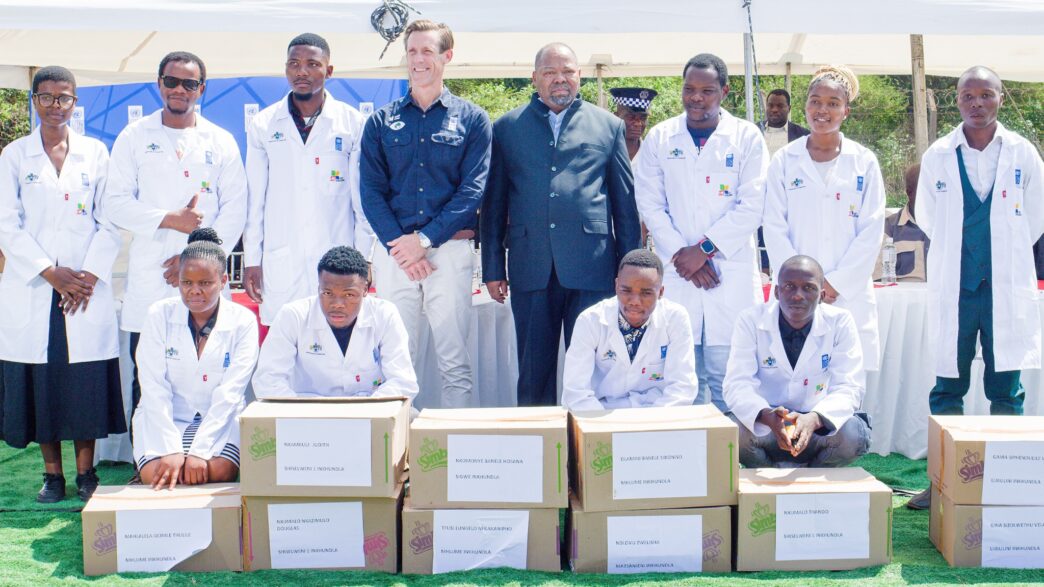
Lubuli Inkhundla in the Lubombo Region became a launchpad for new township businesses this week as 11 young people received start up kits to open cellphone repair workshops in their communities.
The beneficiaries are drawn from five tinkhundlas in the Lubombo and Shiselweni regions and recently completed mobile phone repair training under the Eswatini Youth Empowerment Programme. The initiative targets unemployed young people who have finished high school and are seeking practical skills to enter the job market.
The Eswatini Youth Empowerment Programme is a government initiative developed and implemented in partnership with the United Nations Development Programme and funded by the Ministry of Economic Planning and Development. It comes at a time when Eswatini continues to grapple with high youth unemployment, with about 56 per cent of young people aged between 15 and 35 without a source of livelihood. 
At the same time, mobile phone usage in the country remains widespread, with an estimated 134 mobile connections per 100 people. Mobile devices have become central to communication, banking, education and small business operations, creating steady demand for qualified repair technicians. Despite this demand, few emaSwati currently possess formal technical skills to fix mobile devices.
To narrow this gap, 15 unemployed high school graduates from Lubuli, Matsanjeni South, Mhlume, Shiselweni I and Sigwe tinkhundlas underwent an eight week training course in mobile phone repair. The training was conducted by CIT in Mbabane and focused on practical and market relevant skills to help participants establish viable businesses.
From the initial group, the top 10 trainees, seven male and three female, advanced to a higher level course and qualified for starter kits. An additional trainee, who had already opened a small repair service in his community after completing the first phase, also received a kit in recognition of his initiative.
The handover ceremony was held at Lubuli Inkhundla and was officiated by the Minister of Economic Planning and Development, Honourable Dr Thambo E Gina, who is also the Member of Parliament for Lubuli, together with the UNDP Resident Representative, Mr Henrik Franklin.
“I’m ready to take the market by storm following our successful training. I’m grateful for this skill and invite community members to bring their phones for repair,” said Sizolwethu Gina, one of the artisans from Lubuli Inkhundla.
“I’m looking forward to setting up my own workshop in my community. I’m grateful to the government and UNDP for this opportunity,” said Mahlalela Gcinile from Mhlume Inkhundla.
Lubombo and Shiselweni were prioritised under the programme due to limited economic activity and fewer livelihood opportunities for young people compared to the Hhohho and Manzini regions.
Speaking at the event, Hon Gina said that beyond the artisanal training stream, EYEP has also progressed through its graduate placement pathway, linking education to employment opportunities for thousands of young people.
Since its launch in 2023, the programme has registered 4,128 graduates on the national EYEP portal, which connects youth to workplace opportunities in both the public and private sectors. More than 300 graduates have so far been placed in six month internships across 66 host institutions, including government ministries, parastatal agencies, private companies, United Nations agencies, small businesses and non governmental organisations.
“The Government of the Kingdom of Eswatini remains committed to scaling up youth skills training, supporting entrepreneurship, and strengthening digital and artisanal skills for a modern economy. Initiatives such as EYEP and the upcoming Eswatini Youth Employment Opportunities Project reflect our national vision of inclusive growth and resilient livelihoods,” he said.
Mr Franklin said that in 2026 the programme, working through selected vocational training providers, plans to expand and reach 250 young people in line with market demand.
“I would like to once again express our gratitude to the Ministry of Economic Planning and Development for its financial support to this programme. I also thank Parliament for supporting this vision and for guiding us to place greater focus on capacitating youth from the Lubombo and Shiselweni regions, where opportunities are more limited,” he said.