


UNITED NATIONS, New York – The United Nations General Assembly has passed a resolution recognising the transatlantic slave trade as “the gravest crime against humanity,” with 123 countries voting in favour, three against, and 52 abstaining. The vote followed efforts led by Ghana and backed by the African Union.
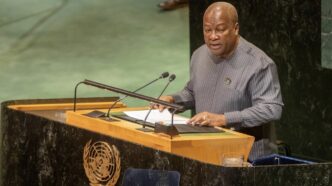
The resolution, A/80/L.48, formally declares the trafficking of enslaved Africans and racialised chattel slavery a crime against humanity, providing a framework for reparatory justice. Ghanaian President H.E. John Dramani Mahama addressed the Assembly at a high-level event on reparatory justice, describing the vote as “a pathway to healing and reparative justice” and “a safeguard against forgetting.”

“The entire transatlantic slave trade was designed to deny African people their humanity,” Mahama said. He detailed the suffering of enslaved Africans, including the brutal Middle Passage where 10 to 15% died, and the stripping of names and identities on arrival in the Americas. 
Mahama outlined the destinations of enslaved Africans: about six million were taken to Brazil, two million to Jamaica, 500 000 to the United States, and over 450 000 to Barbados. He explained how colonial legal frameworks, such as partus sequitur ventrum in Virginia, ensured children of enslaved women were automatically enslaved, often the result of rape by plantation owners.

The President stressed that slavery was a system of profit at the expense of African lives, and he warned against modern attempts to erase or minimise the history of slavery. He referenced recent educational controversies in the United States where Black history and slavery are being removed or reframed in school curricula, describing this as “the type of forgetting” the resolution seeks to prevent.
Mahama called for recognition, reconciliation, and systemic transformation. “When discussing slavery and its resulting institutions and practices, we must always start by reclaiming racial equality, the dignity of Africans, the humanity of our ancestors who were enslaved and, as a matter of course, our own humanity,” he said.
The Ghanaian President also highlighted Africa’s historical contributions to global development, from infrastructure to labour, noting that these achievements are often ignored or misrepresented in historical narratives.
“Truth begins with language,” Mahama said, urging Member States to vote for the resolution to acknowledge the full horror experienced by approximately 15 million enslaved Africans and their descendants.
He concluded by quoting Nelson Mandela: “Our human compassion binds us to one another not in pity or patronisingly, but as human beings who have learnt how to turn our common suffering