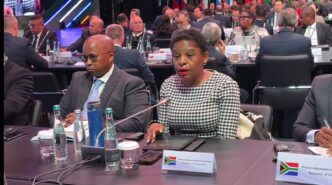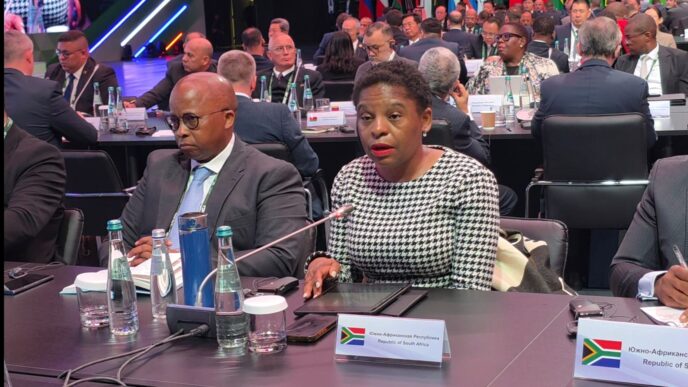


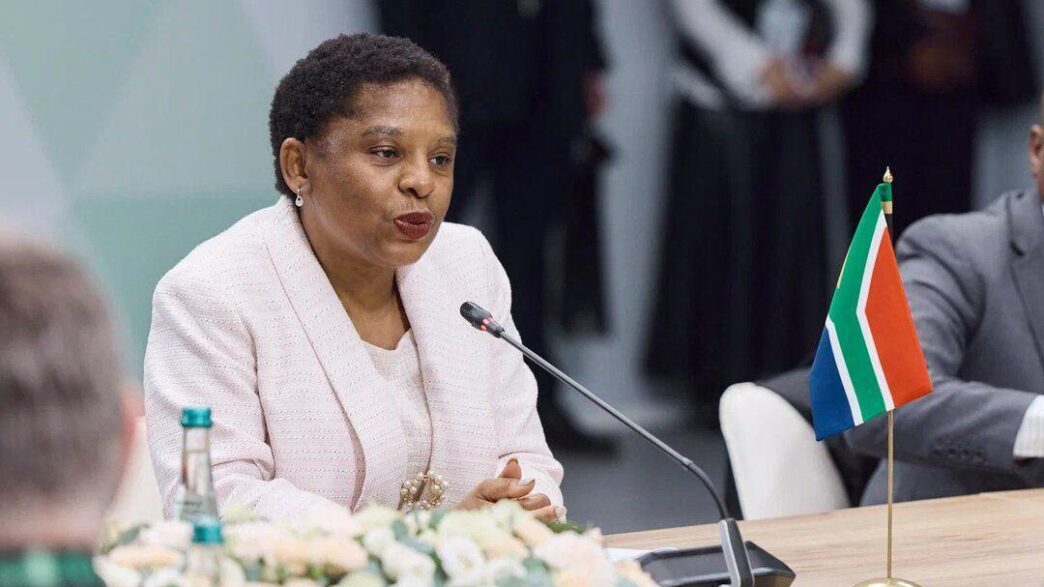
Moscow – South African Minister in the Presidency Khumbudzo Ntshavheni travelled to Moscow this week to attend the First International Security Forum, where she delivered a series of addresses covering global health cooperation, disinformation, the Middle East conflict and food and energy security between 26 and 29 May 2026.
Speaking on health cooperation, Ntshavheni told delegates that forums of this nature cannot speak about the power of cooperation for the health of nations without also building the resilience and regional response capacity of the global South.
She pointed to the double standard witnessed during the COVID-19 pandemic, when wealthy nations hoarded vaccines for themselves in violation of World Health Organisation principles, and blocked patent waiver applications from developing countries at the World Trade Organisation, even from countries they considered allies. 
“When the global South applied for patent waivers at the World Trade Organisation to develop their own Covid-19 vaccines, even our supposed allies in the global North opposed our patent waiver applications,” she said.
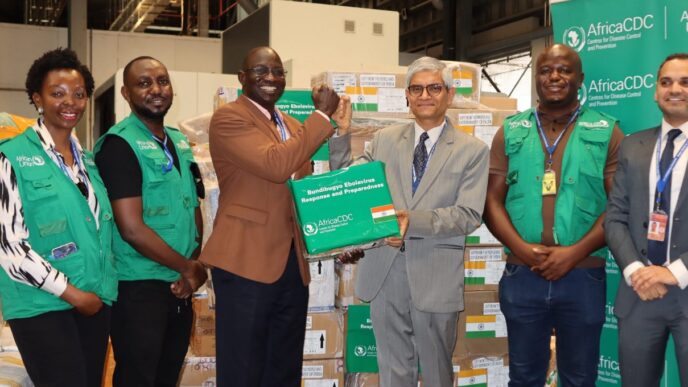
Ntshavheni told the forum that the Central and East Africa region is currently experiencing another Ebola outbreak, yet the global North has chosen not only to watch from the sidelines but has diverted flights from the region without responding to calls for support from the African Union’s Centre for Disease Control.
“South Africa has just pledged US$5 million to the CDC to deal with the current Ebola outbreak. How much is the International Security Forum mobilising to help Africa address Ebola?” she asked.
She also announced that South Africa is driving a partnership to establish Africa’s first end-to-end, multi-vaccine production plant that will produce oral cholera vaccines, later expanding to cover polio, pneumonia and meningitis vaccines. The plant, known as Biovac, is scheduled for completion by 2028 and will have a production capacity of up to 40 million doses annually.
On disinformation, Ntshavheni told the forum that South Africa has faced sustained disinformation campaigns around its elections and both foreign and domestic policy decisions, including the so-called “white genocide” narrative that she said is amplified by international far-right networks at state and non-state levels.
She said South Africa is reviewing its information policies to compel digital platforms to disclose AI-generated content and to prohibit the publication of fake and misleading news about the country. The government is also developing a fact-checking capability to proactively debunk deepfakes and misinformation, as well as a quick guide for government communicators to counter false narratives.
Addressing challenges to international security in the context of a shifting global order, Ntshavheni said South Africa views the move from a unipolar to a multipolar world as not inherently threatening, but warned that the danger lies in how this transition is unfolding.
“Multipolarity must not mean multi-conflict or multi-standards. It must mean shared responsibility, consistent respect for international law, and a greater voice and agency for the Global South in shaping the future of global security governance,” she said.
On the Middle East, the minister painted a grim picture of the situation in Gaza, where she said violence continues amid a severe humanitarian crisis and mass displacement. She described the conflict between the United States and Israel on one side and Iran on the other as entering its fourth month, with a fragile ceasefire in place and Pakistan-led diplomatic efforts ongoing but intermittent.
Ntshavheni warned that Iran is planning to target and disrupt fibre-optic subsea communication cables in the Strait of Hormuz, a move that could affect global technology companies including Google, Microsoft, Meta and Amazon, and cause widespread disruption to communications, financial transactions, social media, e-commerce and streaming services.
“The possibility of the war transitioning from threatening global energy to posing a risk to digital infrastructure could lead to a global digital catastrophe,” she said.
She confirmed that South Africa will continue calling for a negotiated settlement in the region and will support efforts to establish Palestinian statehood within the 1967 borders, alongside Israel, with East Jerusalem as its capital.
On food and energy security, Ntshavheni told BRICS partners that in 2025 an estimated 673 million people still faced hunger, and called on the grouping to use its combined weight, representing 40 to 45 percent of global food production and close to 40 percent of global water resources, to deliver real security for its peoples.
She pointed to South Africa’s Musa Plan, which uses data-driven research to combat food poverty, and the country’s Just Energy Transition Investment Plan, which has attracted around US$13.5 billion in international pledges for renewable manufacturing, grid upgrades and skills development.