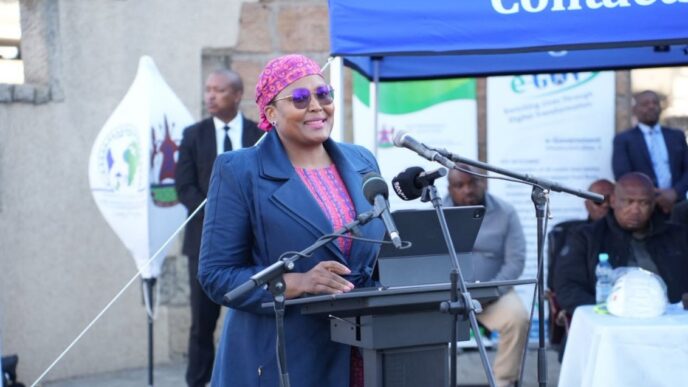



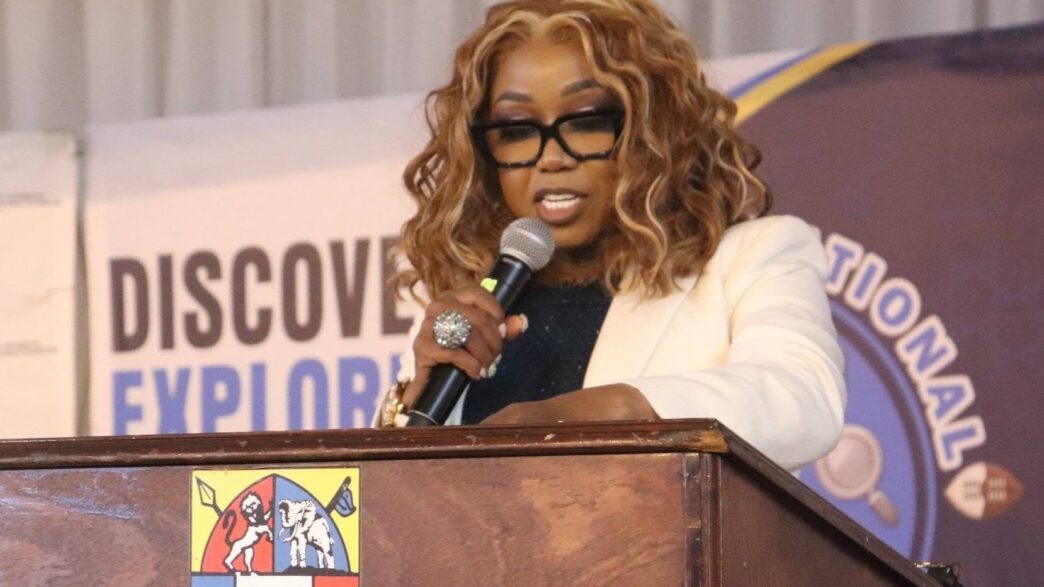
Kwaluseni – Eswatini’s minister of ICT, Savannah Maziya, says the future of science, technology and innovation lies in the youth, and government support could stimulate the economy with the investment.
Maziya is a self-confessed supporter of STEM studies, which she said have made the developed countries what they are. She called for preparations, including funding more students to do science and technology studies.
“One of the things that I have worked on in my life before I was minister was going the length and breadth of our continent and talking about the issue of STEM and how it works together for all of us as Africans and how we can be able to collaborate with business,” she said at the launch of Eswatini Science Month at UNESWA Kwaluseni Campus. 
She informed her colleague, the visiting South African Minister of Science, Technology, and Innovation, Dr Blade Nzimande, that Eswatini is willing to collaborate in this subject.
Advice was directed to African governments to prepare for collaboration in order to compete with sophisticated science and technology nations in terms of successful science, technology, engineering, and mathematics applications.
“Where is the issue for us to be able as government and business to be able to really plan for our countries and to plan for the continent and to collaborate and to not become these Africans who are using the borders that were set before by others to be separate,” she said.
The mining procedure in Africa where there is still talk of beneficiation has also been seen as a let down losing the continent millions in exporting raw materials without ‘any breakdowns of minerals to usable technology.’
Maziya’s warning was direct, that Africa must catch up to speed full exploitation of science and technology, labelling lagging behind as exposure to the ‘threat of being digital slaves’.
Colonisation, apartheid and other discriminatory systems might have had an effect but Maziya says these should have taught the lessons that Africans only ended up discriminating against each other.
She said now machines and artificial intelligence are looking more like human replacement threats in areas of health care and education.
“How do we ensure that as Africans we have been part of that contribution? We have had centuries of being the leaders in science. We are the original scientists. Be it pyramids, we are the original scientists. Be it writing or be it mathematics, we are the original scientists. Even with the curing of people, we are the original scientists.
“Even with what people eat, what you see today is that the world is now moving away from all the fast foods that we currently have in the Western world and are looking to the food that we were originally eating and currently eat for the curing of the body, for the curing of diseases, and for ensuring that we have long lives. What are we doing to be able to say, as Africans we’re going to be part of the production system, not the consumption system?” Maziya stated.