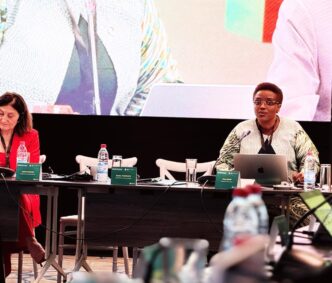


Pretoria – African Tax Administration Forum (ATAF) Executive Secretary Mary Baine has described the United Nations Framework Convention on International Tax Cooperation as “one of, if not the most consequential structural changes in global tax governance in the better part of a century.”
Speaking during the 2026 African Tax Research Network (ATRN) Fireside Chat held at the University of Pretoria in South Africa, Baine said Africa is not a spectator in the process but one of its principal architects.
“The UN process is a process like the minister said that was started by Africa. And honestly, I think it was out of the frustration that we’d been getting through other processes. But it was also out of need,” she said. 
“And I think it is a process that we cannot take lightly and it is not just one of those items on the international tax calendar. It is actually history being made. It is one of if not the most consequential structural change in global tax governance in the better part of a century. And Africa is not a spectator in the process like the his excellency said. Actually, Africa is a principal architect of the process.”
Baine said the process came out of a need, as discussions had long pointed to the fact that the current rules are skewed towards the developed world and pose quite a challenge to the developing world.
She painted a picture of the pressures facing the continent, pointing to the reduction of official development assistance and the debt burden weighing on African countries.
“If you look at the issue of the reduction of ODA, if you look at the issue of the date that is on the continent, I was just as listening to the news the other day and one of the presidents in the region said that because of the reduction in aid because of the debt they have to pay 60% of their health budget has had to go to service their debt. So you wonder are people going to go back to to using leaves and things, you know, for treatment, what is going to happen?” she said.
The Executive Secretary also detailed the practical role ATAF has played in supporting African countries throughout the negotiations, explaining that describing it as technical analysis and coordination can sound abstract.
First, she said, is participation in the Intergovernmental Negotiating Committee as an accredited observer, from the initial work on the terms of reference up to where the process is now. ATAF runs three work streams, one handling the convention itself, another handling cross border taxation, and a third working on dispute resolution.
Second is providing technical intelligence to member administrations, as ATAF cannot participate in the intersessional committees but advises the different countries on work that is technical, complex, and intense.
“So to be able to come up with a position we have had to support the different countries through what we call the inter-institutional coordination mechanism. The inter-institutional coordination mechanism is ably led by the African Union Commission and comprises of like-minded organizations like your UNECA, your Tax Justice Network Africa,” she said.
Third is providing substantive policy positions on the issues that matter most to Africa, zeroing in on issues that relate to the developing world. Baine said one of the lessons learned from the OECD process was the power of building alliances, noting that at the UN it is one country, one vote.
“And because of that we’ve been able to work on a alliances on like-minded, countries, so that we’re able to really, really get a solution that we think is right for the developing world,” she said.
Fourth is coordination with the Africa Group at the UN through ATAF’s institutional relationship with the African Union, which allows the continent to come up with a common position.
“Because the more fragmented you are, the less you’re likely to get any tangible results,” she said.
Fifth is capacity building and knowledge sharing with member countries, unpacking the details of the negotiations and sharing them with the countries.
On the next phase, Baine said there is a need to ensure that everybody can participate, with some countries advancing the African position to make it easier for those struggling technically, and to increase support to the Africa Group.
Looking ahead, she called on African researchers to play a greater role in generating the evidence needed to strengthen the continent’s negotiating positions.
“Arguments without evidence are just that arguments. And so I really would like to end by calling upon everybody in the room. I know you’re all very able researchers. It would be great if you can we can work together to see how to quickly run through some of the very very burning issues so that we are able to support our teams in New York,” she said.