

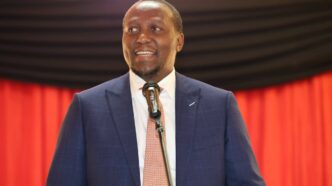

Manzini – Prime Minister Russell Mmiso Dlamini has called on the Methodist Church in Eswatini to use its centenary celebrations to renew its spiritual mission and strengthen its contribution to the country’s development as it begins its second century of service.
Dlamini was speaking at St Paul’s Methodist Church in Manzini during celebrations marking 100 years of the church’s presence and service in Eswatini.
The Prime Minister reflected on the Methodist Church’s century of work in faith, education, healthcare and community service, while calling for greater commitment to prayer, good character, economic empowerment and national transformation. 
PM: “One hundred years is no ordinary milestone. It represents generations of worshippers, preachers, teachers, evangelists and servants who remained faithful to the call of God.”
Dlamini said the church had developed into an institution deeply rooted in Eswatini and led by emaSwati.
PM: “What was planted by the early Methodist missionaries and workers has grown deep roots in the soil of this Kingdom. It has become a Church unmistakably of Eswatini, led by emaSwati, serving emaSwati and participating fully in the spiritual, social and developmental life of our nation.”
As the church enters its second century, Dlamini challenged it to work more closely with Government in promoting economic empowerment and creating opportunities for emaSwati.
PM: “Today, another need calls. The time has come for the Church to join Government with renewed determination in the economic empowerment of our people. Our education must equip citizens not only to seek employment, but also to create employment; not just to participate in the economy, but to own, build and transform it.”
The Prime Minister said national development required more than infrastructure and legislation, arguing that strong institutions needed to be supported by citizens with integrity and a sense of responsibility.
PM: “Government can build roads, schools, hospitals and industries, but institutions alone cannot form character. Infrastructure cannot produce integrity. Legislation alone cannot create patriotism. Economic growth, by itself, cannot give a nation a moral conscience.”
He also called for the development of a new generation of leaders who combine competence with strong values and a commitment to serving the country.
PM: “We must raise a new generation of leaders- men and women of conviction, competence and character; leaders who fear God, love their country and place the welfare of the people above personal interest.”
Dlamini said the church had a responsibility to play a transformative role in society rather than limiting its role to religious gatherings.
PM: “The Church of Jesus Christ was never called to entertain society; it was called to transform society. It was not commissioned to please men; it was commissioned to glorify God. It was not established just to gather crowds; it was established to make disciples.”
He challenged the Methodist Church to place prayer and spiritual devotion at the centre of its work as it begins its second century.
PM: “My challenge to the Methodist Church as it enters its second century is therefore clear: become, afresh, a Church of the secret place. Let every minister be a person of prayer. Let every leader be a seeker of God. Let every family establish an altar. Let every believer hunger for the presence of God.”
The Prime Minister also paid tribute to clergy, lay leaders and members who have served the Methodist Church over the past 100 years.
PM: “To the clergy, lay leaders and members, past and present, who have carried this mission over the past century, the nation says: thank you. Your prayers have not been wasted. Your sacrifices have not been forgotten. Your labour in the Lord has not been in vain.”