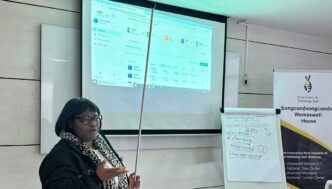


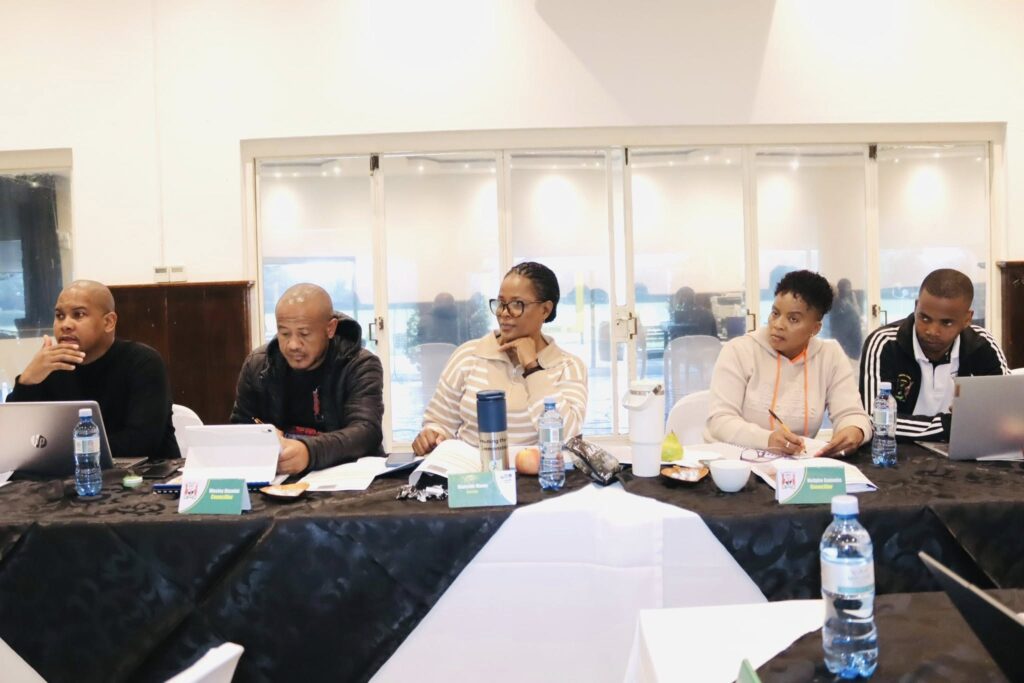
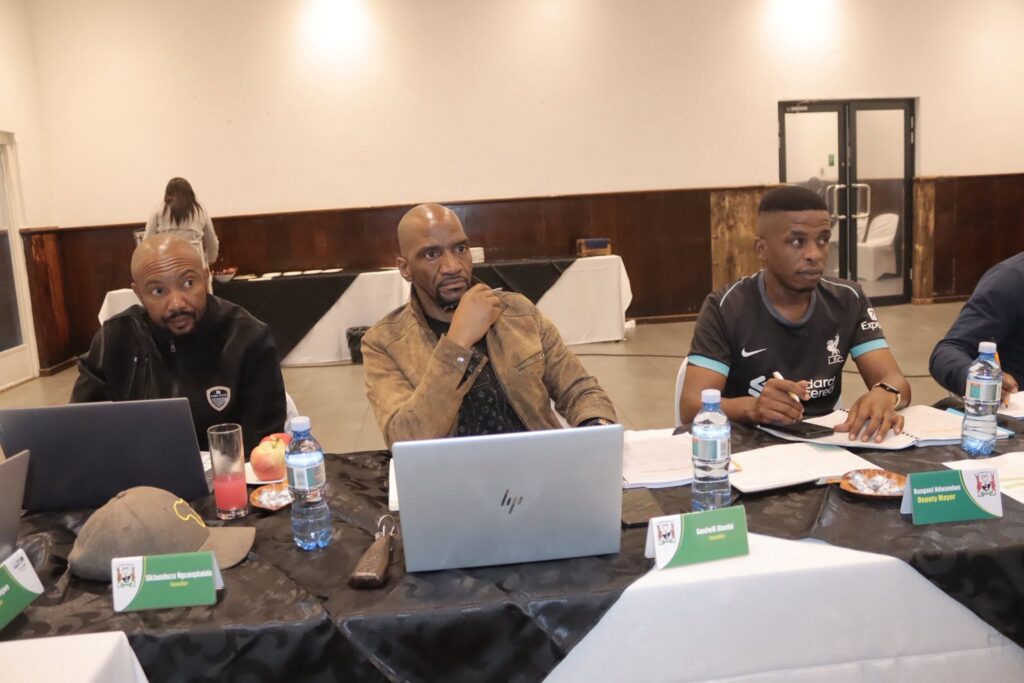
Manzini – The Municipal Council of Manzini is conducting a mid-term review of its 2024 to 2030 Integrated Development Plan this week, with council and management sitting together for the second consecutive day to assess how far the strategy has come since it was adopted two years ago and what still needs to be done before it runs its course in 2030.
The IDP, which the municipality describes as the strategy the city has been running on since 2024, maps out what the council plans to do across five broad areas: infrastructure development, sustainable development, smart city initiatives, social development and economic development. With 2026 marking the midpoint of the planning period, the review is meant to translate findings into corrective actions where necessary.
The city, known as the Heart of Eswatini, sits at the centre of the country, about 35 kilometres from the capital Mbabane and 7 kilometres from the industrial town of Matsapha, covering an area of 2,849 hectares. Its night-time population is estimated at around 40,000 residents, though the city swells to over 120,000 visitors during the day due to its central location as a connection point for travel destinations across the country and into the Southern African Development Community region. 
City General Statistics
12 High Schools
2 Major Tertiary Institutions
Figure 1.5.1: Showing the city’s general statistics snapshot
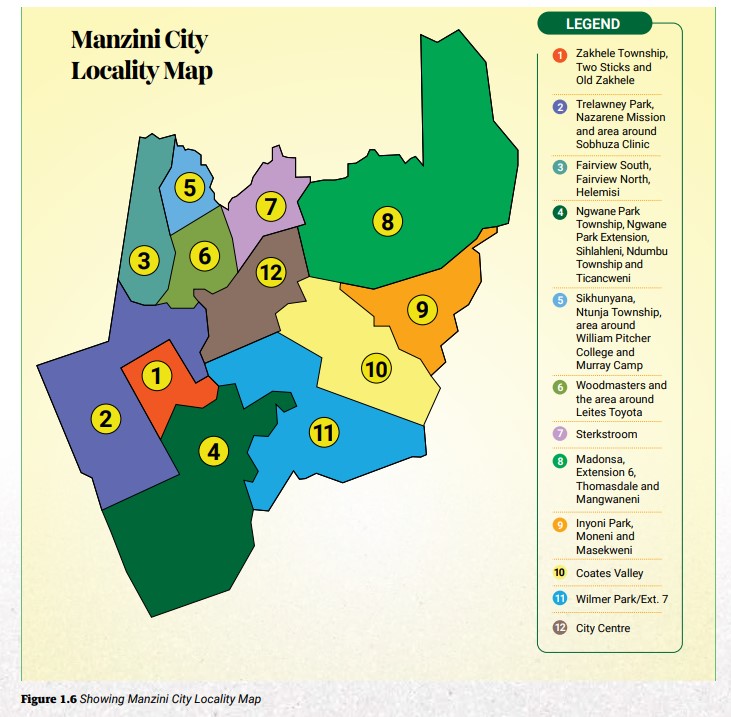
Manzini is spatially divided into 12 constituencies known as Wards and contains 34 townships, including the Central Business District and the recently developed Mkhosi Township below Coates Valley. The city also has five informal settlements, namely Mangwaneni, Murray Camp, Ticancweni, Old Zakhele and Moneni, which are home to medium to low income residents.
Manzini City Property
Categorization
Figure 1.5.2: Showing Manzini City Property Categorization
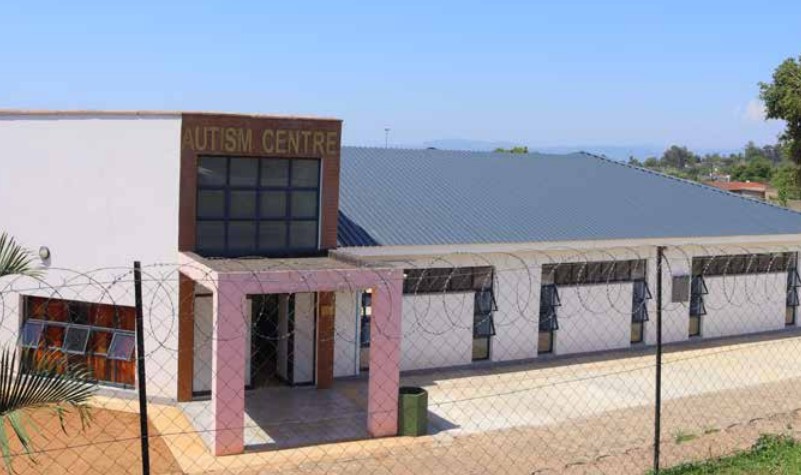
The 2024 to 2030 IDP is the municipality’s third generation development plan since it first adopted the Integrated Development Planning approach in the 2013 to 2018 period. It was developed after the municipality completed its previous plan, which ran from 2019 to 2024, at an implementation rate of 96%. That planning cycle delivered the rehabilitation of more than 15 roads including the Southern Distributor Road, Bosco Bridge, Tenbergen Street, Mentjies Street, Martin Street, Mahlalesikhundleni Street, Tikhuba Road and Mimosa Road. It also saw the construction of the Autism Centre, the expansion of the Manzini Main Market to accommodate more than 1,000 traders, and the development of the Thursday Market Trade Hub in partnership with the Ministry of Commerce, which now accommodates close to 1,000 women traders.
The municipality won the Customer Service Excellence Award three consecutive years from 2021 to 2023, received unqualified audit opinions across all five audits conducted during the 2019 to 2024 period, and planted over 600 trees in the city during that time.
The current plan targets eight thematic areas: human capital and organisational effectiveness, financial sustainability, stakeholder management, urban planning and sustainable human settlements, sustainable environmental management, integrated economic development, integrated infrastructure development, and public health, social and security services. Under those thematic areas, the municipality has identified 20 strategic objectives to guide programmes and projects through to the 2029/30 financial year.
2019-2024 Financial Performance
Figure 2.4.1: Showing the Municipality 2019-2024 revenue performance
Among its key infrastructure targets, the plan aims to increase the proportion of tarred roads from 62% to 70% by 2030. The city currently has 114.63 kilometres of roads, of which 38% remain gravel. The city has 135 official roads and the municipality has flagged that many of them have exceeded their lifespan, requiring constant maintenance that overstretches the budget. Capital road projects in the plan include the rehabilitation of CBD roads covering Mancishane, Tenbergen, Villiers, Esselen and Du Toit Streets, the upgrading of Thomasdale roads, the rehabilitation of Ngwane and Nkoseluhlaza Streets and the upgrading of Sterksroom roads.
Beyond roads, the Capital Investment Programme includes the solarisation of the city through feasibility studies, land acquisition and installation of photovoltaic systems, construction of vending shelters, procurement and supply of skip bins, fencing of the controlled dumpsite, installation of an incinerator, construction of stormwater drains on Lishongolo, Linda and Masalesikhundleni Streets, and the rehabilitation of Fairview Road and Louw Street.
Under Public Private Partnership arrangements, the plan includes the development of Mkhosi Township bulk infrastructure and a shopping complex, development of Fairview Shopping Complex Phase II, construction of satellite bus terminals, relocation and development of the landfill facility, relocation of the municipality office park and the development of a golf course. National government projects planned for the city include the development of Manzini Mall, Manzini Arch Shopping Complex and the MR3 Road.
On smart city development, the municipality plans to integrate technology and city data to improve pavement management, streetlighting, safety and security infrastructure including CCTV cameras and solar lighting, and internet connectivity across the city.
The plan also prioritises the establishment of a municipal police service, expansion of CCTV surveillance, crime prevention community structures and a tactical response security capability. Safety and security was identified as the single most pressing issue across all 12 wards during stakeholder consultations, with residents raising concerns about housebreakings, cable theft, water meter theft, robberies and drug abuse.
On economic development, the municipality plans to implement a Local Economic Development strategy, youth economic empowerment programme, women economic empowerment programme, tourism development programme and an investment promotion programme. The city’s informal sector consists of over 2,200 street vendors and market traders who trade in handicraft products, fruits and vegetables, traditional attire, indigenous medicinal products and second-hand clothing.
For social services, the municipality operates eight social centres in townships including Ngwane Park, Zakhele, Moneni, Murray Camp and Mangwaneni, providing daily meals, early childhood development programmes and education to over 1,400 orphaned and vulnerable children. The plan commits to expanding healthcare services, growing the Autism Centre, continuing HIV and AIDS programmes and improving public health inspections across food and non-food establishments in the city.
On environmental management, the city plans to review its Integrated Waste Management Plan, develop a waste management bylaw, eradicate invasive alien plant species, implement a climate change mitigation and adaptation strategy and review the State of the Environment Report. The municipality has also flagged the current landfill facility as a critical concern, noting it is incomplete, not yet a fully certified sanitary facility and is running out of capacity, with plans to relocate and develop a new facility under a PPP arrangement.

The plan carries a total budget of E881.112 million over the six-year period, comprising strategic programme costs estimated at E265.427 million and a Capital Investment Programme of E615.685 million. Of the capital programme, E127.685 million comes from municipality funding, E42.4 million from Tinkhundla institutional partnerships, E446 million from Public Private Partnerships and additional contributions from national government.
Financially, the municipality relies heavily on property tax, which makes up 78% of projected revenue over the planning period, with total revenue projected at E817.281 million against total expenditure of E798.655 million. User fees account for 10% of revenue. The council has flagged two significant funding pressures: the cessation of government subventions since the 2022/23 financial year, creating a funding gap of E7.4 million, and the non-remittance of infrastructure grants totalling E52.5 million.
To address financial sustainability, the municipality plans to escalate Public Private Partnerships, develop a Financial Turnaround Strategy, conduct a Rates Affordability Study, implement a Property Rating Model Study and pursue resource mobilisation from multilateral organisations, development partners and donors.
The plan was developed through a consultative process that engaged all 12 city wards and seven categories of stakeholders over a period of one month, with more than 800 stakeholders making inputs and comments. The top ten service delivery requests raised across the wards were safety and security, SME business support, waste management, sports and recreational facilities, traffic management, roads infrastructure maintenance, overgrowth control, city lighting, youth empowerment and stormwater drainage management. Safety and security and SME business support were the only two issues raised by all 12 wards.
The plan is monitored through the CEO’s Office via the Strategic Services Unit, with quarterly reviews reported at Executive Committee and Council level, and annual community feedback meetings held to account to residents on progress made.
The municipality’s 2030 vision is to become “an African Smart Sustainable City Providing Exceptional Services with Economic Opportunities,” guided by the values of innovation, accountability, integrity, transparency, inclusivity and agility, and the city motto: “The Heart of Eswatini.”