


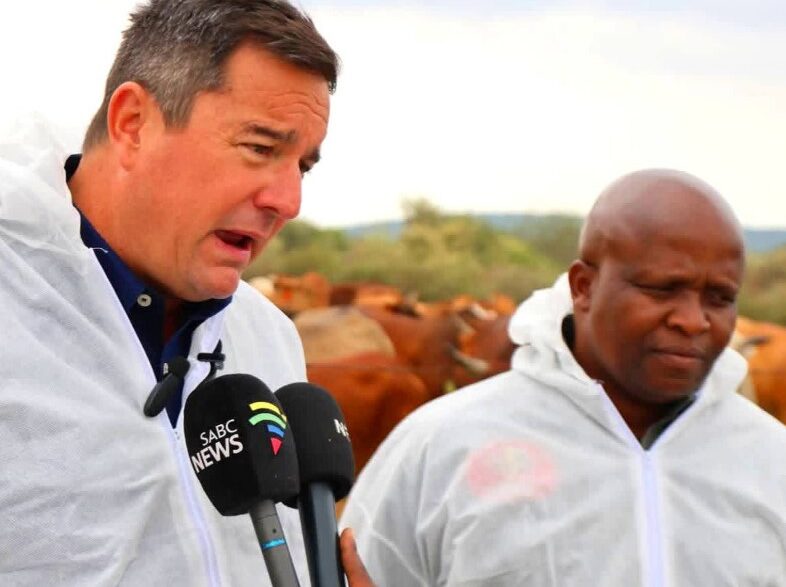
Swartkopfonteinhek, North-West – South African Minister of Agriculture John Steenhuisen this week hosted his Botswana counterpart Onneetse Ramogapi for a joint foot-and-mouth disease vaccination and awareness drive along the Trans Kalahari Corridor at Swartkopfontein.
Ramogapi stood in for the minister ordinarily responsible for the portfolio, Dr Dikoloti.
Swartkopfontein is a critical livestock farming area where cattle frequently move between the two countries, raising the risk of cross-border infection and disease transmission. The joint drive forms part of ongoing efforts to protect Botswana’s beef industry. 
The two ministers engaged directly with farmers, veterinary officials and community leaders on coordinated prevention measures. Discussions centred on limiting uncontrolled cattle movement along the corridor and harmonising surveillance protocols between the two countries.
Ramogapi stressed that Botswana’s beef export sector depends on maintaining its disease-free status in key zones. “Joint corridor management is not optional, it is essential,” he said.
The Trans Kalahari Corridor links Botswana’s cattle-producing regions to South African markets and ports, making biosecurity cooperation a priority for both nations under the Bi-National Commission framework.
The development is also relevant for Eswatini, which shares regional trade routes and livestock movement patterns with both countries. Any outbreak along the corridor could have knock-on effects for the region’s beef industry, including markets that Eswatini relies on for livestock trade.